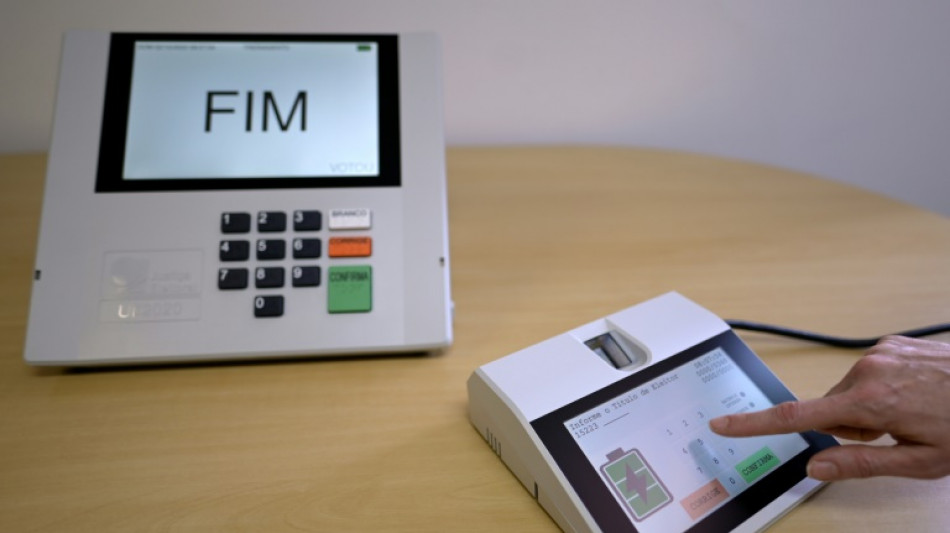
Five things on Brazil's voting machines / Photo: © AFP/File

 Too small for fries: drought shrinks Belgian potatoes

 Drought-hit Danube gives way to fossil hunt in Bulgaria

 Julia Curlee, CIA officer fired by White House for being transgender
 Fave or flop? A guide to gauging video game success
 Williams-Alcaraz fall in US Open mixed quarter-finals

 Mark Carney, the former central banker who said 'no' to Trump
 Segner out of South Africa tour as New Zealand injuries pile up
 Meta knew teen safety tools were ineffective, witnesses testify
 Williams and Alcaraz win opener at US Open mixed doubles
 Man Utd's Fernandes crowned PFA player of the year

 Dolly Parton: quotes on life, love and music

 Brazil fines TikTok $30 mn in 'powerful signal' over child safety

 Cameroon's Baleba joins as Man Utd boost midfield options
 US country music legend Dolly Parton dies at 80

 Kolisi fit to captain South Africa against New Zealand
 Volkswagen workers boo boss during speech on job cuts

 Djokovic, Sabalenka tumble out of US Open mixed doubles

 CIA director Ratcliffe visits Moscow: US media
 Trump threatens to rename Lake Ontario as 'Lake America'
 'Here to win': Xavi vows to restore pride to Dutch football
 Canada unveils counter tariffs of 15% to 50% on US goods

 Spain moves to speed up return of migrants stranded in Ceuta

 At least a quarter of NFL players may get brain disease: study

 Iranians queue for petrol after US announces new sanctions

 Blockchain Infrastructure Firm tZERO Integrates with Sui for Institutional-Grade Digital Asset Securities

Brazil has used electronic voting machines in its elections since 1996. But it is only recently they became controversial, with allegations by far-right President Jair Bolsonaro that they are plagued by fraud.
Here are five things to know about the squat beige computers fueling a raging debate on democracy in Latin America's biggest country.
- How did they start? -
Ironically, given Bolsonaro's bashing, the electronic voting machines were introduced partly to combat fraud.
Brazilians used to vote on paper ballots where they would check a box or write in a name, depending on the type of election.
In a country where 14 percent of the adult population was illiterate, the system was chaotic, slow and fraud-prone.
"There were always problems with the count. Illegible writing, names written in the wrong place, X's outside the box -- all that meant a ballot was declared null," says Henrique Neves da Silva, a former judge on Brazil's Superior Electoral Tribunal.
"There was also a lot of fraud and ballot-box stuffing."
With help from the military, computer experts developed the country's first electronic voting machine, rolled out in 57 cities for the 1996 local elections.
- How widespread are they? -
Celebrated as a success, the voting machines were expanded to 67 percent of the electorate for Brazil's 1998 elections, and 100 percent for the 2000 elections.
Brazil is one of 23 countries using electronic voting for general elections, according to the International Institute for Democracy and Electoral Assistance.
Another 18 use them for regional elections.
- How do they work? -
The machines are equipped with a number pad.
When voters type the two-digit code for their chosen candidate, his or her picture appears.
They then press a green button to confirm.
"It's a very simple machine, with one function: to tally votes," says Da Silva.
A key detail: the machines are not connected to the internet.
When voting closes, poll workers remove the memory card from each machine and send them to the local office of the electoral authority, which in turn sends the information to the central counting system in Brasilia via an independent network.
In remote regions such as the Amazon rainforest, a satellite connection is sometimes used.
Results are usually finalized in around two hours -- not bad for a sprawling country with 156 million voters.
- How secure are they? -
The vote-counting software is updated for every election.
Political parties, the judiciary and the military are allowed to inspect the source code.
Security tests are also held in which IT experts attempt to hack into the system.
"They literally take the machines apart, touch whatever they want. There is way more leeway than what (a theoretical hacker) would actually have on election day," says Da Silva.
No major security flaw has ever been detected.
- What does Bolsonaro say? -
Bolsonaro insists the system is plagued by fraud, but has provided scant evidence.
He claims he should have won the 2018 presidential election in the first round, instead of the runoff, but has offered no proof.
He is pushing for a paper print-out to be made of every vote, so the count can be checked.
But election authorities say that would only introduce an avenue for fraud.
Prosecutors are investigating the president on charges of spreading disinformation about the voting system, including during a meeting with foreign ambassadors in July that was spattered with falsehoods.
The US embassy said after that meeting that Brazil's elections are "a model for the world."
Bolsonaro has repeatedly threatened not to recognize the election result if the system is not changed.
N.Fournier--BTB