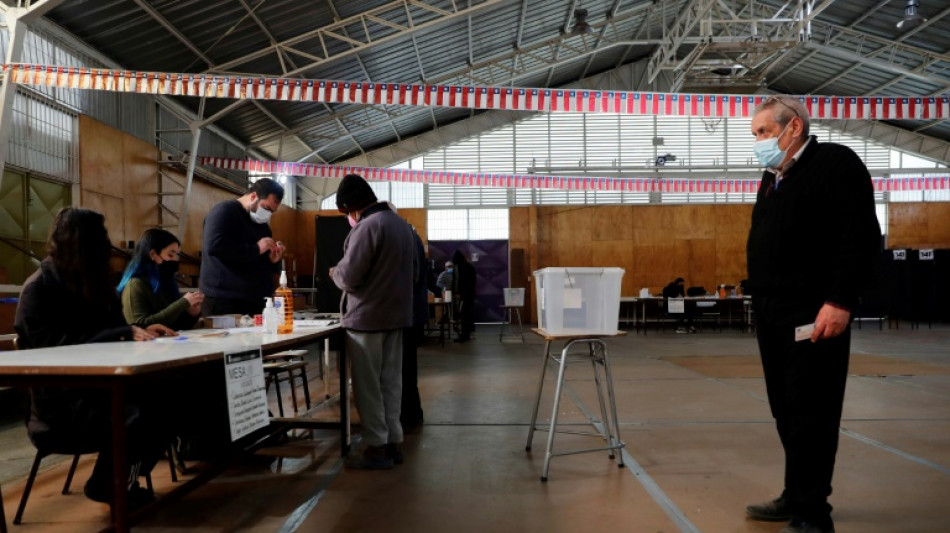
Chile votes on overhaul of dictatorship-era constitution / Photo: © AFP

 Pakistan hospital fire kills 14 infants

 Iceland to vote on resuming EU talks in close referendum
 North Korea to 'bring joy' to Kim with 100 athletes at Asian Games
 US LGBTQ community mourns 'diva' Dolly Parton

 England bid to banish booze woes as Pakistan seek self-respect
 High quality, low risk: record number of Japanese in Premier League

 Stocks edge higher as oil drops on fresh Mideast hopes
 Pakistan's girls fight for their place in the boxing ring
 Five things to know about Anthropic ahead of Wall Street debut

 Social media use on the rise among Australian under-16s after ban: data

 Instagram chief admits touting teen safety tool while omitting it was barely used

 'Final Fantasy', 'The Witcher' in spotlight at Europe gaming bash
 Syrian Kurdish leader dissolves force that spearheaded jihadist fight

 Trump raises prospect of demolishing iconic Kennedy Center

 PGA Tour to end in two-week matchplay showdown from 2028: CEO

 United States of Dolly: how a country queen bridged America's divide

 PGA chief says 'no current plans' for LIV stars to return

 Golf giant Callaway apologizes after ad sparks outcry

 Ioane stars as New Zealand recover to beat Johannesburg Lions

 Ukrainians seeking beauty in a bomb-scarred city

 Dolly Parton: Country music's dolled up but deserving queen

 US robotaxi firm Waymo plans to launch in Germany

 'Here to win': Xavi vows to restore pride in Dutch football

 Cameroon's Baleba joins as Man United boost midfield options
 'Shocking' book about Putin's private life wins French literary prize

Chileans voted Sunday on whether to adopt a new constitution that would break from the era of Augusto Pinochet's dictatorship, foster a more welfare-based society and boost Indigenous rights.
Although Chileans previously voted in droves for a rewrite of the current constitution -- adopted in 1980 during Pinochet's rule -- opinion polls suggest the new text could be rejected.
Polling stations opened at 8:00 am (1200 GMT), with long lines of voters gathered in some parts of the country.
Social upheaval that began in 2019 provided the impulse to overhaul the constitution, but the 388-article draft -- including proposals to legalize abortion -- has proved controversial and often confusing.
"I will reject it because it was a constitution that started badly," Maria Angelica Ebnes, a 66-year-old homemaker, told AFP in Santiago. "It was forced, through violence."
In October 2019, protests sprung up mostly in the capital led by students initially angered by a proposed metro fare hike.
Those demonstrations spiraled into wider discontent with the country's neoliberal economic system as well as growing inequality.
Those in favor of the new text are still holding out hope of victory.
"People will go out to vote en masse and the polls will be wrong once again," said Juan Carlos Latorre, a legislator in the ruling coalition of leftist President Gabriel Boric, who supports the new text.
Boric called for national unity whatever the outcome as he voted in Punta Arenas.
More than 15 million Chileans are eligible to vote in the compulsory referendum.
- Protect natural resources -
Among the chief concerns of opponents is the prominence given to the country's Indigenous peoples, who make up close to 13 percent of the 19 million population.
Proposals to enshrine reproductive rights and protect the environment as well as natural resources such as water, which some say is exploited by private mining companies, have also garnered much attention.
The new constitution would also overhaul Chile's government, replacing the Senate with a less powerful "chamber of regions," and requiring women to hold at least half of positions in public institutions.
While recent polls have had the "reject" vote leading by as much as 10 percentage points, sociologist Marta Lagos said the result was not certain.
In the vast Santiago metropolitan area, the majority of people appear likely to vote in favor of the new constitution, Lagos said.
"There's always the possibility that all the polls are wrong," Lagos told AFP. "(But) I don't think this possibility is more than five percent, and 'reject' is 95 percent likely to win."
Only a simple majority is required for the new constitution to be adopted.
Around 40 world-renowned economists and political scientists have expressed their support for the new constitution.
Yet some fear the new text would generate instability and uncertainty, which could then harm the economy.
"What you can see is a certain conservatism in the Chilean electorate that we haven't seen for years," said Lagos.
It was certainly muted last December when millennial Boric was elected president.
- Social tensions -
Those in favor of the new constitution say it will prompt changes in a conservative country marked by social and ethnic tensions and lay the foundation for a more egalitarian society.
They say the current constitution gave private enterprise free rein over crucial industries and created a fertile breeding ground for the rich to prosper and the poor to struggle.
Although the 1980 constitution has undergone several reforms since it was adopted, it retains the stigma of having been introduced during a dictatorship.
Chileans have already voted once to rewrite the constitution and then again to elect the representatives to do so, making Sunday's vote the third time in just two years that they have gone to the polls over the issue.
The new text was drawn up by a constitutional convention made up of 154 members -- mostly with no political affiliation -- split equally between men and women and with 17 places reserved for Indigenous people.
The resulting proposal recognizes 11 Indigenous peoples and offers them greater autonomy, particularly on judicial issues.
Some critics accuse the authors of trying to turn the traditionally marginalized Indigenous people into a higher class of citizens.
If accepted, Chile's congress will then start deciding how to apply the new laws.
If the new text is rejected, the current constitution will remain in place.
S.Keller--BTB