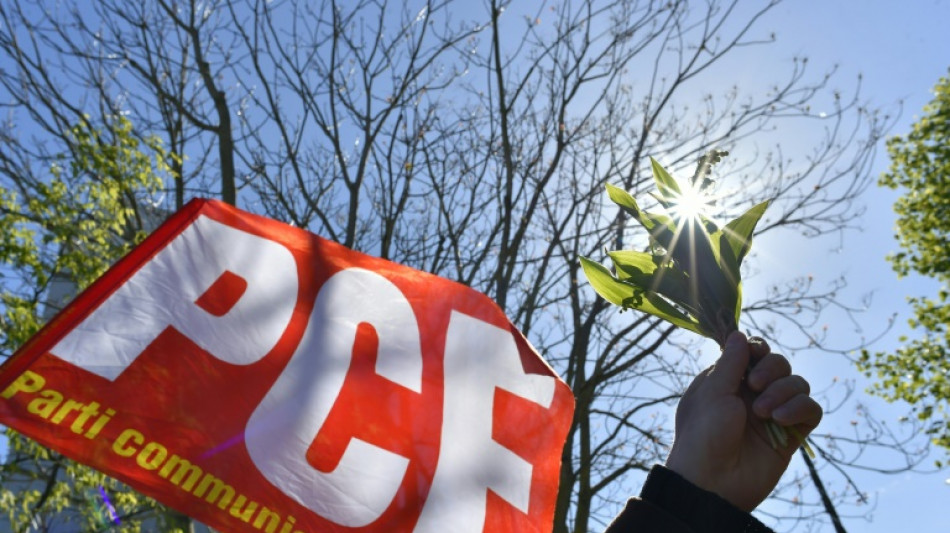
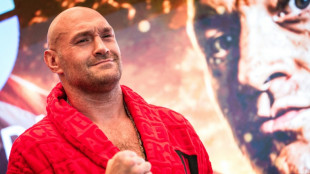
'Happy days'?: French communists hope to come in from cold / Photo: ©

 Italy bans burqas in schools, caps numbers of foreign students per class

 Israel policies threaten 'life and existence' of Palestinians, Abbas says

 Paolini steers Italy past China in BJK
 Zidane admits emotion on eve of first game as France coach
 Breetzke and Maharaj sink Australia in first one-day international
 Zelensky broke confidentiality with North Korea POWs disclosure: South's president
 Former Liverpool star Carroll reveals he was sexually assaulted
 Dominican Republic calls for Haiti force to be strengthened
 Dolly Parton's nephew ordered to stay away from estate staff, properties

 Early exit for Philippine darling Eala at Singapore Open
 Hurricane Polo triggers huge waves in coastal Mexican city
 What happens if the US bans diesel exports
 Macklemore hits back with 'Free Palestine Tour' after Sheeran split
 Met Opera to give New Yorkers free tickets in affordability push
 Top ECB official to resign to take up IMF role

 Xi and Trump call for peace in lavish White House state visit
 Five up-and-coming players looking to make mark in Nations League

 CNN, MS NOW, Politico request court hearing after White House access denied
 Eviction of pensioner puts Spain housing crisis in spotlight
 CNN, MS NOW, Politico say reporters still barred from White House

 Udinese sign ex-Real Madrid defender Alaba on free transfer
 Trump welcomes Xi to Washington with lavish praise
 Kane relishing chance to become England's most-capped player
 Average EU diesel price hits record 2.23 euros a litre: AFP analysis

 Whitetip Investments Marks 10 Years of Regulation, Transparency & Responsible Trading

Armed with its most charismatic leader in decades, France's Communist party aims to return to its glory days in the upcoming presidential election and win back voters who have drifted to the right.
To illustrate its newfound optimism, the Communist Party of France (PCF) has picked the most upbeat slogan in the campaign so far: "Happy Days for France" -- a reference to a French Resistance manifesto during World War II, from which it emerged as France's biggest party.
PCF head Fabien Roussel, 52, is the first Communist candidate in a presidential campaign in 15 years, with the party opting to back hard-left firebrand Jean-Luc Melenchon in the past two elections instead of fielding a candidate of its own.
The Communists' promise of happiness stands in stark contrast to the doom-laden prophecies of anti-immigration populist Eric Zemmour, who has monopolised much of the media attention in the race so far.
Polls show Roussel, an MP, still languishing in the low single digits, a far cry from the Communists' heyday which they polled over 21 percent in the 1969 elections -- but a new tone is clear.
"Our programme deserves a larger audience," Roussel told AFP at the party's headquarters in Paris.
"We need to talk about happiness and how change is possible, after being told for years by various governments that we need to make more efforts, that we need to tighten our belts," he said.
- 'Change is possible' -
During the Covid crisis, the state's willingness to mobilise huge sums to save the economy showed that "there is plenty of money around", Roussel said.
But instead of "that money going to multinationals", he said, "we want it to be used in the service of the people" -- mostly in the shape of pay rises for low-income professions including nurses and teachers.
True to dogma, Roussel's programme calls for the nationalisation of big banks -- including BNP Paribas, the EU's biggest -- and of energy giants TotalEnergies and Engie.
But he is just as relaxed about backing nuclear power, defending the police force or supporting hunting -- all red rags for other parties on the left.
Roussel's team says their man needs to attract apathetic young voters as well as those on the left who have turned to Melenchon's populism or Marine Le Pen's nationalist far-right RN party.
"Our challenge is to win back those hearts and minds," Ian Brossat, Roussel's campaign manager and a deputy mayor for Paris, told AFP.
- 'Good wine, good meat' -
Roussel, who currently polls at three percent, got the country's attention when he said that French gastronomy consisted of "good wine, good meat and good cheese", sparking an outcry across the left which accused him of disrespect towards vegans and of ignoring multiculturalism.
Analysts said the seemingly off-the-cuff remark is part of an effort to appeal both to the patriotic instincts of far-right voters and to traditional communists who feel no kinship to an urban, progressive left they see as elitist.
His greatest asset is an entrenched grassroots base across France, where the party still counts 600 card-carrying mayors and thousands of other local officials.
The Soviet collapse in the 1990s hastened the decline of the PCF in French national politics, but the party proved more resilient locally, a fact many attribute to the movement's key role in the World War II resistance and postwar social reforms.
"People don't say 'communism', they say 'French Communist Party' with its history in France," Roussel said, calling the party's patriotic grounding "unique".
Hence, Paris city hall never renamed its "Stalingrad" metro station, and there are still plenty of streets, stadiums or cultural centres called "Karl Marx", "Lenin" or "Engels" in the so-called "red belt" around the capital.
- 'People suffered less' -
The annual "Fete de l'Huma", named after the communist newspaper "L'Humanite", is France's biggest festival with hundreds of thousands of visitors for days of concerts and other events.
"There is still a cultural link, a kind of nostalgia for the Communist Party", Frederic Dabi, a political analyst who heads up the Ifop research institute, told AFP.
"Many people accept communists as decent, committed people", he said, even though they also mostly reject communist ideology.
This contrast is obvious in Avion, a small former mining town in the northern Pas-de-Calais region, where the PCF regularly captures over 60 percent of the local vote.
But in national contests, the far-right picks up many of the votes in the region, which mostly backed Marine Le Pen in the 2017 presidential run-off against Macron.
"To be a communist is to be at the heart of people's daily lives," said Avion's mayor, Jean-Marc Tellier.
"I'm concerned with the underpaid worker who gets up every morning to work and can't make ends meet," he told AFP, adding that he hoped communists could now also "reclaim our place on the national scene".
For Jaime Prat-Corona, a 77-year-old party member, such a comeback can't come fast enough.
"Whenever the Communist Party is strong, people suffer less," he told AFP at a recent campaign rally.
K.Brown--BTB