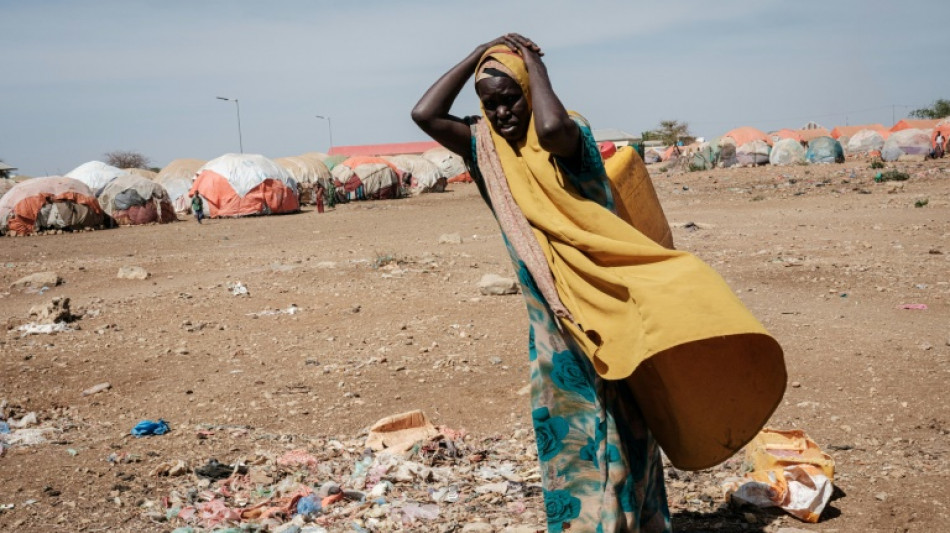
Dying of hunger: What is a famine? / Photo: © AFP/File

 Pakistan hospital fire kills 14 infants

 Iceland to vote on resuming EU talks in close referendum
 North Korea to 'bring joy' to Kim with 100 athletes at Asian Games

 US LGBTQ community mourns 'diva' Dolly Parton

 England bid to banish booze woes as Pakistan seek self-respect
 High quality, low risk: record number of Japanese in Premier League

 Stocks edge higher as oil drops on fresh Mideast hopes
 Pakistan's girls fight for their place in the boxing ring

 Five things to know about Anthropic ahead of Wall Street debut

 Social media use on the rise among Australian under-16s after ban: data

 Instagram chief admits touting teen safety tool while omitting it was barely used

 'Final Fantasy', 'The Witcher' in spotlight at Europe gaming bash
 Syrian Kurdish leader dissolves force that spearheaded jihadist fight

 Trump raises prospect of demolishing iconic Kennedy Center

 PGA Tour to end in two-week matchplay showdown from 2028: CEO

 United States of Dolly: how a country queen bridged America's divide

 PGA chief says 'no current plans' for LIV stars to return

 Golf giant Callaway apologizes after ad sparks outcry

 Ioane stars as New Zealand recover to beat Johannesburg Lions

 Ukrainians seeking beauty in a bomb-scarred city

 Dolly Parton: Country music's dolled up but deserving queen

 US robotaxi firm Waymo plans to launch in Germany

 'Here to win': Xavi vows to restore pride in Dutch football

 Cameroon's Baleba joins as Man United boost midfield options

 'Shocking' book about Putin's private life wins French literary prize

On Monday, the UN's humanitarian chief Martin Griffiths warned that Somalia was on the brink of famine for the second time in just over a decade.
Here is an exploration of a term that evokes the very worst of human suffering.
- What is a famine? -
"Famine" is a word freighted with dread of hunger and privation, dating back to the dawn of humanity.
More recently, though, it has been codified scientifically to help policymakers and focus humanitarian aid.
Since 2004, global agencies are supposed to only use the term according to the Integrated Food Security Phase Classification (IPC) scale.
Famine is the fifth and highest phase of the scale, with the IPC defining it as "an extreme deprivation of food".
"Starvation, death, destitution and extremely critical levels of acute malnutrition are or will likely be evident."
According to the IPC scale, famine exists when at least 20 percent of households in a specific area have extremely limited access to basic food; at least 30 percent of children suffer from acute malnutrition; and two people out of every 10,000 die each day "due to outright starvation or to the interaction of malnutrition and disease".
- Where have famines occurred? -
Over the last century, famines hit China, the Soviet Union, Iran and Cambodia, often the result of human actions.
Europe suffered several famines in the Middle Ages, but its most recent were during World War I and II, where parts of Germany, Poland and the Netherlands were left starving under military blockades.
In Africa there have been several famines in recent decades, from Biafra in Nigeria in the late 1960s to the 1983-1985 Ethiopian famine, which ushered in a new form of celebrity fundraising and unprecedented media attention on the suffering.
The last time famine was declared was in South Sudan in 2017 in Leer and Mayendit counties, areas that have often been a flashpoint for violence.
In Somalia, famine in 2011 in southcentral areas of the country killed an estimated 260,000 people, half of them children under the age of six.
Griffiths, the head of the UN Office for the Coordination of Humanitarian Affairs (OCHA), said Monday that famine was likely in two areas of south-central Somalia, Baidoa and Burhakaba, between October and December.
- What are the causes? -
Throughout history, famines have generally been caused by human action, usually wars which ravage crops and livestock, ruin trade, displace people and complicate the distribution of aid.
Famine "represents a failure on the part of many parties," said Daniel Maxwell, professor of food security at Tufts University in the United States, told AFP.
"Currently in famine-risk areas (Somalia, Ethiopia, South Sudan, Yemen, northeastern Nigeria), violent conflict is the common denominator, but climate factors are playing an increasing role," Maxwell said.
"Even in the context of violent conflict, drought has been a factor in all recent famines in Somalia."
An arid country whose impoverished population depends on livestock and agriculture, Somalia is considered one of the regions most vulnerable to climate change.
In recent years, increasingly extreme droughts and floods have added to devastation caused by a locust invasion and the Covid-19 pandemic, as well as instability fuelled by a jihadist insurgency.
- How does famine kill? -
When lack of food has led to an 18 percent loss of weight, the body starts undergoing physiological disturbances, according to a 1997 study of hunger strikes published in the British Medical Journal (BMJ).
When people have insufficient food over several weeks, it leads to organ failure and eventually death.
"In most contemporary famines, most people don't literally starve to death," said Maxwell.
"In crowded conditions, killer diseases like cholera or measles are more frequently the actual cause of death, especially of young children. Unfortunately, we have already seen outbreaks of both cholera and measles in Somalia this year."
Lack of food weakens the immune system, making the body more vulnerable to disease, while those displaced by drought often live in makeshift camps, with poor hygiene and limited access to drinking water.
"Between starvation and death, there is nearly always disease," the World Health Organization (WHO) has said.
Hunger leads to stunted growth and impacts cognitive development, and can lead to poor health throughout a person's life.
Even without reaching famine, parts of Africa go through regular cycles of hunger that have long-term social consequences.
N.Fournier--BTB