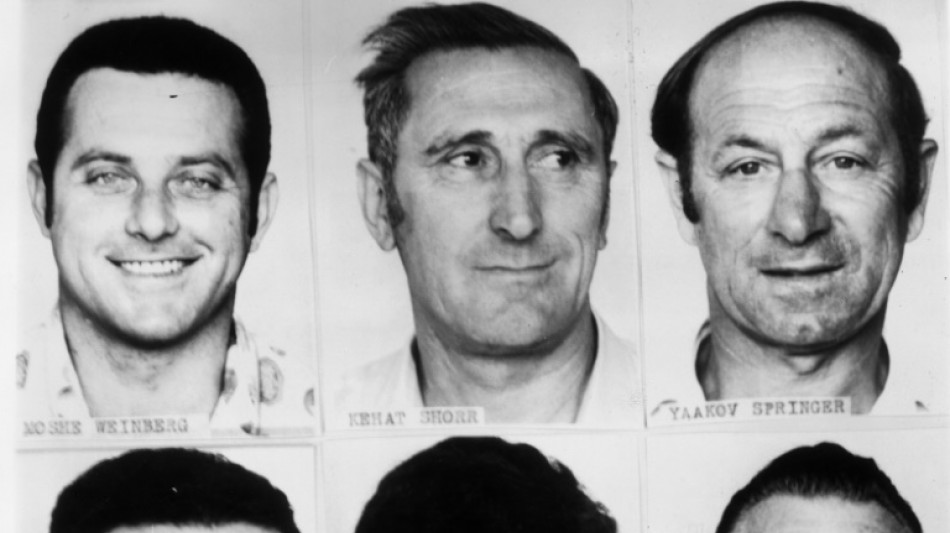
'Wrath of God': Israel's response to 1972 Munich massacre / Photo: © IPPA/AFP/File

 'Black smoke' chokes Pakistan maternity ward as hospital fire kills 14 infants
 French flight attendant wins landmark breast cancer ruling
 Sri Lanka 83-2 after India enforce follow-on in second Test
 Pakistan hospital fire kills 14 infants

 Iceland to vote on resuming EU talks in close referendum
 North Korea to 'bring joy' to Kim with 100 athletes at Asian Games
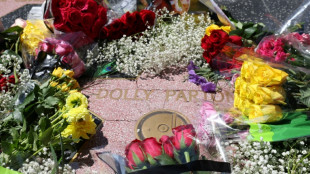
 US LGBTQ community mourns 'diva' Dolly Parton

 England bid to banish booze woes as Pakistan seek self-respect
 High quality, low risk: record number of Japanese in Premier League

 Stocks edge higher as oil drops on fresh Mideast hopes

 Pakistan's girls fight for their place in the boxing ring
 Five things to know about Anthropic ahead of Wall Street debut
 Social media use on the rise among Australian under-16s after ban: data

 BioNxt Advances Cladribine Clinical Program for MS with Completion of the Investigational Medicinal Product Dossier (IMPD) Ahead of Human Clinical Studies
 Williams-Alcaraz fall in US Open mixed quarter-finals

 Mark Carney, the former central banker who said 'no' to Trump
 Segner out of South Africa tour as New Zealand injuries pile up
 Meta knew teen safety tools were ineffective, witnesses testify
 Williams and Alcaraz win opener at US Open mixed doubles
 Man Utd's Fernandes crowned PFA player of the year

 Dolly Parton: quotes on life, love and music

 Brazil fines TikTok $30 mn in 'powerful signal' over child safety

 Cameroon's Baleba joins as Man Utd boost midfield options

 US country music legend Dolly Parton dies at 80

 Kolisi fit to captain South Africa against New Zealand

The killing of 11 Israelis at the 1972 Munich Olympics prompted Israel to turn to a strategy which endures to this day: deploying secret operatives abroad to assassinate its enemies.
Ever since the Mossad intelligence service embarked on its Operation "Wrath of God" to hunt down senior militants it blamed for the Munich bloodbath, it has covertly targeted Israel's enemies overseas.
Half a century ago next week, Palestinian gunmen from the Black September militant group broke into the Olympic village and stormed the quarters of the Israeli athletes and their coaches.
After a violent hostage drama, worsened by the blunders of German security services, all the Israelis were dead -- sparking deep dismay in the Jewish state less than three decades after the Holocaust.
"It was a real shock for the Israeli population," recalls Ehud Barak, a former Israeli prime minister who at the time served as a commando leading an elite military unit.
"The combination of the nature of the assassinations and the helplessness of the athletes who were attacked and the fact that it was on German soil somehow resonates," he told AFP.
The killings sparked "deep sorrow with a lot of outrage" and a concerted drive to "take revenge, to kill (the) people involved" and to prevent similar attacks in the future, he said.
The clandestine programme was spearheaded by then Mossad chief Zvi Zamir, prime minister Golda Meir and her counterterrorism adviser Aharon Yariv, said historian Michael Bar-Zohar.
Initially, "after Munich, Golda Meir didn't know what to do", Bar-Zohar said.
The two security chiefs, both with "the air of university professors", met Meir, the Israeli historian said.
"They were timid, well-dressed, and said one thing: 'Now we must destroy Black September'."
The trio, aware it would be nigh impossible to hunt down all members of Black September, instead devised a strategy of "smashing the head of the serpent" by killing the group's leadership, said Bar-Zohar.
"Golda really hesitated," he said. "Should she authorise assassinations throughout Europe and the Middle East?
"She said 'yes'."
Over the next few months, the heads of Black September and their allies from the Palestine Liberation Organization began to die in mysterious circumstances in Rome, Paris and Cyprus.
- Lipstick and bombs -
Among those targeted were three Palestinians, who were killed in Beirut in April 1973 by a hit squad dressed in women's clothing.
One of the operatives disguised with make-up and fake breasts was Barak, then a commander of the Sayeret Matkal unit deployed to kill Mohammed Youssef al-Najjar, Kamal Adwan and Kamal Nasser.
The hit squad travelled by naval vessel, then smaller speedboats to reach Beirut, where they were met by Mossad agents with rental cars posing as tourists.
The team anticipated that more than a dozen young men walking through an upmarket area of Beirut could arouse suspicion.
"So we decided to 'make some of us girls'," said Barak, now 80. "I was the commander of the unit, but I had a baby face at the time, so I was one of the girls.
"I was a brunette, not a blonde, with lipstick and blue on the eye, and we took some military socks to fill our breasts," he recalled.
The four agents disguised as women wore wide trousers, hiding weapons in jackets and bags, and were armed with hand grenades and explosives.
Splitting up into small groups, they headed toward the homes of their targets but came under heavy fire. Two Israelis were killed, along with several Lebanese civilians and the three Palestinians.
Within hours, Barak was back home in Israel, where his wife quizzed him on the eyeshadow and lipstick smeared across his face.
"I couldn't tell her," the ex-premier recalled, adding that happily "she turned on the radio and there were discussions about what had happened".
- Hunting the 'Red Prince' -
Such early successes may have made Israel overconfident, however, contributing to subsequent failures.
Three months after the Beirut operation, Mossad believed they had located Ali Hassan Salameh, Black September's head of operations, known as the "Red Prince".
Israel dispatched assassins to the Norwegian town of Lillehammer where, in a case of mistaken identity, they killed the Moroccan waiter Ahmed Bouchikhi.
The hit squad was "too sure of themselves", said Bar-Zohar, who has authored a series of books about Israeli intelligence including the Norway operation.
"They arrived in Lillehammer with false information... They were already fairly certain that it was a routine operation and they ignored all the evidence that proved it wasn't him," he said.
"For example, they saw that the man they were following lived in a run-down neighbourhood, that he rode a bicycle, that he went alone to the swimming pool. A terrorist chief doesn't do that."
After killing the wrong man, three Israeli agents were arrested by Norwegian police and spent 22 months in prison.
Undeterred, Mossad pushed on with a years-long operation to ensnare Salameh.
Israel deployed an operative code-named "D" to Beirut, who befriended the Palestinian and his beauty queen wife Georgina Rizk.
D, in a 2019 documentary aired by Israel's Channel 13, described his time undercover as "my real life" in Beirut, where he frequented a sports club with Salameh and studied his habits and movements.
"I considered him at the same time a friend and a mortal enemy," D said. "It's not easy. You know, deep down inside, that he must die."
In January 1979, nearly five years after the start of the operation, Salameh was killed by a car bomb in Beirut.
- Targeting Iran -
The assassination of a top Black September member did not end the killing spree.
Israel instead turned its sights on other targets, such as those it blamed for attacks on Israelis during the first Palestinian Intifada, or uprising, as well targets from its arch-enemy Iran.
Ronen Bergman, author of the book "Rise and Kill First" about Israel's targeted killings, said the Munich attacks made Israel realise "there would be no-one else" to protect its own interests and citizens.
"There is a direct link between what happened then and what we see now," he said.
Today "Israel is using targeted killings as one of its main weapons in its policy of defending national security interests," he said.
Bergman pointed to the death of top Iranian nuclear scientist Mohsen Fakhrizadeh, whose assassination outside Tehran nearly two years ago was blamed on Israel.
The author said that, while targeted killings were "really effective" against the organisers of attacks against Israelis, "there is still a debate about how effective are the assassination of nuclear scientists that started back in 2007".
"Those are very hard to measure, but it is clear that Israel is continuing with the same kind of policy."
Israel accuses Iran of seeking to develop a nuclear weapon, a goal which Tehran denies, and vehemently opposes negotiations between the Islamic republic and world powers reviving the frayed 2015 nuclear deal.
Few expect Israel's "shadow war" with Iran, and Mossad's clandestine operations, to end anytime soon.
Earlier this year, Israeli Prime Minister Yair Lapid said his country will do "whatever we must to prevent Iran from acquiring a nuclear capability".
J.Fankhauser--BTB