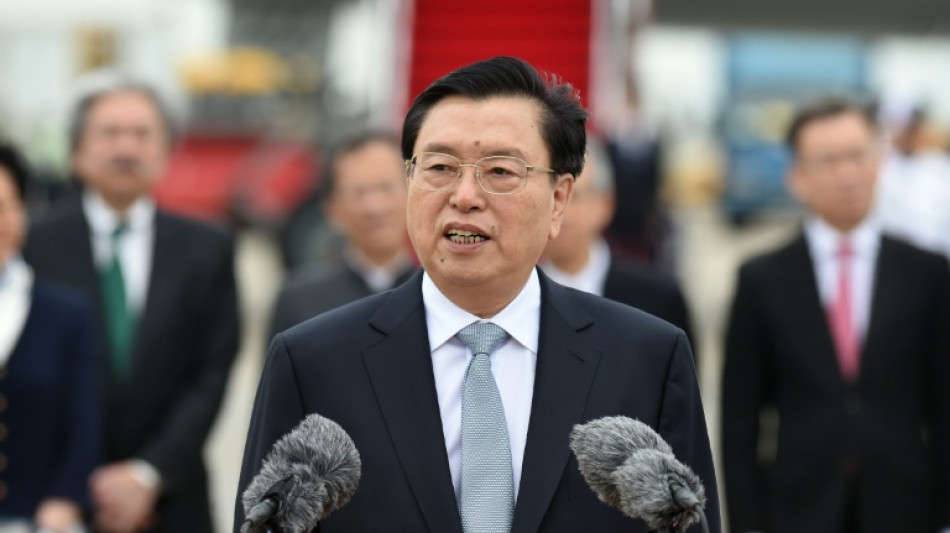
Zhang Dejiang: economics student to Chinese potentate / Photo: ©

 Prague’s Concert for the Future Kicks Off on Wenceslas Square

 Prince William and Princess of Wales to Announce Earthshot Prize Winners in Mumbai

 Indonesia Forest Fires: Health Crisis, Diplomatic Strains and the Search for Solutions

 BYD Dolphin G Leasing Deal: Plug-in Hybrid Supermini Available from £174 a Month

 JUEL Group Expands from Real Estate to Hospitality with Hyatt Centric Malta Opening

 French Economy Shrinks 0.1% as Consumer Confidence Slumps

 Wall Street Ends Turbulent Week Higher Despite Inflation and AI Jitters
Top Chinese Communist Zhang Dejiang, currently visiting Hong Kong, studied economics in North Korea and went on to run China's richest and most populous province before ascending to the highest levels of the ruling party.
Now 69, he was born in Liaoning in the northeast and was "sent down" to the countryside during the Cultural Revolution -- which was declared 50 years ago on Monday.
After his studies at Kim Il-Sung University in Pyongyang he became an administrator at Yanbian University in Jilin province, and started to rise up the Communist ranks.
He now chairs the National People's Congress, China's Communist-controlled legislature, and is consistently named third in official media reports of party activity, putting him in that position in the hierarchy, although actual power can vary.
He is reportedly head of the party's organ overseeing Hong Kong affairs.
Zhang was the top official in Guangdong province, which borders Hong Kong, from 2002 to 2007.
Critics blame him for the cover-up of the outbreak of Severe Acute Respiratory Syndrome (SARS), which emerged in Guangdong in late 2002 before spreading to Hong Kong and around the world the following year, killing more than 800 people.
He has also been accused of strangling liberal local media outlets, including the high-profile Southern Weekly newspaper.
Zhang's term saw clashes between Guangdong villagers and police over compensation for land requisitioned by the government.
In 2005, paramilitary forces opened fire on residents protesting against the construction of a large coal-fired power plant in Dongzhou, killing as many as 30 according to locals.
State media reported at the time that protesters attacked police with knives, batons and homemade weapons including explosives.
Guangdong governor Huang Huahua -- Zhang's number two in the provincial Communist party -- later told reporters that disputes were a result of rapid economic development.
"We can say Guangdong's economy is at a golden development period, a peak period for cases to develop, a period for readjustments of interests and a period where a lot of contradictions happen," Huang said.
Nonetheless Zhang was promoted to the seven-member Politburo Standing Committee, the party's top body, at its five-yearly congress in 2012, appearing third in the line-up behind President Xi Jinping and Premier Li Keqiang.
C.Kovalenko--BTB