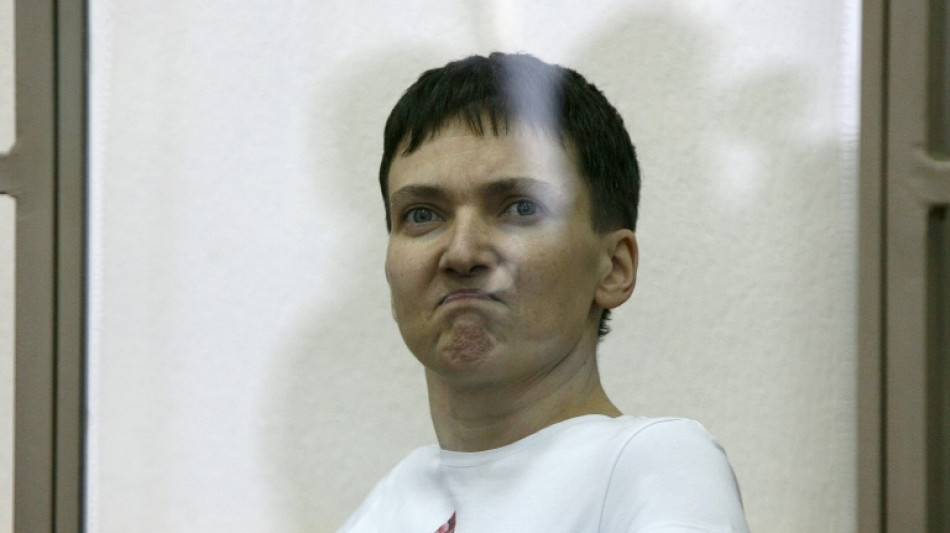
Savchenko: Ukraine's 'symbol of defiance' to Russia / Photo: ©

 All Blacks knew Nonu would perform solo Haka - coach Rennie
 Britain's Glave upstages Jacobs to win European 100m gold
 Greece's Tentoglou wins fourth European long jump title
 Doctors ignored 'warning signs' before Maradona's death, court hears
 Pereira, the 'zombie city' devastated by Colombia's earthquake
 UN says 2 staff arrested by Afghan intelligence agency
 Colombia scrambles to find survivors as quake kills 240

 Ramsay-Peaty out of medals as Italy's Martinenghi wins European gold
 AI firm Manus to resume 'independent' operations after China blocks Meta deal
 Caught between great powers: the cautionary tale of Manus
 Heatwave hits evicted families sleeping rough in Rome

 US company stokes Greenland tensions by unloading drilling gear

 Cambridge academic in plagiarism row publishes memoir
 LeBron's Sixers hope to spoil Knicks party on NBA opening night
 UK 'on course' to record warmest summer for second year in a row
 Spotify to launch badge identifying AI music

 New plastic treaty document criticised for weaker ambition
 Hungary parliament approves Orban-critic judge as president
 Ebola outbreak in DR Congo kills more than 2,000
 ChargeAfter Powers BYLD Finance Expansion into Consumer Financing for Equipment Retailers

 MEXC Upgrades RealStocks With Three New Features to Enhance U.S. Stock Trading Experience

 Israel demolishes home of slain Palestinian involved in deadly West Bank clash
 Liverpool fans seek clarity on Bezos bid to buy stake
 Solar eclipse sparks scramble for protective glasses across Europe
 Oil prices jump as US-Iran deal hopes falter

Ukrainian pilot Nadiya Savchenko, freed by Russia in a prisoner exchange on Wednesday, has been condemned by Moscow as a murderer but was rapturously received as a national hero back home.
The 35-year-old army helicopter navigator was sentenced to 22 years in March over the killing of two Russian journalists in the separatist conflict in east Ukraine.
After President Vladimir Putin pardoned her, citing the wishes of the journalists' relatives, she was secretly flown in to Kiev on a government plane.
The move came as part of a swap with two alleged Russian soldiers convicted of fighting alongside separatists in the east.
Barefoot and wearing a white T-shirt with the Ukrainian trident symbol, she declared to crowds welcoming her: "I'm ready once again to lay down my life for Ukraine on the battlefield."
Ukrainian President Petro Poroshenko hailed her as a "symbol of pride and defiance, just like Ukraine itself" and decorated her with the Hero of Ukraine medal.
The cropped-haired Iraq War veteran has always insisted on her innocence, calling her trial a mockery of justice.
She defiantly gave her judge a one-finger salute and refused to appeal, saying she has no faith in Russian courts.
In April she staged a hunger strike in protest against her sentence, refusing all food and liquids until persuaded to stop by Poroshenko.
Kiev and its Western allies expressed outrage, calling Savchenko a victim of a Kremlin power game and urging her release.
Both the European Union and the United States back Savchenko's account that she was abducted by pro-Moscow eastern Ukrainian separatists, smuggled to Russia and then slapped with false charges.
The Belarussian Nobel Prize winning writer Svetlana Alexievich described her as the "Ukrainian Joan of Arc," while The Economist magazine called Savchenko "a modern martyr".
But Moscow argues she was the "spotter" who helped Ukrainian forces target a deadly mortar strike at the Russian journalists.
"When they accuse me of killing the Russian journalists -- I would not do it out of principle," she told a Moscow television reporter in 2014.
"I would never open fire on an unarmed person."
- 'The smell of gunpowder' -
Savchenko was born in Kiev when Ukraine was still part of the Soviet Union and went to a Ukrainian-speaking school.
She joined the Ukrainian army and soon became the only female combat soldier among the 1,690 people Kiev sent to support the US-led military campaign in Iraq.
Savchenko described it as her first step to becoming a fighter pilot.
"I believe you can only become an officer after enlisting and taking part in live combat, getting the smell of gunpowder," she told Ukrainian television in Iraq in 2005.
Savchenko then mounted a successful campaign to become one of the few women accepted to Ukraine's highly-selective Air Force University.
She graduated in 2009 and was soon posted to an aviation regiment. But her primary duty involved navigating military helicopters -- not piloting the fighter jets she had wished to fly.
The separatist revolt that broke out in the east two months after the February 2014 ouster of Kiev's Moscow-backed leaders prompted Savchenko to take what she describes as a "vacation" and join the Aidar volunteer battalion.
Aidar's fighters have been branded as "fascists" by Russia and condemned for resorting to the torture of captives and other abuses by the UN High Commissioner for Human Rights.
- 'This was a kidnapping' -
What happened next is a matter of dispute.
The June 17 deaths of two Russian journalists in shelling came after Savchenko had been in the immediate vicinity.
Savchenko says she had rushed to the scene because the insurgents had just hit "two armoured personnel carriers and a tank, and I went to see if anyone was wounded."
She told Russian television in July 2014 that she was then immediately "ambushed" by the insurgents.
"This really was a kidnapping," she said.
Her lawyers pointed to Savchenko's mobile phone billing records that support her account that she was taken to the region's central city of Lugansk at least an hour before the Russians were killed.
But prosecutors insisted that Savchenko was detained later after she had voluntarily crossed into Russia.
Savchenko is viewed by her supporters as a symbol of resistance against Moscow's bid to destabilise its pro-Western leadership by unleashing the eastern conflict -- a charge Russia denies.
She was elected to parliament in absentia on the nationalist ticket of former prime minister Yulia Tymoshenko in October 2014 and given her country's highest honour by Poroshenko in March 2015.
J.Bergmann--BTB