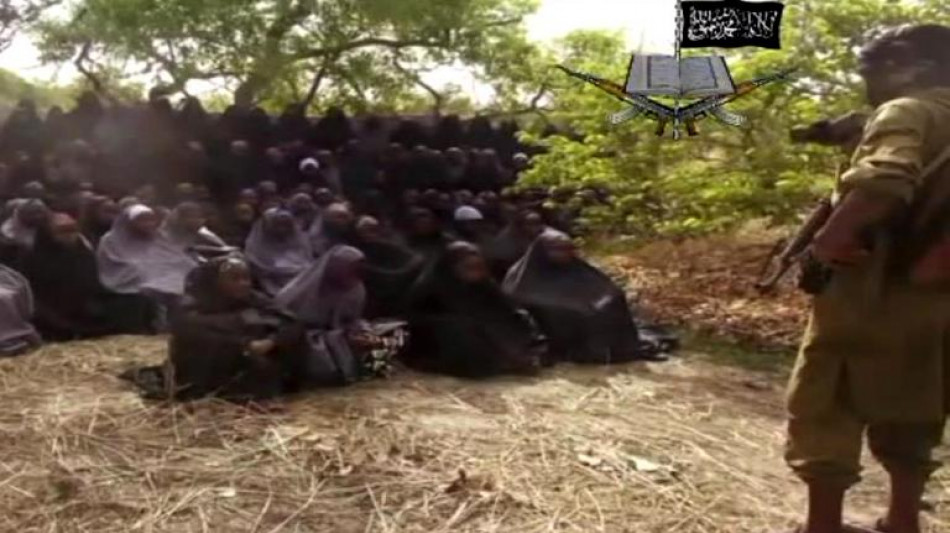
Nigeria's kidnapped schoolgirls: two years gone / Photo: ©

 All Blacks knew Nonu would perform solo Haka - coach Rennie

 Britain's Glave upstages Jacobs to win European 100m gold

 Greece's Tentoglou wins fourth European long jump title

 Doctors ignored 'warning signs' before Maradona's death, court hears

 Pereira, the 'zombie city' devastated by Colombia's earthquake

 UN says 2 staff arrested by Afghan intelligence agency
 Colombia scrambles to find survivors as quake kills 240

 Ramsay-Peaty out of medals as Italy's Martinenghi wins European gold

 AI firm Manus to resume 'independent' operations after China blocks Meta deal

 Caught between great powers: the cautionary tale of Manus

 Heatwave hits evicted families sleeping rough in Rome

 US company stokes Greenland tensions by unloading drilling gear

 Cambridge academic in plagiarism row publishes memoir

 LeBron's Sixers hope to spoil Knicks party on NBA opening night

 UK 'on course' to record warmest summer for second year in a row

 Spotify to launch badge identifying AI music

 New plastic treaty document criticised for weaker ambition

 Hungary parliament approves Orban-critic judge as president
 Ebola outbreak in DR Congo kills more than 2,000
 ChargeAfter Powers BYLD Finance Expansion into Consumer Financing for Equipment Retailers

 MEXC Upgrades RealStocks With Three New Features to Enhance U.S. Stock Trading Experience

 Israel demolishes home of slain Palestinian involved in deadly West Bank clash

 Liverpool fans seek clarity on Bezos bid to buy stake

 Solar eclipse sparks scramble for protective glasses across Europe
 Oil prices jump as US-Iran deal hopes falter

Here is a snapshot of key events since the abduction of more than 200 schoolgirls from the remote town of Chibok in northeastern Nigeria two years ago.
Nigeria's army confirmed on Wednesday that one of the girls has been found.
- Snatched from school -
On April 14, 2014, gunmen from the Islamist group Boko Haram seize 276 girls from the Government Girls Secondary School in Chibok, Borno state.
The girls are forced from their dormitories onto trucks and driven into the bush. Fifty-seven girls manage to flee.
An international media campaign is launched, backed by personalities including US First Lady Michelle Obama and Nobel Peace Prize laureate Malala Yousafzai.
The hashtag #BringBackOurGirls underpins a social media storm that ultimately achieves little.
Boko Haram leader Abubakar Shekau claims responsibility for the mass abduction in a video released on May 5, and vows to sell the girls as slave brides.
- Global response -
One week later, a second video shows about 100 of the missing girls. Boko Haram says they have converted to Islam and will not be released unless militant fighters held in custody are freed.
On May 17, Benin, Cameroon, Chad, Niger and Nigeria vow to fight Boko Haram together, in what Cameroon President Paul Biya terms a "declaration of war".
The UN Security Council says the kidnappings "may amount to crimes against humanity," after Britain, China, France, Israel and the US offer help.
US military specialists deploy to neighbouring Chad but later move elsewhere after Nigeria stops requesting their services.
On May 26, Nigeria's Chief of Defence Staff Alex Badeh says the girls have been located but warns a rescue operation would put their lives at risk.
- 'Married off' -
On October 31, Shekau quashes rumours of a deal with Nigerian authorities and says the girls have converted to Islam and been "married off".
- One year on -
On April 14, 2015, Nigeria's president-elect Muhammadu Buhari warns he "cannot promise that we can find" the girls, as vigils are held in many countries to mark their first year as hostages.
Amnesty International believes the girls have been separated into three or four groups and are being held in camps, some of which might be in Cameroon or Chad.
- Others freed -
Buhari says in late December he is willing to negotiate with any "credible" Boko Haram leadership, a week after claiming the country has "technically" won the war against Boko Haram.
Throughout 2015, the Nigerian military announces the rescue of hundreds of people, most of them women and children, who have been kidnapped by Boko Haram.
But the missing schoolgirls are not among them, despite several unconfirmed sightings.
Suicide attacks using women and young girls increase against "soft" civilian targets such as mosques, markets and bus stations, fuelling fears about Boko Haram's use of its captives.
In March 2016, it emerges that Boko Haram also seized 500 women and children from the Borno town of Damasak just months after the Chibok abduction. The kidnapping had been denied at the time.
- 'Proof of life' -
On April 13, 2016, US television station CNN reports that Boko Haram has sent a "proof of life" video which shows 15 of the girls, the first concrete indication that at least some are still alive.
On May 18, 2016 the Nigerian army confirms the first of the schoolgirls has been found.
M.Ouellet--BTB