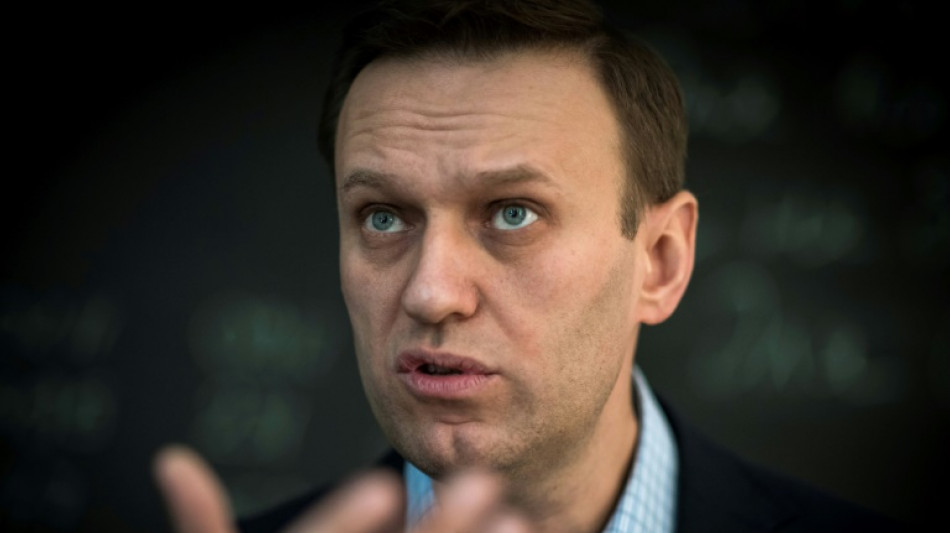
Suspected poison attacks on Kremlin critics / Photo: ©

 All Blacks knew Nonu would perform solo Haka - coach Rennie

 Britain's Glave upstages Jacobs to win European 100m gold

 Greece's Tentoglou wins fourth European long jump title

 Doctors ignored 'warning signs' before Maradona's death, court hears

 Pereira, the 'zombie city' devastated by Colombia's earthquake

 UN says 2 staff arrested by Afghan intelligence agency
 Colombia scrambles to find survivors as quake kills 240

 Ramsay-Peaty out of medals as Italy's Martinenghi wins European gold

 AI firm Manus to resume 'independent' operations after China blocks Meta deal
 Caught between great powers: the cautionary tale of Manus
 Heatwave hits evicted families sleeping rough in Rome

 US company stokes Greenland tensions by unloading drilling gear

 Cambridge academic in plagiarism row publishes memoir

 LeBron's Sixers hope to spoil Knicks party on NBA opening night
 UK 'on course' to record warmest summer for second year in a row
 Spotify to launch badge identifying AI music

 New plastic treaty document criticised for weaker ambition

 Hungary parliament approves Orban-critic judge as president
 Ebola outbreak in DR Congo kills more than 2,000
 ChargeAfter Powers BYLD Finance Expansion into Consumer Financing for Equipment Retailers

 MEXC Upgrades RealStocks With Three New Features to Enhance U.S. Stock Trading Experience

 Israel demolishes home of slain Palestinian involved in deadly West Bank clash
 Liverpool fans seek clarity on Bezos bid to buy stake

 Solar eclipse sparks scramble for protective glasses across Europe

 Oil prices jump as US-Iran deal hopes falter

Ailing Russian opposition leader Alexei Navalny, whom Germany says was poisoned with nerve agent Novichok, is not the first Kremlin critic suspected or proven to have been poisoned.
Nor is it the first time Navalny has been physically hurt. Following is a list of cases involving Navalny and four other critics in the last 15 years.
- Cases involving Navalny -
Navalny, 44, falls ill after boarding a plane in Siberia in July. Initially treated in a local hospital he is then flown to Berlin for treatment. On Wednesday the German government says tests provide clear proof that he was poisoned by a chemical nerve agent Novichok, demanding explanations from Moscow. Russian prosecutors have said they have "no evidence" of a deliberate crime.
In July 2019 Navalny suffers body rashes and his face becomes swollen while he is in prison during a crackdown on anti-Kremlin protesters and after he had called for an unauthorised rally.
In 2017 he endures chemical burns to an eye when attackers throw green dye used as a disinfectant at his face outside his office.
- Former double agent Sergei Skripal -
In March 2018 former Russian double agent Sergei Skripal and his adult daughter are found unconscious on a bench in the southern English city of Salisbury and hospitalised in critical condition.
Police say they have been poisoned with the highly toxic nerve agent Novichok. London accuses Moscow of wanting to kill the ex-agent for his work with European intelligence agencies. The Kremlin denies the charges.
The Skripals survive but the case becomes one of the biggest irritants in Britain's relations with Russia.
In June, British counterterrorism police appeal for more information about the attack, which it blames on two Russian security service officers who allegedly entered Britain using false passports. Russia continues to deny the claims.
- Ex-Russian spy Alexander Litvinenko -
Former Russian spy Alexander Litvinenko dies in agony in November 2006, three weeks after drinking tea laced with highly radioactive polonium-210 at a London hotel.
A British inquiry in January 2016 accuses Moscow of the poisoning, which it denies.
- Pussy Riot activist Pyotr Verzilov -
Pyotr Verzilov, an anti-Kremlin activist and associate of the punk group Pussy Riot, is admitted to hospital in Moscow on September 14, 2018, suffering from apparent poisoning from medical drugs.
He is quickly flown to Germany where doctors say poisoning was "highly plausible".
Verzilov's estranged wife, Pussy Riot's Nadezhda Tolokonnikova, says the suspected poisoning was "probably an assassination attempt, if not it was an intimidation."
After he is discharged from hospital on September 26, Verzilov says he is "convinced" he was poisoned by Russia's secret service.
- Ukraine politician Viktor Yushchenko -
In September 2004 Ukrainian politician Viktor Yushchenko, campaigning against a Russian-backed candidate for the presidency, falls seriously ill.
Tests in an Austrian clinic determine that he had ingested a massive amount of dioxin. He survives and goes on to win the election, but his face is left bloated and pockmarked.
His supporters accuse the Russian secret service of involvement.
S.Keller--BTB