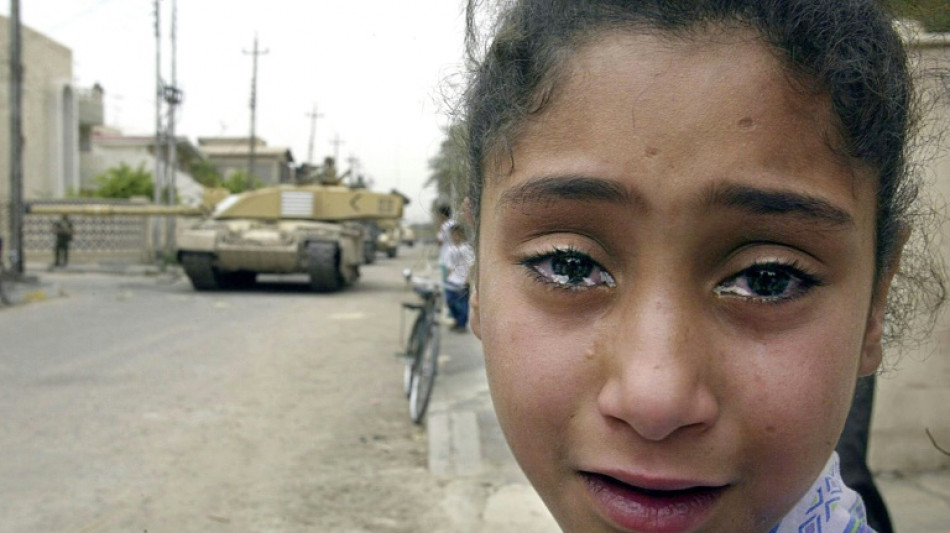
What's at stake in Britain's Iraq war inquiry / Photo: ©

 All Blacks knew Nonu would perform solo Haka - coach Rennie
 Britain's Glave upstages Jacobs to win European 100m gold

 Greece's Tentoglou wins fourth European long jump title
 Doctors ignored 'warning signs' before Maradona's death, court hears
 Pereira, the 'zombie city' devastated by Colombia's earthquake
 UN says 2 staff arrested by Afghan intelligence agency
 Colombia scrambles to find survivors as quake kills 240
 Ramsay-Peaty out of medals as Italy's Martinenghi wins European gold
 AI firm Manus to resume 'independent' operations after China blocks Meta deal
 Caught between great powers: the cautionary tale of Manus
 Heatwave hits evicted families sleeping rough in Rome

 US company stokes Greenland tensions by unloading drilling gear

 Cambridge academic in plagiarism row publishes memoir
 LeBron's Sixers hope to spoil Knicks party on NBA opening night
 UK 'on course' to record warmest summer for second year in a row
 Spotify to launch badge identifying AI music

 New plastic treaty document criticised for weaker ambition
 Hungary parliament approves Orban-critic judge as president
 Ebola outbreak in DR Congo kills more than 2,000
 ChargeAfter Powers BYLD Finance Expansion into Consumer Financing for Equipment Retailers

 MEXC Upgrades RealStocks With Three New Features to Enhance U.S. Stock Trading Experience

 Israel demolishes home of slain Palestinian involved in deadly West Bank clash
 Liverpool fans seek clarity on Bezos bid to buy stake

 Solar eclipse sparks scramble for protective glasses across Europe
 Oil prices jump as US-Iran deal hopes falter

The Chilcot inquiry report on Britain's role in the Iraq war could still have significant fallout when it is published Wednesday -- even though it is seven years after the probe was launched.
Here are some of the likely ramifications:
- Tony Blair -
The former Labour prime minister took Britain into the US-led invasion, making the case to the public and parliamentarians, many of whom were strongly opposed.
The justification was that Iraqi leader Saddam Hussein had weapons of mass destruction (WMD), but these were never found and the intelligence was later severely criticised.
Blair's close relationship with US president George W. Bush led to accusations that he privately pledged British support for the war well before parliament agreed to it.
During the war, the International Criminal Court was petitioned to investigate alleged war crimes by Blair and his ministers relating to Iraqi civilian casualties.
The court has said it would look at the Chilcot report but noted it cannot rule on the legality of the war and could only act if British courts first refused to take up the case.
A group of MPs led by former Scottish first minister Alex Salmond is also investigating possible legal action and whether Blair could be retrospectively impeached.
In a CNN interview last year, Blair said: "I apologise for the fact that the intelligence we received was wrong."
He added: "I also apologise for some of the mistakes in planning and, certainly, our mistake in our understanding of what would happen once you removed the regime.
"But I find it hard to apologise for removing Saddam."
- Relatives of soldiers killed -
Relatives of the 179 British soldiers killed in Iraq had pressed for the inquiry, amid criticism of the motivation, planning and management of the conflict, and accusations that the troops were not properly equipped.
Lawyers will be scouring the report for any potential basis for legal action against Blair, other officials or the Ministry of Defence, likely based on misconduct in office or neglect of duty.
However, some relatives are reportedly boycotting the launch, already convinced it will be a whitewash.
- Military and intelligence chiefs -
The inquiry is expected to deal extensively with the failures in the military operation, from the planning of the war to the occupation, during which Iraq descended into sectarian violence from which it has yet to emerge.
"There is already general recognition that there were systemic failures in the operation after we entered Basra and the south," said Malcolm Chalmers, deputy director general of the Royal United Services Institute think tank.
He said British forces underestimated the strength of the local opposition and the determination of regional powers -- notably Iran -- to undermine the US and Britain.
Previous reports have criticised the failures in intelligence that led to the conclusion that Iraq had WMD, and how that was used by politicians -- but Chilcot could add to this.
Britain's Chief of Defence Staff Nick Houghton, who was a senior British military commander in the Iraq war, could be singled out for criticism, the Guardian newspaper reported earlier this year.
- Labour party, and parliament -
Opposition Labour leader Jeremy Corbyn, who is facing a rebellion by more than 80 percent of his MPs, is expected to use the Chilcot report to bolster his position.
The veteran socialist was strongly opposed to the war in Iraq and maintains it was illegal, while many of those trying to unseat him had supported it.
But one of his supporters, Paul Flynn, said that "parliament is on trial" over the war.
"It was not just one man; it was hundreds of MPs, three select committees of this House, the military and the press who were in favour of joining a war in pursuit of non-existent weapons of mass destruction," he said.
- US-British relations -
The report will reportedly include 29 letters sent by Blair to Bush in the run-up to the invasion, which will only be lightly redacted.
There will also be some form of record of conversations between them, as well as between their successors Gordon Brown and Barack Obama.
Diplomatic wrangling over what could be published was one of the reasons why the Chilcot report took so long.
J.Bergmann--BTB