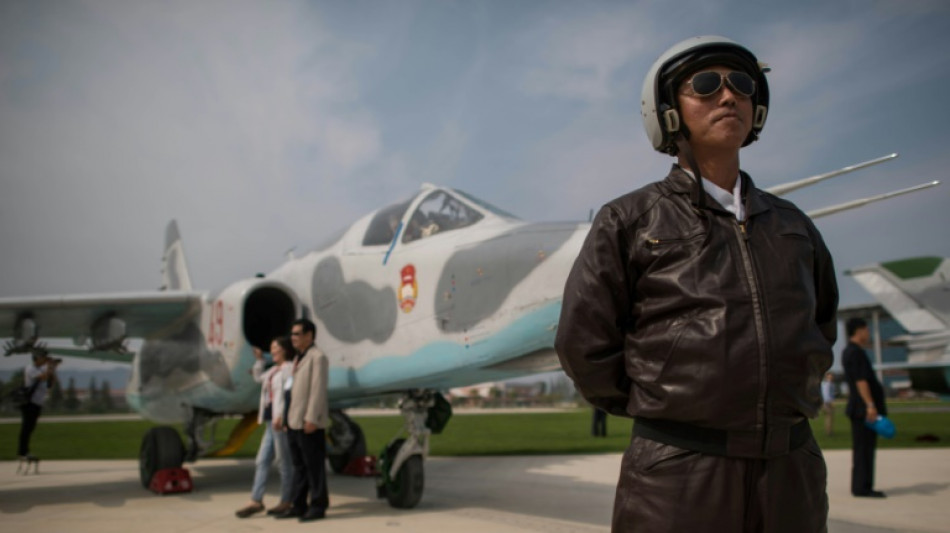
The weakest link? North Korea's crumbling air force / Photo: © AFP/File

 Spurs boss De Zerbi targets one more big signing before window shuts

 Fed chair Warsh flags high US inflation as 'concerning'

 Same Election Question, Two Different Odds: Predictions.io Launches Free Cross-Venue Comparison Tools
 Man Utd new signing Baleba sidelined for three weeks
 Juve's Yildiz to miss 'several months' with foot injury
 Celine Dion arrives in France ahead of sold-out comeback dates

 All-round Tongue stars for England in second Test against Pakistan
 UEFA's legal move 'massive escalation' in bitter Infantino feud

 MEXC Launches Earn Plus With Limited-Time Event Offering Up to 800% APR Booster
 Norway's new King Haakon VIII, popular face of shaken monarchy
 Stocks rise ahead of Fed chair's policy speech

 Norway's new King Haakon VII, popular face of shaken monarchy

 Last-wicket duo take England to 290 all out in 2nd Test against Pakistan
 MPSC Drug Inspector Exam Leak: Rutuja Patil Allegedly Paid Rs 50 Lakh for Leaked Paper

 Japan spent record $96 bn in yen interventions: ministry
 Nepal-China floods disaster: Latest developments
 Duplantis needs A-game to fend off Karalis pressure
 Architect Minenhle Makhanya Ordered to Repay R147 Million for Nkandla Upgrades

 Iran says still open to diplomacy as war with US hits six months

 20,000 Salmon Return to Klamath River Following Dam Removal, Yet Recovery Faces Ongoing Challenges

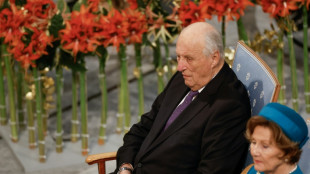 King Harald, 'symbol' of Norway, dead at 89

 Norway's new King Haakon, popular face of shaken monarchy

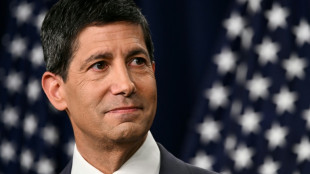 Most stocks rise as attention turns to Warsh speech
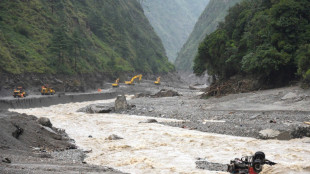
 Japanese rugby U-turns on limits on naturalised players

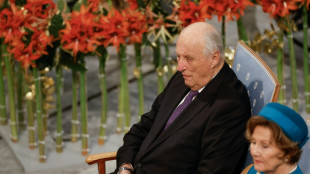 Norway's King Harald dead at 89

North Korea on Tuesday described its record-breaking blitz of missile launches last week as a "just counteraction" to the biggest-ever US-South Korea air exercises.
Pyongyang has long condemned joint military exercises by Seoul and Washington, calling them rehearsals for an invasion -- but it has appeared especially sensitive to air force drills.
That is because North Korea's air force is the weakest link in its military, experts say.
Here is a look at the service, officially known as the Korean People's Army (KPA) Air and Anti-Air Force:
-How many planes does it have?-
The KPA air force has more than 900 combat aircraft, 300 transport planes and 300 helicopters, according to an assessment published last year by the Pentagon's Defense Intelligence Agency.
But most of its fighters and bombers are either obsolete or near-obsolete, acquired decades ago mainly from the Soviet Union and China.
Even the most potent jets in its fleet, the Soviet-designed MiG-29s, were procured in the late 1980s.
The "on paper" estimates do not "represent the smaller 'active' fleet, with an unknown proportion in long-term storage or withdrawn, unlikely to ever fly again", Joseph Dempsey, a researcher at the International Institute for Strategic Studies (IISS), told AFP.
North Korea is believed to be rotating its "ageing to obsolete" fleet in and out of storage "to keep them serviceable but also manage lifespan", he added.
-What about its pilots?-
North Korea "does not have the capacity to pay for enough fuel, cover maintenance costs or adequately train its pilots," according to a 2020 IISS report.
Without enough fuel and therefore enough flight time, its pilots cannot learn or even maintain combat readiness, analysts say.
North Korean combat pilots get as little as 15-25 hours in the air every year, the DIA estimated.
That is far lower than the reported average in the US and South Korean air forces.
The North Korean air force is so far behind that it is "simply incomparable" to other countries, North Korean studies scholar Ahn Chan-il told AFP.
"It is no exaggeration to say that the North's air force is an 'air force on the ground' that almost never gets any proper training."
-How did it become so weak?-
North Korea boasted about "twice the air power" of the South in the 1970s, according to a 2013 report by Seoul's Institute for Military History.
The then-strong North Korean air force sent help to Hanoi in the Vietnam War and to Syria and Egypt during the 1973 Yom Kippur War, it said.
But the demise of the Soviet Union -- a critical source of financial and military support -- along with the deterioration of its own economy left North Korea deeply impoverished by the 1990s.
"Russia eventually established diplomatic ties with Seoul (in 1991) and partly because of it, Moscow decided not to provide the North the kind of military support the Soviets used to offer," Chun In-bum, a retired South Korean army general, told AFP.
Pyongyang was also hit with crippling sanctions over its nuclear weapons and missile programmes, making it even more difficult to find the resources to build up and maintain modern conventional forces.
"North Korea eventually decided to fully focus on developing its nuclear programme instead," Chun told AFP.
This was a "strategic" decision on Pyongyang's part, added Yang Moo-jin, a professor at the University of North Korean Studies.
"The best card for North Korea to negotiate with the world is nuclear weapons."
-How does it compare with US, S. Korean air forces?-
In the unlikely event of air combat with South Korea or the United States, the North Korean air force would be "severely overmatched", said Daniel Pinkston, a senior lecturer at Troy University in Seoul.
"In an intense conflict with combined and joint South Korean and US forces... North Korea's air power and air defences would be degraded very quickly."
The difference in resources and technology was in sharp focus last week during the joint US-South Korean air drills, dubbed Vigilant Storm, which involved some of the most advanced aircraft in the world.
Unlike North Korea's Soviet-era jets, US and South Korean pilots flew high-tech F-35 stealth fighters, B-1B long-range heavy bombers, electronic warfare jets and in-flight refuelling tankers.
Last week, many of North Korea's missile launches were drills simulating the destruction of enemy air force bases.
"North Korea considers it important to strike and neutralise air bases first because their air power is weak," said Cheong Seong-chang, a researcher at the Sejong Institute.
O.Lorenz--BTB