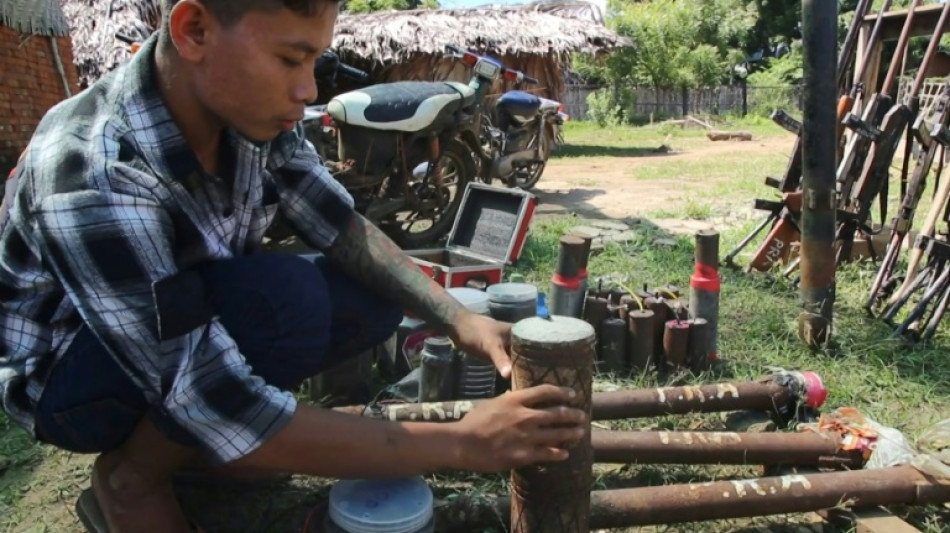
Myanmar rebels risk life and limb in DIY weapons factories / Photo: © AFP

 Spurs boss De Zerbi targets one more big signing before window shuts

 Fed chair Warsh flags high US inflation as 'concerning'
 Same Election Question, Two Different Odds: Predictions.io Launches Free Cross-Venue Comparison Tools

 Man Utd new signing Baleba sidelined for three weeks

 Juve's Yildiz to miss 'several months' with foot injury

 Celine Dion arrives in France ahead of sold-out comeback dates
 All-round Tongue stars for England in second Test against Pakistan

 UEFA's legal move 'massive escalation' in bitter Infantino feud

 MEXC Launches Earn Plus With Limited-Time Event Offering Up to 800% APR Booster

 Norway's new King Haakon VIII, popular face of shaken monarchy
 Stocks rise ahead of Fed chair's policy speech

 Norway's new King Haakon VII, popular face of shaken monarchy

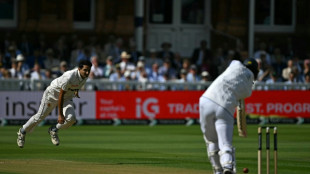 Last-wicket duo take England to 290 all out in 2nd Test against Pakistan

 MPSC Drug Inspector Exam Leak: Rutuja Patil Allegedly Paid Rs 50 Lakh for Leaked Paper

 Japan spent record $96 bn in yen interventions: ministry

 Nepal-China floods disaster: Latest developments

 Duplantis needs A-game to fend off Karalis pressure
 Architect Minenhle Makhanya Ordered to Repay R147 Million for Nkandla Upgrades

 Iran says still open to diplomacy as war with US hits six months

 20,000 Salmon Return to Klamath River Following Dam Removal, Yet Recovery Faces Ongoing Challenges

 King Harald, 'symbol' of Norway, dead at 89

 Norway's new King Haakon, popular face of shaken monarchy

 Most stocks rise as attention turns to Warsh speech
 Japanese rugby U-turns on limits on naturalised players

 Norway's King Harald dead at 89

Under an awning in a bamboo thicket in northern Myanmar, an anti-coup fighter following instructions from YouTube welds scavenged steel into crude mortar rounds and shells to be fired at junta troops.
Almost two years after seizing power, the military has been unable to crush local militias that have sprung up to fight the putsch with hit-and-run tactics.
In turn, these People's Defence Forces (PDF) remain massively outgunned by the military's artillery strikes, Chinese and Russian-made jets and Israeli-patterned rifles.
Captured weapons and expensive purchases on the black market have provided patchy boosts to PDF firepower, analysts say, but many militias have turned to risky trial-and-error operations to churn out their own rockets, mines and mortars.
"We just learn how to build weapons from the internet or YouTube," said Nay Min, an anti-coup fighter from the northern Sagaing region.
"We search how to cook saltpetre (potassium nitrate), how to combine it to get gunpowder, how to build rifles. We haven't received any training," he told AFP.
Those with engineering or mechanical backgrounds, like his comrade Nay Myo Win, experiment and come up with prototypes or copies of captured weapons, he said.
Blowtorches in hand, they sweat for hours in makeshift workshops powered by generators that are frequent targets of junta raids.
Nay Myo Win mixes saltpetre to make the gunpowder needed to fire mortar shells filled with lead and scrap metal that he claims have a range of just over two kilometres (1.2 miles).
- Crude armaments -
Laid out on a tarpaulin ahead of a mission in October, the mortars are unimpressive -- little more than construction pipes welded to bipods.
The shells require two charges to detonate -- one to fire the shell and the other to explode on impact -- a method first used at the beginning of the 20th century.
But the damage is substantial, Nay Min said -- "around 15 feet from the target it will hit people and they will die or be wounded".
One batch of shells was made from a telecoms tower owned by a firm close to the military, which was sabotaged by PDF fighters some months ago.
"We just wanted to destroy their business," Nay Min added.
"But, after we had started making homemade weapons ... we needed more stainless steel and we thought of the tower."
Nay Min's group is one of dozens of PDF militias in Sagaing making their own weapons in a bid to turn the tide in the fighting.
Many upload footage of successful tests of mortars, rockets or mines to social media, with joyous shouts accompanying each loud bang.
But the work can be deadly.
"It's more than dangerous," said Bo Shaung, an anti-coup fighter and rocket maker from another group operating in Sagaing.
"When we cook gunpowder, if we add too much saltpetre, it's dangerous. If we add too little, it's also dangerous."
One video obtained by AFP shows a new mortar being tested. The shell explodes in the barrel, killing the fighter who had just loaded it.
Thu Ya, another anti-coup fighter, said he lost his sight six months ago when the explosive he was handling went off too soon.
"I got injuries on my hands and feet which have recovered now but I... still have blurry vision," he said.
In the absence of machines like lathes and voltage regulators, each shell is made by hand.
And for all the risk that comes with producing them, the homemade munitions are often more bark than bite.
- 'Drain on morale' -
Once a target has been selected, preparing ammunition for an attack can take up to 10 days, Nay Min said.
His group relies on information from locals to gauge troop positions.
To guide their fire they have little more than Google Maps to measure the distance from the target.
"We normally attack them in our own areas and we all know the locations and distance," he said, insisting that most attacks were accurate.
Assessing the effectiveness of these weapons is "extremely difficult" in the absence of impartial reporting from the field, said Bangkok-based security analyst Anthony Davis.
Both sides regularly inflate or play down their casualty figures, analysts say.
But Davis said the spread of locally made mortars and rockets "indicates that these systems are far from simply window-dressing".
"They inflict real casualties but perhaps as importantly are a constant drain on the morale of often isolated army units on the receiving end."
The junta has labelled all PDF groups as "terrorists". It blames anti-coup fighters for the deaths of more than 4,000 civilians.
Nay Min sees his group's fight as justified.
"We are satisfied with what we have done," he said.
But "we need everything. Especially we need weapons."
M.Odermatt--BTB