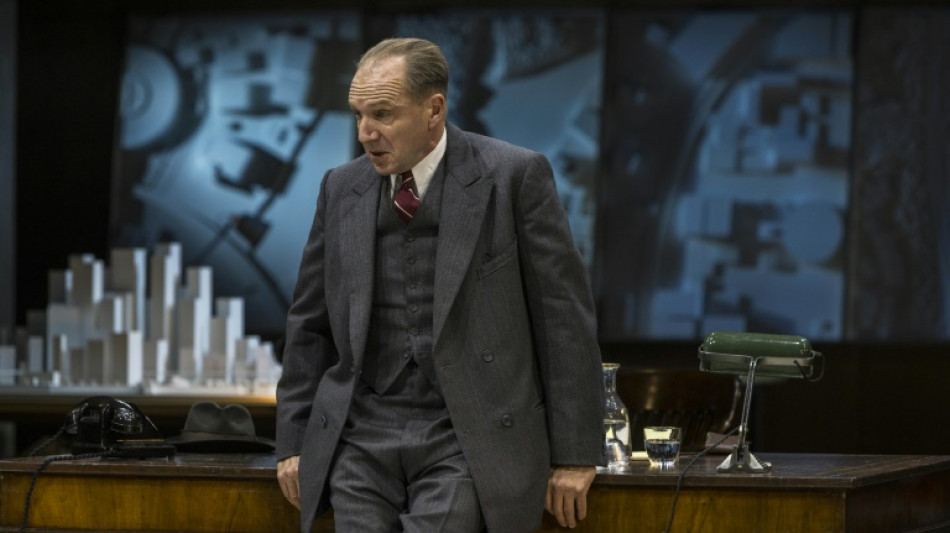
Making New York - new play tells tale of ruthless powerbroker / Photo: © THE SHED/AFP

 Birmingham City Seek First Championship Win Against Wrexham

 Four-wicket Robinson stars as Pakistan collapse in second Test

 Alcaraz anxious after layoff but feels 'great' about wrist

 Bezzecchi edges Marquez brothers in blazing Spanish MotoGP practice

 Ukraine opposes reintegration of Russia to motorsport
 The chaotic saga of Kanye West's planned Russian concerts

 Missing soar over 2,400 after deadly Nepal, China floods

 India Orders Wind Turbine Makers to Report on Data Localization for Cybersecurity

 Leknessund breaks away to win emotional Vuelta stage seven
 Four-wicket Robinson stars as Pakistan all out for 110 in second Test

 Fed chair Warsh signals 'work to do' on high US inflation

 Watkins's legacy at Villa untarnished, says Emery as Jackson arrives
 Spurs boss De Zerbi targets one more big signing before window shuts

 Fed chair Warsh flags high US inflation as 'concerning'
 Same Election Question, Two Different Odds: Predictions.io Launches Free Cross-Venue Comparison Tools

 Man Utd new signing Baleba sidelined for three weeks
 Juve's Yildiz to miss 'several months' with foot injury

 Celine Dion arrives in France ahead of sold-out comeback dates
 All-round Tongue stars for England in second Test against Pakistan

 UEFA's legal move 'massive escalation' in bitter Infantino feud

 MEXC Launches Earn Plus With Limited-Time Event Offering Up to 800% APR Booster

 Norway's new King Haakon VIII, popular face of shaken monarchy

 Stocks rise ahead of Fed chair's policy speech

 Norway's new King Haakon VII, popular face of shaken monarchy

 Last-wicket duo take England to 290 all out in 2nd Test against Pakistan

Was he a visionary or a corrupt racist with a god complex? The troubled legacy of Robert Moses, the master builder who shaped New York, comes under scrutiny this fall in a new play starring Ralph Fiennes.
Robert Moses was an urban planner who, despite never holding elected office, launched building projects in the early 20th century which transformed New York and inspired cities across the United States.
While his vision lives on in New York's vast network of parks, roads and bridges, Moses' name became synonymous with the racist undertones of "urban renewal."
The city's ambivalence about Moses gets a fresh airing in "Straight Line Crazy," a two-act dramatization of Moses' decades-long tenure atop the New York power jungle.
Fiennes depicts a Moses who cajoles politicians, outmaneuvers opponents, and shrugs off doubters in his insatiable quest to fulfill his ambitious vision for the city.
"Our job is to lead, not to follow," Moses tells an underling who worries about pleasing the public. "People don't know what they want until they have it."
- Corruption of power? -
Written by the British playwright David Hare, "Straight Line Crazy" was originally presented in London.
It marks the latest effort to reckon with Moses, who amassed unparalleled authority from holding posts on as many as a dozen municipal bodies simultaneously in a career that spanned four decades.
Moses was celebrated for much of his professional life for his building projects and the leading role he played in bringing the United Nations to New York and in developing the Lincoln Center.
But in 1974, the journalist Robert Caro lifted the veil on the underside of Moses' imperial-like reign in a book that won the Pulitzer Prize.
He depicted him as a ruthless and corrupt dictator who held grudges, smeared opponents and hoodwinked allies while running a municipal machine of monumental proportions.
Caro exposed how Moses marshaled massive public funds to favor suburban elites.
Poorer, non-white communities were displaced from condemned neighborhoods and suffered from Moses' lack of support for public transit as he promoted mammoth highway projects that championed the car.
Hare has called Caro the authoritative expert on Moses, but views his subject differently.
"Caro believes that... what corrupted Moses was power and that he became sort of crazed with power," Hare said at a panel discussion at The Shed theater, where the show runs through December 18.
However, Hare believes his life "was about pursuit of an idea that was too rigid."
Compared with Caro's monster-like figure, the play humanizes Moses, while still zeroing in on significant character flaws.
Dan Doctoroff, a former deputy mayor for economic development and rebuilding and a board member of the Shed, said Moses' story offers some clues for policy makers on how to tackle ambitious projects, such as the need to back up a vision with detailed plans.
"He did magnificent things. He did terrible things, and the reality is you're never going to get everything right," Doctoroff said during the panel conversation. "But at the end of the day, his disdain for the common person tarnishes the legacy forever."
- What 'democracy couldn't deliver' -
The play, based on real events but with invented dialogue and some fictionalized characters, spotlights two moments in Moses' career, riffing on a rise-and-fall narrative arc.
In the first act, he casually flouts governance norms as he outwits Long Island gentry to push through the construction of the Jones Beach State Park in 1926.
However, Moses meets his match in the second act, when grassroots opponents mobilize in 1955 to ultimately derail his plan for an expressway in lower Manhattan.
A longtime aide warns of waning patience with Moses' autocratic style and calls out his favoritism of "clean people... well-off people... white people."
But Moses says he knows that "people may not like me, but they need me."
"Now, of course, it's suddenly fashionable to dislike me, because I'm the dirty bastard who pushed through the things democracy needed but which democracy couldn't deliver."
W.Lapointe--BTB