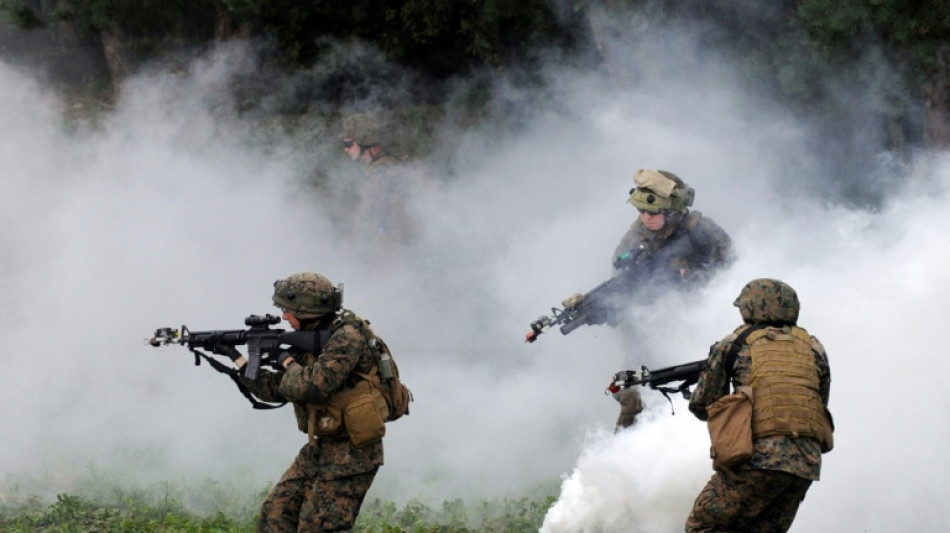
Russians pose threat to US training mission in Ukraine / Photo: ©

 Prague’s Concert for the Future Kicks Off on Wenceslas Square

 Prince William and Princess of Wales to Announce Earthshot Prize Winners in Mumbai

 Indonesia Forest Fires: Health Crisis, Diplomatic Strains and the Search for Solutions

 BYD Dolphin G Leasing Deal: Plug-in Hybrid Supermini Available from £174 a Month

 JUEL Group Expands from Real Estate to Hospitality with Hyatt Centric Malta Opening

 French Economy Shrinks 0.1% as Consumer Confidence Slumps

 Wall Street Ends Turbulent Week Higher Despite Inflation and AI Jitters

 Kansas City Fed Chief Says Inflation Is Still Running Too Hot

The US military could be forced to withdraw American soldiers currently based in Ukraine if Russia invades the country.
Close to 200 National Guard troops are in Ukraine, part of a regular rotation dating back to 2015, training with the Ukrainian army alongside troops from NATO countries like Canada and Germany.
In addition there is an unknown number of US special operations forces in the country, working with their Ukrainian counterparts.
US President Joe Biden has ruled out the possibility of US soldiers fighting against the Russians if they do attack Ukraine. This is seen as a distinct possibility as Moscow has deployed more than 100,000 of its troops and heavy fighting equipment along the country's borders, according to Western estimates.
That could mean those Americans now inside the country being forced to beat a hasty retreat if fighting erupts.
"The Florida National Guard has members currently deployed to Ukraine in this rotating advise-and-assist capacity," said Pentagon Press Secretary John Kirby.
"Obviously . . . we are going to continue to watch the situation on the ground, and if we need to make decisions for force protection purposes, we'll do that," Kirby said.
There are no changes planned to their operations in Ukraine "at this time," he said.
Since 2015 American reservists have been participating in disaster relief operations and joint military training in Ukraine on regular nine-month rotations.
They are based in Yavoriv in the country's far west, near Poland and well away from the fighting between government troops and pro-Moscow secessionists in the east.
The current contingent arrived in November and is scheduled to leave at the end of June.
- Special forces -
Less is known about the small number of US special operations troops inside Ukraine.
"Special Operations Command Europe plays a large role in the development of Ukrainian Special Operations Forces through regular validation training exercises," said Lieutenant Colonel Anton Semelroth, a Pentagon spokesman.
However, he said their number is kept secret "due to operational security."
"Training with our Ukrainian partners cultivates trust, fortifies readiness, and develops relationships, which in turn promotes peace and stability throughout Europe," he said in a statement.
One part of training involves teaching Ukrainian soldiers how to operate arms that Washington provides them, which include coastal patrol vessels and Javelin anti-tank missiles.
On Wednesday the United States released $200 million in new defense aid for Kyiv, adding to $450 million allocated last year before Russia began moving tens of thousands of troops to the Ukraine border.
Nevertheless, the presence of some 10,000 to 15,000 US citizens in Ukraine who might need evacuation in a war could change the mission of the US troops there.
In December US Defense Secretary Lloyd Austin dodged the question of whether US soldiers could take part alongside Ukrainians in a possible war with Russians.
"In situations like this, I think conveying red lines only exacerbates the problem. I think we need to focus on finding ways to de-escalate and reduce tensions,” he said.
M.Furrer--BTB