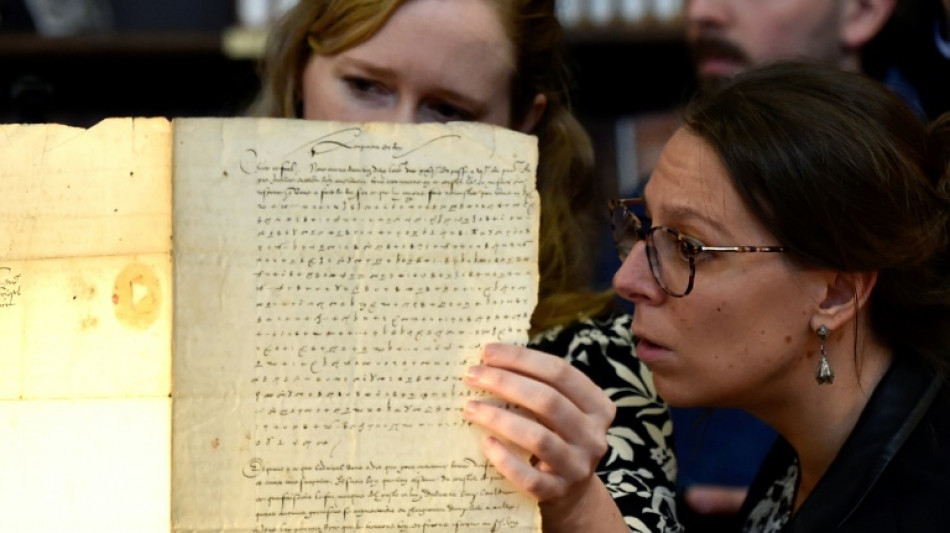
Emperor Charles V's secret code cracked after five centuries / Photo: © AFP

 In war-split Myanmar 'spirit consorts' commune across divide

 Leaders of Russia, China, Iran to attend summit in Kyrgyzstan

 Hovland and Gerard share lead at Tour Championship

 Maresca salutes 'unbelievable' Cherki after Man City star sinks Palace

 Marquinhos rescues last-gasp draw for PSG at Lille in Ligue 1

 ICE detains British far-right activist Milo Yiannopoulos in Louisiana

 Milo Yiannopoulos held by ICE after missing immigration hearing

 Six Flags closes X2 rollercoaster after reports of severe brain injuries

 Jury ends second day without verdict in Lindsay Clancy murder trial

 Artist says criticised Ronnie O'Sullivan mural is unfinished

 UAE grants Starlink 10-year satellite broadband licence

 US says Hormuz mines cleared as diplomacy and military deployments continue

 Nepal-Tibet flood toll reaches 584 as more than 2,400 remain missing

 Cherki makes his point to Maresca as Man City sparkle in Palace rout

 COP17 soil assessment links worsening land degradation to food and nutrition risks

 Medical AI paper predicts autonomous systems could outperform doctors in core clinical tasks by 2030

 REI Labor Day sale runs through September 7 with outdoor gear discounts

 Meta tests robots for cabling, server resets and maintenance inside data centers

 Nepal-Tibet flood rescue resumes after overflowing debris lake forces temporary withdrawal

 Extreme heat exposes vulnerabilities across Britain's rail network

 Dollar rallies after Fed chief lifts rate expectations

 Slumping Sabalenka 'confident' ahead of US Open three-peat bid

 Aston Villa seal swoop for Chelsea striker Jackson

 Number of missing in deadly Nepal, China floods jumps past 2,400

 Birmingham City Seek First Championship Win Against Wrexham

A team of researchers has cracked a five century-old code which reveals a rumoured French plot to kill the Holy Roman Emperor and King of Spain Charles V.
Charles was one of the most powerful men of the 16th century, presiding over a vast empire that took in much of western Europe and the Americas during a reign of more than 40 years.
It took the team from the Loria research lab in eastern France six months to decipher the letter written in 1547 by the emperor to his ambassador in France.
The tumultuous period saw a succession of wars and tensions between Spain and France, ruled at that time by Francis I, the Renaissance ruler who brought Leonardo da Vinci from Italy.
The letter from Charles V to Jean de Saint-Mauris had languished forgotten for centuries in the collections of the Stanislas library in Nancy.
Cecile Pierrot, a cryptographer from Loria, first heard of its existence at a dinner in 2019, and after much searching was able to set eyes on it in 2021.
Bearing the signature of Charles V, it was at once mysterious and utterly incomprehensible, she told reporters on Wednesday.
- 'Snapshot of strategy' -
In painstaking work backed by computers, Pierrot found "distinct families" of some 120 symbols used by Charles V.
"Whole words are encrypted with a single symbol" and the emperor replaced vowels coming after consonants with marks, she said, an inspiration probably coming from Arabic.
In another obstacle, he also used symbols that mean nothing to mislead any adversary trying to decipher the message.
The breakthrough came in June, when Pierrot managed to make out a phrase in the letter, and the team then cracked the code with the help of historian Camille Desenclos.
"It was painstaking and long work but there was really a breakthrough that happened in one day, where all of a sudden we had the right hypothesis," she said.
Another letter from Jean de Saint-Mauris, where the receiver had doodled a form of transcription code in the margin, also helped.
- More discoveries to come -
Desenclos said it was "rare as a historian to manage to read a letter that no one had managed to read for five centuries."
It "confirms the somewhat degraded state" in 1547 of relations between Francis I and Charles V, who had signed a peace treaty three years earlier, she said.
But relations were still tense between the two, with various attempts to weaken each other, she said.
So much so that one nugget of information revealed was the rumour of an assassination plot against Charles V that was said to have been brewing in France, Desenclos said.
She said "not much had been known" about the plot but it underlined the monarch's "fear".
The researchers now hope to identify other letters between the emperor and his ambassador "to have a snapshot of Charles V's strategy in Europe", she said.
"It is likely that we will make many more discoveries in the coming years," the historian said.
O.Bulka--BTB