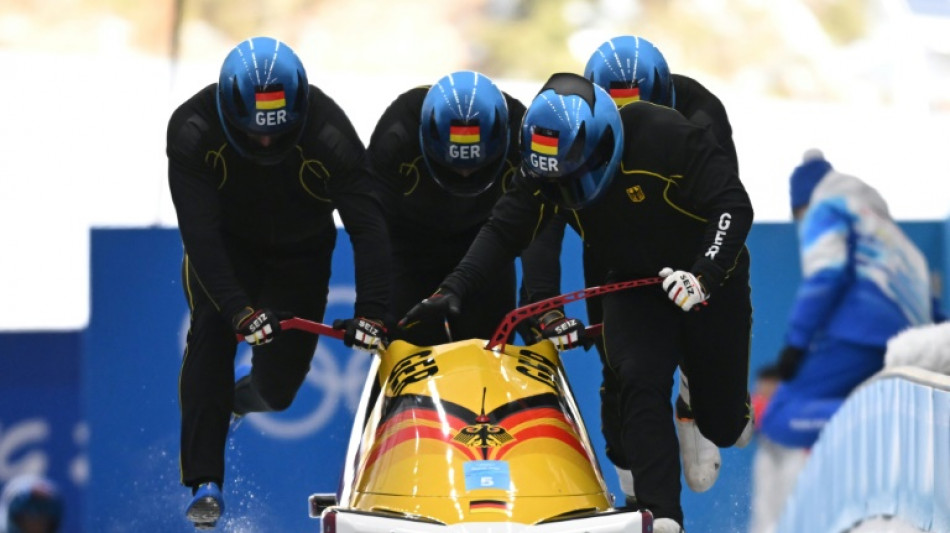
'F1 materials' rev high-speed Germany to Beijing Olympic gold / Photo: ©

 Spotting AI writing: how reliable are the detectors?
 French youth await pope after AI 'paradise of machines' warning
 Man City found guilty of Premier League charges, set to appeal: reports

 Embolo follows Xhaka out of Swiss squad over fake Covid documents

 Trump, Xi inspect founding documents of US democracy to close summit
 'Bottle Claus': Kipchoge's 'hero' helping runners chase Berlin marathon glory
 Olympic medallist Samba-Mayela handed provisional doping ban
 First US trial against TikTok to open Monday
 Palmer misses 'too many' England games, says Tuchel
 UN refugees chief warns conditions in W.Sahara 'deteriorating'
 Antonelli 'mad' about crash in Azerbaijan qualifying
 'Perfect lap' gives Russell pole for Azerbaijan GP as Antonelli crashes out

 UN Security Council condemns Houthi attacks on Saudi Arabia
 China swimmer makes Asian Games history as Thai wins 100m sprint
 Top French literary prize drops best-selling novel over AI claims
 US 'must choose' whether to end war: Iran president
 Pope warns against losing humanity in AI-driven 'paradise of machines'
 Pope warns against losing humanity in 'paradise of machines'

 From FBI warning to literary acclaim: the Russian journalist who took on Putin
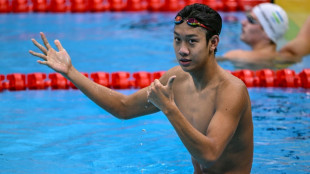 China swimmer in Asian Games first as North Korea lifters reign
 French literary prize removes novel from longlist after AI claims
 China's Zhang wins record seventh Asian Games swimming gold

 Verstappen edges Russell in final practice in Azerbaijan
 English, Spanish, Italian, German football leagues call for FIFA reform

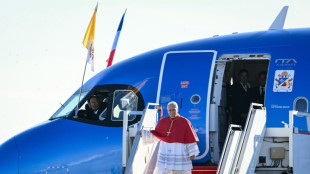 Pope arrives in France on first official visit in 18 years

Germany have dominated sliding sports at the Beijing Olympics on high-speed sleds using materials "basically similar to Formula One", says one of the men who builds them.
Going into the final weekend of the Games, the Germans have won 12 of the 24 medals at Yanqing National Sliding Centre, including seven of the eight golds.
Together with the expertise and determination of their athletes, Germany's success is down to technology from about 7,000 kilometres (4,00 miles) away in Berlin.
The Institute for Research and Development of Sports Equipment (FES) in the German capital builds and tests the bobsleigh, luge and skeleton sleds.
The materials for them would not be out of place on a Formula One racing car, says engineer Konstantin Schulze, who oversees their construction.
Underlining the comparison, in Friday's training for the four-man bobsleigh, Germany's Johannes Lochner was fastest, clocking speeds of up to 136 kilometres per hour.
Germany's top bobsleigh pilot Francesco Friedrich rates FES as "enormously important" as he looks to win a second gold in Beijing in Sunday's four-man bobsleigh.
Like the other German pilots, Friedrich works closely with FES experts whenever he races.
"You have to imagine it like a sports car that the athlete needs to deliver the perfect performance," says Schulze.
German sleds are sought after and Friedrich sold a bobsleigh he no longer needed to Canadian rival Christopher Spring before the Winter Games.
"He (Friedrich) definitely wouldn't have sold it if he didn't have something better, right?" said Canadian pilot Justin Kripps last week.
FES engineers tinker with the sleds on the ice at one of Germany's four tracks or in the wind tunnel at their Berlin headquarters.
"We try to cut two tenths (of a second) from each run during an Olympic cycle," said FES director Michael Nitsch.
In a sport often decided by fine margins, that could make the difference between winning an Olympic medal or not.
Such technology does not come cheap.
The German government provides annual funding of seven million euros ($8 million) to FES, which has 80 employees.
Their know-how benefits German athletes in other Olympic sports such as speed skating, canoeing and cycling.
Germany's success on the Yanqing ice track is born out of bitter defeat.
At the 2014 Sochi Games, Germany failed to win a bobsleigh medal for the first time in 50 years.
As a result, the German federation turned to FES and Austrian manufacturer Wallner.
The two-pronged approach saw Germany win all three bobsleigh medals at the 2018 Pyeongchang Games. Friedrich won two- and four-man golds while Mariama Jamanka took the two-woman title -- all in FES sleds.
Nitsch dismisses suggestions that FES gives German racers an unfair advantage.
Other national teams are "also allowed to do what we do", says the FES boss.
K.Brown--BTB