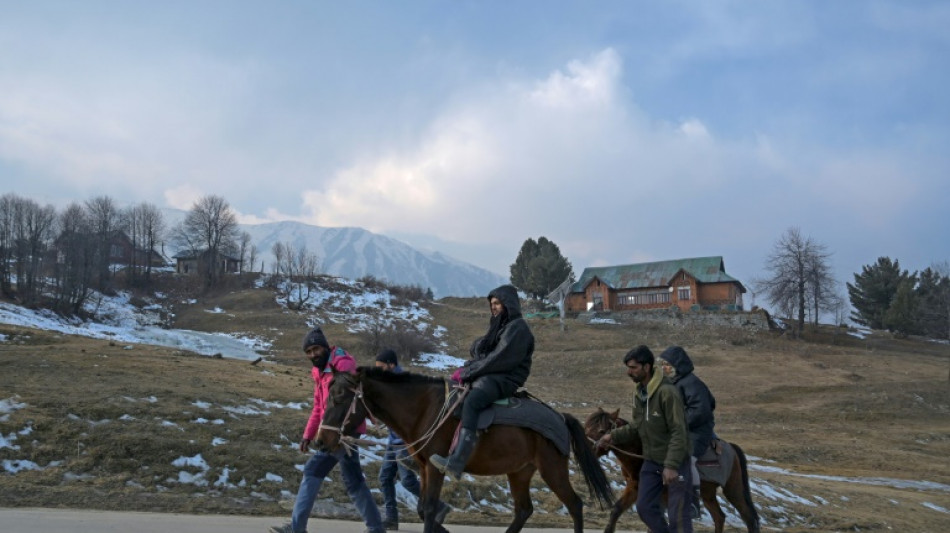
India's Kashmir ski industry melts as temperatures rise / Photo: © AFP

 Hotel Blacklist Launches New Accommodation Industry Risk Assessment Tool

 Bangladesh nuclear plant draws hope -- and worry
 US beat Canada 1-0 to wrap up four-win international break

 Turkey, Australia's joint COP31 leadership raises doubts

 For Turkish NGOs, COP31 offers rare space for action

 Sleep, appetite, gene-editing experts contend for Nobel chemistry prize
 Nobel Peace Prize haunted by the 'spectre' of Trump

 Africa launches own credit agency in bid for cheaper borrowing

 US, China, EU: three paths to regulating AI

 Australia's High Court rules against coal mine in landmark climate case

 Australia touts new funds for Pacific infrastructure at Fiji 'pre-COP'

 Eva Marie Saint, Oscar winner of Hollywood classics, dies at 102

 Australia probes app used in cheap smart glasses over privacy fears

 England needed to 'move on' from World Cup pain, says Tuchel

 O'Neill to stay at Celtic after period of "reflection"

 Kane marks 125th England cap with Wembley Nations League double

 Quebec's incoming separatist leader wants to block Crown from swearing-in

 Emmys gala will now stream its premier television awards

 Paramount completes Warner Bros takeover, creating Skydance

 Trump blames France unrest on Islam, migration

 Apple's Cook praises EU over efforts to protect children online

 Nobel winner Halzen says years of October 'misery' finally over

 Quebec separatist win rattles Carney's unity push

 'Itching' for change: Shiffrin cuts back slaloms this season

 'Gen Z has risen up': Tens of thousands mass for tense France school protests

Winter in the Himalayas should mean blanketing snow, and for Gulmarg in Indian-administered Kashmir, one of the highest ski resorts in the world, that usually means thousands of tourists.
This year, the deep powder once taken for granted is gone. The slopes are brown and bare, a stark example of the impact of the extreme weather caused by the rapidly heating planet, experts say.
The lack of snow is not only hammering the ski industry but has a worrying impact on agriculture, the mainstay of Kashmir's economy.
"Seeing this snowless Gulmarg, I feel like crying every day," said adventure tour operator Mubashir Khan, who has put wedding plans on hold with his business teetering near collapse.
"In the 20 years of my working here, this is the first time I see no snow in Gulmarg in January," said Majeed Bakshi, whose heliskiing service for high-spending tourists stands idle.
A lone helicopter waits for the few tourists who have still come, offering flights over higher peaks that have a dusting of snow.
"Our guests are mainly skiers, and they have all cancelled their bookings," said hotel manager Hamid Masoodi. "Those who come despite no snow are also disappointed."
Ski lifts are closed, rental shops are shut and a newly constructed ice rink is a pool of dank water.
"The current dry spell is an extreme weather event -- which are predicted to become more intense and frequent in the future," said climate scientist Shakil Romshoo, from Kashmir's Islamic University of Science and Technology.
- Rising temperatures -
For decades, an insurgency seeking independence or a merger with Pakistan -- and military operations to crush that movement -- has seen tens of thousands of civilians, soldiers and rebels killed in Kashmir.
The rebellion has lost much of its former strength, and India has been heavily promoting domestic tourism in the region, home to spectacular mountain scenery
But in Gulmarg, hotel bookings have plunged by as much as three-quarters, tourism professionals say, as hundreds of guides and scooter drivers sit waiting in the sunshine, praying for snow.
"Most foreigners who mainly come for skiing on the deep powder slopes have cancelled," Bakshi said. "I have lost about 70 percent of bookings so far."
Perched at 2,650 metres (8,694 feet), the Himalayan resort is also home to the Indian army's High Altitude Warfare School, located close to the highly militarised Line of Control, the de facto border that divides contested Kashmir between India and Pakistan.
Kashmir has recorded little rain, and temperatures are about six degrees Celsius (42.4 degrees Fahrenheit) higher than normal since autumn last year, according to meteorology officials.
Last month, precipitation across Kashmir was down 80 percent from past years.
Gulmarg received a few snow showers, but that soon melted.
India's Ministry of Earth Sciences said in a 2020 report they expected the Himalayas and Kashmir would be "particularly subject" to warming temperatures.
Earlier this month, the UN's World Meteorological Organization said the 2023 annual average global temperature was 1.45 degrees Celsius above pre-industrial levels (1850-1900) -- the warmest year on record.
The nine hottest individual years on record were the last nine.
In Kashmir, the impact is clear. Gulmarg's bowl-shaped landscape, beloved by tourists for the snow in winter and meadows of flowers in spring, is brown and bleak.
- 'Prolonged dry spells' -
Scientists warn rising global temperatures are unleashing a cascade of extreme weather events.
Beyond the collapse of the skiing industry, many in the ecologically fragile region are worried about impending water shortages that would have a dire potential impact on agriculture.
Romshoo, the climate scientist, said research indicates Kashmir "will experience more frequent and prolonged dry spells", worsening in the decades ahead.
Changing weather patterns have already altered farming practices.
Snow melt usually helps refresh the usually full rivers, but this week, authorities in Kashmir warned of water shortages and the risk of forest fires, with many wooded areas tinder dry.
Rice farmers needing plentiful water for their paddy fields have begun switching to fruit.
But that crop is also at risk, with the dry spell and sunshine meaning some trees are already flowering, blossoming more than two months early.
C.Kovalenko--BTB