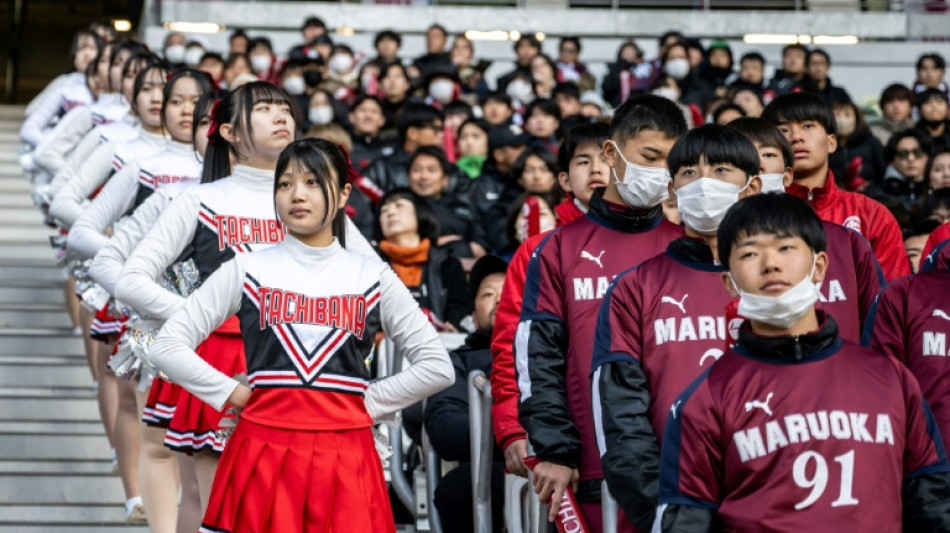
Drama, dreams: Japan's wildly popular school football breeds future stars / Photo: © AFP

 The German state premier hoping to halt far-right surge

 Lebanon wants Israel security deal as prelude to peace: president to AFP

 England's Brook keen to learn from 'hero' Pietersen after stunning ton

 Saudi says Houthis target Mecca, warns of 'red line'

 Phillippines ex-leader Duterte makes first appearance at ICC

 Lebanon wants Israel security deal, Hezbollah disarmament without confrontation: president to AFP

 BASIS.pro Expands On-Chain Infrastructure with XDC Network Partnership and Zypher DAO as Auto Earn Goes Live

 Samson relishing battle with teen star Sooryavanshi for India spot

 Pickle-flavoured tart? AI inspires Japan's convenience stores

 Macau holds first closed-door national security trial

 Bank of Japan set to raise rates under pressure from inflation, US

 Zverev, Shelton back on court for Davis Cup qualifiers

 Peace is a 'dangerous' word in Russian city heading to polls

 Meta chief pushes back on AI slowdown calls

 'Resident Evil' film brings video game's ethos to the big screen

 Court orders N. Korea pay Seoul $32.5 mn for blowing up office

 US military buildup in Palau stirs war fears

 US Fed to deliver rate decision with markets betting on hike

 Saudi, Egypt demand open Red Sea as Riyadh vows response to Houthi attacks

 Hydrosat Unveils Osiris Constellation, The Future of Thermal Intelligence

 Capitals say hockey star Ovechkin 'was asked' to film Putin ad

 Spurs in 'tough moment' after League Cup exit as De Zerbi says sorry

 Arteta salutes 'unbelievable' Dowman after Arsenal's teen star sinks Ipswich

 Empty seats as schools reopen in Venezuela's quake-hit Guaira

 Messi set for Argentina farewell in Benin friendly

Japan's national high school football tournament is thriving after more than 100 years, attracting huge crowds, millions watching on TV and breeding future stars, despite professional clubs trying to lure away young talent.
The annual tournament kicked off on Saturday and is still regarded as the pinnacle of amateur football with young players dreaming of playing in the final in front of tens of thousands at the National Stadium in Tokyo.
Matches are a massive occasion for the whole school as student cheering squads wave flags, bang drums and roar on their teams in a spectacle of noise and colour.
"All the teams are at a similar level of technical ability so it's about who wants to win the most," 18-year-old Junpei Fukuda, the leader of Ryutsukeizai University Kashiwa High School's cheering squad, told AFP.
"We want our voices to be the loudest."
Unlike in Europe, where young players are snapped up by professional club academies, high school football in Japan still attracts elite talent.
Many go on to the professional game and play for their country with current Japan stars such as Daizen Maeda and Reo Hatate of Celtic and Crystal Palace's Daichi Kamada all having played high school football.
The landscape has begun to change in recent years, with more top young players turning their backs on the high school game and joining the youth teams of top-flight J. League clubs instead.
The school tournament's quality has taken a hit as a result, but its magic endures for many.
Ryutsukeizai Kashiwa midfielder Kanaru Matsumoto, who will turn professional with the J. League's Shonan Bellmare next year, said the tournament was "the stage I've aspired to play on ever since I was little".
"The main reason I came to this school was because I thought I could play at the national high school tournament here," the 17-year-old said.
- Millions tune in -
The national high school tournament was first played in 1917, long before professional football came to Japan with the J. League in 1993.
Teams from each of Japan's 47 prefectures, with two from Tokyo, compete in a knockout competition over 18 days with matches played in and around the capital.
All games are televised locally and the semi-finals and final are broadcast to a national audience, with millions tuning in.
Last season's final in Tokyo was played in front of 55,000 fans, comfortably eclipsing most J. League attendances.
High school baseball and rugby tournaments are also popular and football journalist Masashi Tsuchiya said it was because school sports strike a chord in Japan.
"I'm from Gunma Prefecture and I always support the Gunma team, even if it isn't my old high school's team," he said.
"It's a tournament that places importance on local pride and old school ties."
Not all players who appear at the tournament have ambitions to play at the top level.
Some play on at university only, while others give up the sport after graduating from high school.
Ryutsukeizai Kashiwa manager Masahiro Enomoto said the tournament marks a transition after three years together as a team.
"It's where kids, who have worked really hard for something, become adults," he said.
- Floods of tears -
TV broadcasts of games go beyond events on the pitch, delving into the players' back stories, playing up emotional bonds and featuring scenes of beaten teams in floods of tears.
"Japanese people love that kind of drama more than they think about the quality of the football," said Enomoto, even though the standard remains undoubtedly high.
School sides still hold their own against J. League youth teams, who are increasingly regarded as a better route to the professional game.
The nationwide Prince Takamado Under-18 Premier League features a roughly even split of high school and J. League youth teams, and Ohzu High School were crowned this year's champions.
Tsuchiya said high school football should not be thought of only as a stepping stone to the top.
"Yes, you can watch it for the quality of football and the quality of the players," he said.
"But you can also just enjoy watching the kids give everything they've got to try to win each game."
J.Bergmann--BTB