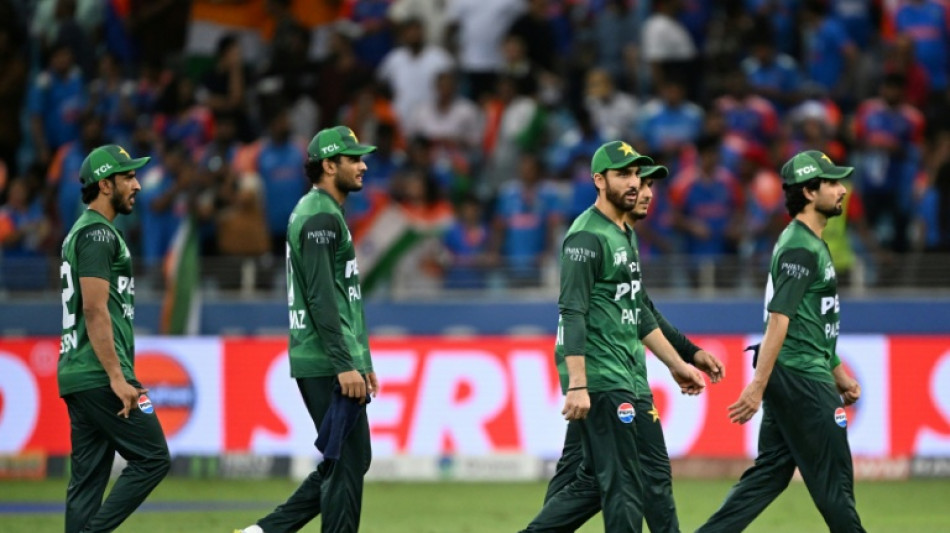
India and Pakistan meet again at Asia Cup after handshake row / Photo: © AFP

 Energy bill plan could use HMRC income data to target support

 Business owner earning £6,000 a month tackles £70,000 debt

 Nvidia chief faces inquiry after disclosing affair with suspected Chinese agent

 Comet returns as online electrical marketplace 14 years after collapse

 Aston Villa Defy History With Rare Victory at Old Trafford
 Democrats Face Criticism Over Social Security Reform Plans Amid Trust Fund Crisis

 Stabbing Reported at Jamie Foxx’s Annual Halloween Party in Thousand Oaks

 Binance CFO Kaiser Ng Departs Amid Aftermath of $6.3 Billion Hack
India and Pakistan clash again in the Asia Cup on Sunday, renewing one of cricket's fiercest rivalries a week after their last match was overshadowed by a handshake row.
India won the September 14 group match by seven wickets in Dubai and afterwards refused to shake hands with their opponents, angering Pakistan.
It was the first meeting between the neighbours since a four-day cross-border conflict in May left more than 70 people dead.
The Pakistan Cricket Board lodged a protest with the International Cricket Council alleging that match referee Andy Pycroft had told skipper Salman Agha not to approach Indian counterpart Suryakumar Yadav for a handshake at the toss.
The PCB demanded Pycroft be removed from their matches and threatened to withdraw from the eight-team Twenty20 competition.
Their last group game was held up for an hour before the PCB said Pycroft had apologised and the match, with the Zimbabwean in charge, eventually went ahead.
Pakistan beat hosts the United Arab Emirates to qualify for the next stage, the Super Fours, and set up another meeting with India in Dubai.
Indian media has reported that the team plans to stick to its no-handshake policy for Sunday's clash.
India spinner Kuldeep Yadav sought to defuse the controversy.
"When you step onto the field it's just a batter in front of you. I have always approached it this way against Pakistan," he said ahead of India's last group game, against Oman on Friday.
Agha also stuck to sport.
"If we play good cricket like we have played in the last few months I think we'll be good against any side," the Pakistan captain told reporters.
- Simmering tensions -
Because of fraught political ties, nuclear-armed neighbours India and Pakistan only meet at neutral venues during multi-team tournaments.
Tensions soared ahead of the Asia Cup after the two countries engaged in their worst conflict since 1999.
The hostilities in May left more than 70 people dead in missile, drone and artillery exchanges, before a ceasefire.
The conflict was triggered by an April attack on civilians in Pahalgam in Indian-administered Kashmir that New Delhi accused Pakistan of backing, a charge Islamabad denies.
India resisted calls to boycott the first Pakistan match.
A potential third India-Pakistan showdown looms if both sides qualify for the final on September 28 in Dubai.
India lifted the Asia Cup in its last, 50-over edition and are favourites to retain the crown.
India and Pakistan advanced to the next stage from Group A while Sri Lanka and Bangladesh qualified from Group B.
Sri Lanka face Bangladesh on Saturday in the first Super Fours fixture.
Sri Lanka, unbeaten so far, look dangerous while Bangladesh carry the underdog tag under skipper Litton Das.
Along with regional bragging rights, the Asia Cup serves as build-up towards the T20 World Cup in February-March in India and Sri Lanka.
H.Seidel--BTB