World Rugby defend head-injury test as row rages over Sexton return / Photo: © AFP

 Manchester United rallies past Roma as PSG dominates in Champions League

 Qatar sees tentative opening for renewed regional diplomacy

 Qatar Tourism joins Pacific Asia Travel Association at London travel market
 Abdul El-Sayed Wins Michigan Senate Seat in Historic Election
 Qatar media bodies discuss support for humanitarian initiatives

 No. 22 UCLA defeats No. 5 Arizona 84-75 despite Kharchenkov's 38 points

 Vessel operator seeks witnesses after Vancouver grounding

 US Air Force deploys F-16 fighters to remote Aleutian base for readiness drill

 Bezos grant helps Seattle nonprofit move thousands of families toward housing

 Shrini Srivastava joins crew of Varanasi-Delhi Vande Bharat Sleeper service

 Nearly Half of Australian Workers Overqualified, Survey Finds

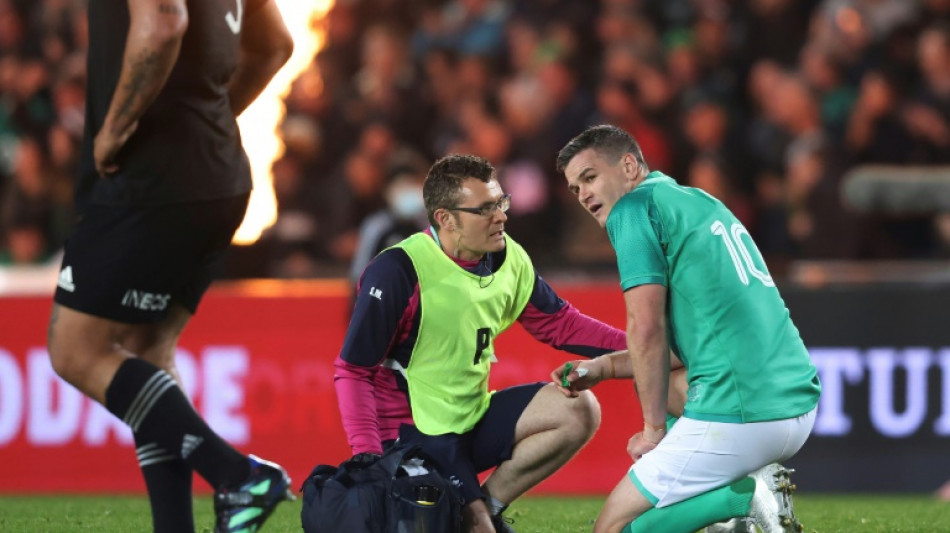
World Rugby has defended its Head Injury Assessment procedure against "irresponsible" remote diagnosis following a row over the selection of Ireland captain Johnny Sexton for this weekend's second Test against New Zealand.
The outstanding fly-half, 37 next week, failed an on-field HIA after suffering a blow to the head a half-hour into Ireland's 42-19 defeat by the All Blacks in Auckland last weekend and did not return to the field at Eden Park.
Nevertheless, he was named Thursday in Ireland's starting XV for the second Test in Dunedin, prompting safety campaign group Progressive Rugby to say HIA checks were "being exposed".
World Rugby, however, has stressed failing the on-field assessment does not automatically mean a player has sustained concussion and there are two more stages in the process, both of which Sexton has passed ahead of being cleared to play on Saturday.
"It is the duty of any individual or organisation commenting on the Head Injury Assessment process to do so using the facts," a World Rugby spokesperson told Britain's PA news agency.
"Attempting to diagnose a serious medical condition like concussion from afar, without all the relevant information including a player's medical history, is irresponsible and no substitute for the world-leading medical care received by elite rugby players."
Sexton, who has had numerous concussions during his career, was withdrawn after slipping and colliding with New Zealand's Sam Kane.
Prior to 2011, a player concussed in rugby union was stood down for three weeks. But following concerns this encouraged players to conceal their symptoms, World Rugby reduced the mandatory stand-down period to a week, provided return-to-play protocols were followed.
This, however, was recently extended to 12 days by the global governing body.
World Rugby said Thursday those displaying obvious symptoms should be immediately removed from play, adding: "Any player who had not displayed obvious concussion symptoms and who compares to a pre-recorded baseline on HIA2 and HIA3 assessments, which take place two and 36 hours after an incident respectively, is deemed by medical professionals to be clear of concussion."
- 'Extreme caution' -
Several former players, including England World Cup winner Steve Thompson, are mounting a legal case against the global governing body and other rugby authorities over an alleged failure to protect them from concussion risks.
And Progressive Rugby said failing the first stage of the current HIA process was concerning enough in itself.
"Elite players who fail an in-game HIA 1 have, by definition, displayed cognitive dysfunction requiring their removal," said a Progressive Rugby statement, adding this was enough in itself to exercise "extreme caution" for the good of their health.
"Regrettably, the HIA is being exposed... The fact is there remains no examination by any expert that can demonstrate a brain has healed and is not at risk of further damage.
"As such, if player welfare is truly the game's number one priority, the only option must be to err on the side of caution -- otherwise the new elite protocols are failing in their key purpose."
New Zealand Rugby admitted last week that medical staff had erred in allowing Ireland prop Jeremy Loughman to play on in a tour match against the Maori All Blacks, despite the front row displaying clear concussion symptoms.
NZR said a "gap" in the HIA process meant an independent doctor and medical staff did not see damning television footage of Loughman staggering and falling after taking a blow to the head in the opening minutes of the game.
O.Krause--BTB