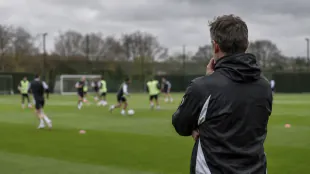
Deschamps says adaptation the key to not becoming an 'old fool' / Photo: © AFP

 Nick Harkaway Expands John le Carré’s Spy Universe in 'The Taper Man'

 Rene Eyre Revisits Autobiographical Performance 'Say A Little Prayer' in London

 UAE's HCT Holds Record Graduation and Announces Major Training Expansion
 NASA Awards $10B Lunar Contract Framework to SpaceX, Blue Origin

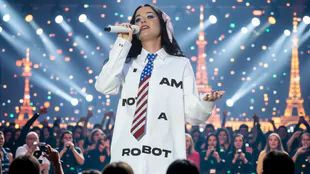 Katy Perry Tells Fans Ex-Husband Russell Brand 'Should Be in Jail' During UK Concert

 South African election results renew debate over identity-based voting

 South African voters report smoother local election but declining IEC trust

 Dolly Parton museum and Nashville hotel open after singer’s death

 George and Amal Clooney attend New York political-comedy reading
France coach Didier Deschamps admitted to AFP in an interview that he has had to learn to adapt to the younger generation of players rather than impose his ideas on them, to avoid becoming an "old fool".
The 56-year-old -- a World Cup winner both as captain in 1998 and coach in 2018 -- has been at the France helm since 2012, and said that even in that time, he has seen an evolution in the behaviour and temperament of young players.
"Players are more sure of themselves, they have more confidence," Deschamps told AFP this week, ahead of World Cup qualifiers against Azerbaijan on Friday and Iceland on Monday.
"Before, young players did what we told them to do and that was it.
"Now, they're more comfortable because they ready earlier, they play earlier, they're more mature."
Whereas before, a player might simply be satisfied with being called up to the international set-up, now they have higher expectations and it means that a coach must "deal differently" with them, Deschamps said.
"It's like in the world of business: the youngster arrives and he's able to go to his boss and tell him that he wants his job.
"That can be seen as a lack of humility -- or as ambition."
While Deschamps believes that "certain things were better before", he acknowledged that those "could not work now: such as the ban on telephones" in the changing room.
"Players from the current generation are ultra-connected: they're born with a mobile phone," he added.
"The key is for me to adapt to them."
Deschamps said that younger players' power of concentration is "a bit limited" and so he has to tailor his coaching to them.
"I prefer to keep it short, concise... I don't want to become background music, I prefer them to listen to me," he said.
"It is by adapting to players who are inevitably getting younger (relatively) -- since you are getting older -- that you navigate between not being an old fool, nor a fake youngster."
G.Schulte--BTB