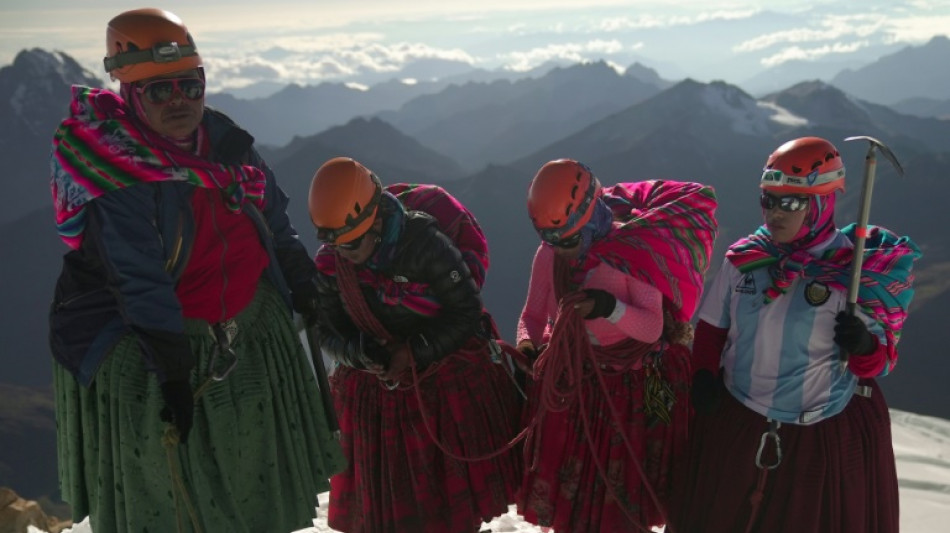
Bolivian indigenous women break barriers through mountaineering / Photo: © AFP

 Benvenuto Cellini wins Breeders' Cup Turf

 Roma thrash Udinese ahead of Milan derby

 Kane laments Dortmund draw after 'incredible high' of Ballon d'Or

 Spanish village holds memorial mass for train crash victims

 Israeli protesters demand opposition ally with Arab parties to oust Netanyahu

 De Minaur upsets Zverev and will face Alcaraz in Vienna final

 Kane misses penalty as Bayern held by Dortmund

 In Mexico City, Day of the Dead parade inspired by 007

 Rubio flags challenges in finding consensus as G20 talks wrap

 Zaman's century foils Sri Lanka as Pakistan win tri-series

 Bordeaux edge Bayonne to keep pressure on Toulouse

 Spanish village gathers for memorial Mass for train crash victims
 Haas sideline Ocon and give 32-year-old Hirakawa F1 debut in Mexico

 Brighton stun Man City, 10-man Man Utd beaten by Chelsea

 Erdogan takes Russia, Ukraine to task over Black Sea attacks

 Leipzig sink Schalke, Fuellkrug's fine form continues
 Germans join Europe's wave of 'Gen Z' protests

 Polish president holds crisis talks after court standoff
 Police fire tear gas as thousands march in France
 Alcaraz sees off Medvedev to reach Vienna Open final

 Cummins admits changes may be made after loss to South Africa

 Atletico beat Levante to move top above Barcelona

 Chelsea defeat pushes Carrick closer to Man Utd exit

 Pogacar 'happy to be alive' after difficult Vuelta crash recovery
 South Africa beat Australia by 176 runs in third Test to win series

A sudden gale drowns out the crunching sound of footsteps on the ice and makes skirts billow in the freezing night.
Ten indigenous Aymara women slowly trek up a Bolivian mountainside in their traditional dress as a statement of their emancipation.
The Climbing Cholitas of Bolivia Warmis is a group dedicated to campaigning for the rights of Indigenous women through mountaineering.
Cecilia Llusco, 36, is the daughter of a mountain guide and dreamt since she was young of climbing the snow-capped Huayna Potosi that rises over 6,000 meters above sea level.
However, for many years she limited herself to cooking for other mountaineers and packing their backpacks.
That was until she and several other rural women, including some of her sisters, decided to change their destiny.
"Why can't we climb mountains?" she said they asked themselves, while drawing dismissive reactions from some men.
"What are these women doing here, on the mountain?" Llusco recalls them saying.
Seven years after their initial expedition, and after climbing nearly a dozen peaks in Bolivia, Peru and Argentina, the Cholita Climbers, named after indigenous Bolivian women called "cholas" or "cholitas," are tackling Huayna Potosi again on this austral winter night.
And they did not compromise on their style.
"We wanted to show that women are strong and brave, that we can do it with our clothing," said LLusco, who wears her hair in long braids decorated with brown wool.
- 'A lot of discrimination' -
Whenever they can, and often helped by funding from NGOs and private businesses, they hire a minivan to drive two hours from their homes in El Alto -- the satellite overlooking La Paz, to the wall of ice they plan to scale.
There are 14 members and every time they climb they share an 'aptapi' -- a banquet in which every person brings some food to share.
After resting for a couple of hours in a refuge, the Cholitas get up at 11:00 pm and start dressing in their traditional colored pleated skirts, called polleras.
A ragbag of home-makers, carriers and tourist guides, they start climbing the glacier at midnight so as to reach the summit at sunrise.
Over their woollen clothing they carry typical mountaineering equipment: helmets, crampons, ice axes, boots and leggings.
But instead of a backpack, they carry their equipment in a traditional cloth sack slung over their shoulders and tied around the neck.
"There has been a lot of discrimination against the pollera woman," said Llusco, pointing to the femicide rate in Bolivia being the highest in South America, according to international organizations.
Indigenous people, who make up almost half of Bolivia's population, have long been marginalized.
- 'Flying between clouds' -
In the dark of night, all that is visible is an ant-like line of lanterns lighting up the ice on either side.
One by one the Cholitas cling to a safety harness and carefully dig their crampons into the ice to avoid tumbling 30 meters into an abyss.
The oxygen levels drop and temperatures plunge to minus 10 degrees Celsius.
In the distance, 30 kilometers way, the lights of El Alto are visible.
With the first light of the day, the coppery faces of these women -- aged between 18 and 42 -- become visible.
As a couple of snowy peaks poke through the low-lying cloud, several Cholitas stop to take photos of the dawn sun poking out from spectacular landscapes with their mobile phones.
The extreme altitude brings on head and stomach aches which the Cholitas try to alleviate by chewing coca and chocolate leaves.
Close to the summit, two exhausted climbers decide they have had enough and abandon.
The final path is steep and narrow. Clinging to a rope they push on slowly.
At the top it is all smiles, hugs and dancing.
"When we reach the mountain peak it is as if we were flying between clouds," said Llusco.
Her daughter Camila Tarqui, a new recruit, says she likes "how the pollera flutters" at this altitude.
"You're almost able to touch a star when you come up here at night," she said.
On a plain a few meters below the summit, the Cholitas play a football match.
High altitude football is nothing new in Bolivia, whose national team plays its matches in La Paz on the highest pitch in the world used for international matches.
Having already scaled South America's highest peak in 2019 -- the Aconcagua in Argentina -- the Cholitas now dream of tackling Mount Everest.
"We women have broken down several barriers ... and we want to go further, always carrying high the Aymara culture," said Llusco.
R.Adler--BTB