New name, little hope, in New York, Ukraine / Photo: ©

 Ed Sheeran returns to stage after Palestinian controversy
 Asian Games to open in Japan after troubled build-up
 Drone owners rush to offload devices ahead of Beijing ban
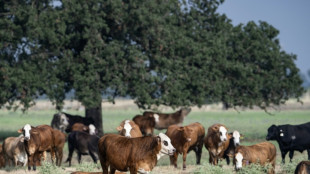 Trump's beef policies irk Texas ranchers, testing their loyalty
 Nvidia, OpenAI CEOs to attend Xi dinner at White House
 Anthropic picks Accenture for in-house AI safety evaluation
 Balogun returns as Monaco beat Lens to continue strong Ligue 1 start

 'Pause' on overt repression in Venezuela, but reforms still needed: HRW
 Global stocks mixed as yen falls despite Bank of Japan rate hike
 Cuba hit with seventh major blackout of the year

 Murray out with concussion so Wentz will start for Vikings
 UN chief 'deeply regrets' US visa refusal to Abbas for annual meeting
 England quick Carse to face no charges over alleged nightclub assault
 Mancini brings nine newcomers into the first squad of his Italy comeback
 Czechs level Davis Cup tie against USA as South Korea eye Finals
 New France boss Zidane confirms Mbappe as captain after naming first squad
 California governor signs order to explore AI 'kill switch'
 Head leads run spree as Australia win Zimbabwe ODI series
 In-form Raphinha wants to finish career at Barcelona
 Warren Buffett steps down as Berkshire Hathaway chairman
 Carrick confident Man Utd can 'work through' tough time

 Mbappe ends Nike partnership to join Swiss brand On

 Liverpool boss Iraola puts Bournemouth love affair on hold
 'A disaster' if Man City do not win says Maresca after flawless start
 Kerry James Marshall: American 'blackness' painter celebrated in Europe

The local billionaire's chemical plant stands on the edge of the frontline in New York, eastern Ukraine.
The only renovated building of this war-bruised town, called Novgorodske ("new city" in Ukrainian) until last year, is the local cultural centre.
Tetyana Krasko proudly pushes open its metal door and shows off an exhibit paying homage to Ukrainian soldiers fighting Russia-backed rebels for the past eight years.
But the centre offers few clues as to how a group of German settlers decided to call their new home in what was then part of the Russian empire New York in the 1800s.
Soviet officials switched the name to Novgorodske in 1951, only for the locals to flip it back to New York last year.
"It's a mystery that still hasn't been solved," Krasko says about all the name changes.
The name could very well change again should the masses of Russian forces encircling Ukraine on almost every side follow through with their feared invasion.
For now, New York's empty streets echo with the sounds of exploding shells from a new escalation in a separatist conflict that has claimed more than 14,000 lives and pushed 1.5 million from their homes.
Many of the houses in this town of what was once 10,000 people stand empty today. And those who remain have dark thoughts about the days ahead.
"We tell ourselves that they would be too afraid to bomb New York," Krasko says with a bitter laugh, before turning gravely serious.
"It's not funny. There have already been shellings. New York has already suffered."
- Generational divide -
Novgorodske became New York after a campaign launched by young activists in 2016, when the separatist war was just turning quieter after months in which dozens of people were dying each day.
"There was no desire from the local officials for the name change," said Krasko.
"Maybe they were afraid it would cause a scandal. Maybe they thought that having a New York on the frontline would sound weird."
The officials were supported by the older generation who felt personally attached to the old Soviet name.
"But the young people, those with an active social life, were all in favour of change," she said.
Sergiy and Angela, two 16-year-old interns at a college about 40 kilometres (25 miles) from New York, are not terribly bothered about the new name.
In fact, perhaps more than anything, they are thinking of leaving. There is just not that much to do in New York.
The town's main employer is a chemical plant owned by Rinat Akhmetov, a billionaire who has been viewed for years as one of Ukraine's most powerful men.
Akhmetov spends little time in this New York, which is the final stop on a train running from Kramatorsk, a city 45 kilometres to the north that serves as Kyiv's administrative centre for the war-torn east.
About 25 kilometres south lies Donetsk, the rebel stronghold.
"When I grow up, I don't know if it would make sense for me to stay," Sergiy says. "I don't know how long the war will last. We will probably have to leave."
- 'They are fools!' -
The war is on everyone's mind. A sharp escalation at the end of last week has locals fearing the worst.
"Is there going to be a war?" Klava Blynska, 90, shouts down from her balcony.
"I don't want a war! I've seen it before," she says, clearly in no mood to give serious thought to her town's name change.
"They are fools! Why did they do that," she fumes, before returning to the subject at hand: "If (Vladimir) Putin goes to war, he's a moron!"
But for her, as seemingly for many other Russian speakers in New York, the main culprits are the Ukrainian leaders who came to power after a 2014 pro-EU revolution.
"They would judge me in Kyiv if I told you what I think about all this," one middle-aged man said before slamming shut his gate in a huff.
Ella Pylipenko, a 29-year-old mother, contradicted most of her neighbours by saying, in a hushed voice, that she wanted "our land to remain in Ukraine", rather than become Moscow-run.
"But it's very difficult to live here," she added. "There's nowhere to work, the wages are small and there is this shelling."
R.Adler--BTB