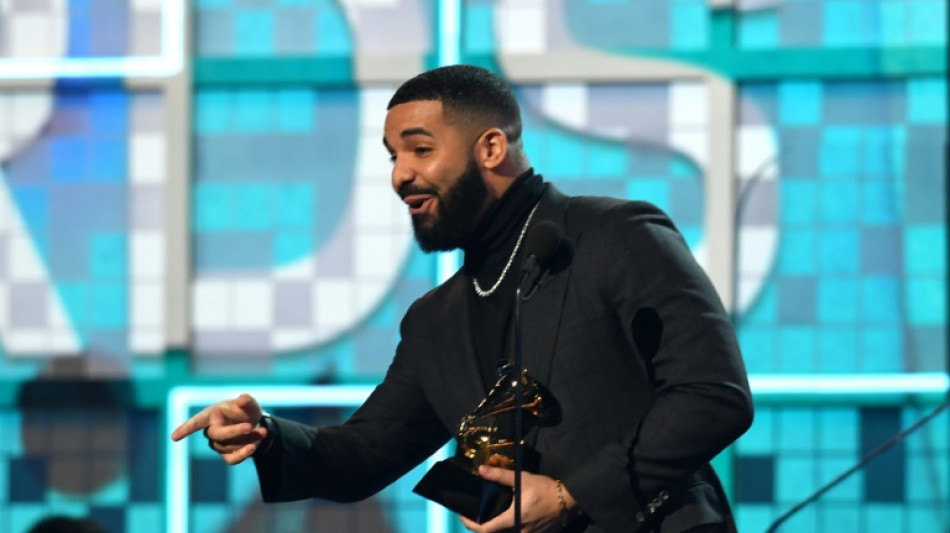
Did the AI Drake song breach copyright? / Photo: © AFP

 Stocks rise on AI buzz, oil prices cool
 India narrowly survive huge scare against minnows Japan
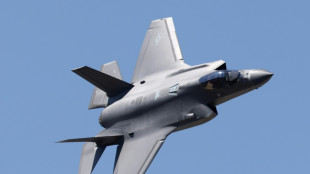 Missing F-35 fighter parts 'not sensitive', says Australia minister

 Cambodia showcases scams crackdown with global conference
 Afghan cyclist who disguised herself as man wins Asian Games silver
 Typhoon Dujuan leaves four dead in Japan, 45,000 houses without power

 G7 leaders condemn Houthi strikes on Saudi Arabia

 Google data centre sparks protests in Austria

 Shin Ohashi: Junk food-loving teen and Japan's next big swimming hope

 Stocks rise on AI buzz, drop in oil prices

 China's robot dancers limber up for America's Got Talent final

 Despite military might, Saudi struggles to crush the Houthis

 Trump to tout deals, defend Iran war in UN speech

 Sri Lanka to issue verdict in landmark Easter attack trial

 No green light to lift EU sanctions on Russian oligarchs, talks to resume

 UK agrees support for Saudi in struggle with Houthis: reports

 EU foreign policy chief calls for continued sanctions on Russia

 Flights scrapped, evacuations urged as Typhoon Dujuan wallops Japan

 Fonseca to take break from tennis

 A Cuban zoo, and its animals, in epic battle for survival

 Infantino proposes consulting federations to reform FIFA

 El Nino weather pattern enters record territory: scientist

 OpenAI calls for US to lead global effort on AI standards

 South African ostriches plucked alive for luxury fashion: report

 US networks halt Trump coverage in revolt over White House ban

A viral AI-generated song imitating Drake and The Weeknd was pulled from streaming services this week, but did it actually breach copyright as claimed by record label Universal?
Created by someone called @ghostwriter, "Heart On My Sleeve" racked up millions of listens before Universal Music Group asked for its removal from Spotify, Apple Music and other platforms.
However, Andres Guadamuz, who teaches intellectual property law at Britain's University of Sussex, is not convinced that the song breached copyright.
As similar cases look set to multiply -- with an uncanny AI replication of Liam Gallagher from Oasis causing buzz -- he spoke to AFP about some of the issues being raised.
- Did the song breach copyright?-
The underlying music on "Heart On My Sleeve" was new -- only the sound of the voice was familiar -- "and you can't copyright the sound of someone's voice," said Guadamuz.
Perhaps the furore around AI impersonators may lead to copyright being expanded to include voice -- rather than just melody, lyrics and other created elements -- "but that would be problematic," Guadamuz added.
"What you're protecting with copyright is the expression of an idea, and voice isn't really that."
He said Universal probably claimed copyright infringement because it is the simplest route to removing content, with established procedures already in place with streaming platforms.
"Most of the time, these issues are not resolved by law, but just by record companies making a stink with the platforms. It's easier for the platform just to comply," said Guadamuz.
- Were other rights breached?
An AI-generated impersonator may be breaching other laws.
If an artist has a distinctive voice or image, this is potentially protected under "publicity rights" in the United States or similar image rights in other countries.
Bette Midler won a case against Ford in 1988 for using an impersonator of her in an advert. Tom Waits won a similar case in 1993 against the Frito-Lays potato chips company.
The problem, said Guadamuz, is that enforcement of these rights is "very hit and miss" and taken much more seriously in some countries than others.
And streaming platforms currently lack straightforward mechanisms for removing content seen as breaching image rights.
- What comes next?
The big upcoming legal fight is over how AI programmes are trained.
It may be argued that inputting existing Drake and Weeknd songs to train an AI programme may be a breach of copyright -- but Guadamuz said this issue was far from settled.
"You need to copy the music in order to train the AI and so that unauthorised copying could potentially be copyright infringement," he said.
"But defendants will say it's fair use. They are using it to train a machine, teaching it to listen to music, and then removing the copies.
"Ultimately, we will have to wait and see for the case law to be decided."
But it is almost certainly too late to stem the flood.
"Bands are going to have to decide whether they want to pursue this in court, and copyright cases are expensive," said Guadamuz.
"Some artists may lean into the technology and start using it themselves -- especially if they start losing their voice."
J.Bergmann--BTB