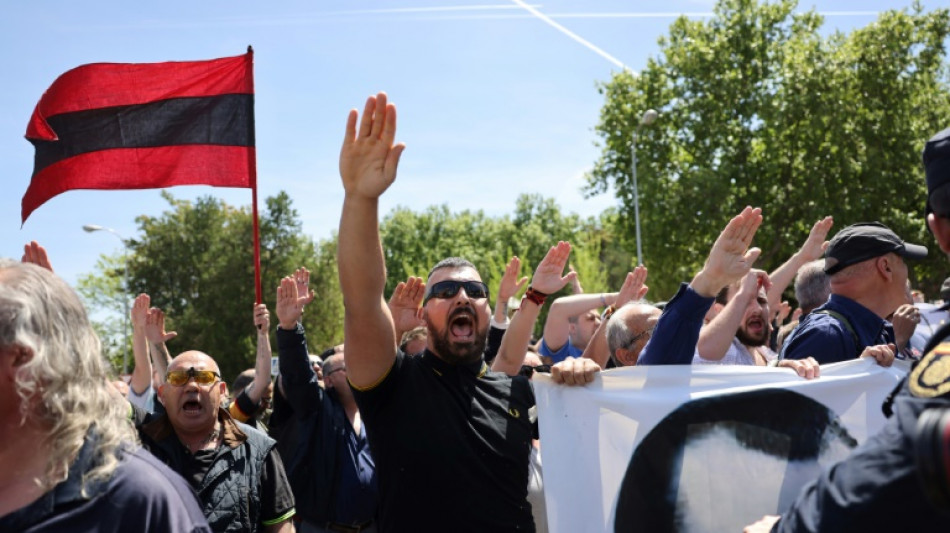
Far-right backers, police tussle as Spain fascist leader re-buried / Photo: © AFP

 Stocks rise on AI buzz, oil prices cool
 India narrowly survive huge scare against minnows Japan

 Missing F-35 fighter parts 'not sensitive', says Australia minister

 Cambodia showcases scams crackdown with global conference
 Afghan cyclist who disguised herself as man wins Asian Games silver
 Typhoon Dujuan leaves four dead in Japan, 45,000 houses without power
 G7 leaders condemn Houthi strikes on Saudi Arabia
 Google data centre sparks protests in Austria
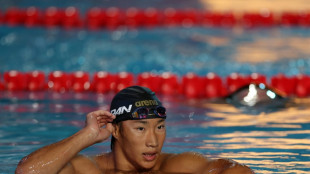 Shin Ohashi: Junk food-loving teen and Japan's next big swimming hope
 Stocks rise on AI buzz, drop in oil prices
 China's robot dancers limber up for America's Got Talent final

 Despite military might, Saudi struggles to crush the Houthis
 Trump to tout deals, defend Iran war in UN speech
 Sri Lanka to issue verdict in landmark Easter attack trial

 No green light to lift EU sanctions on Russian oligarchs, talks to resume
 UK agrees support for Saudi in struggle with Houthis: reports
 EU foreign policy chief calls for continued sanctions on Russia
 Flights scrapped, evacuations urged as Typhoon Dujuan wallops Japan
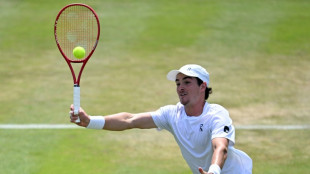 Fonseca to take break from tennis
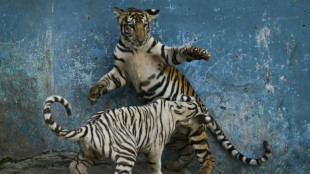 A Cuban zoo, and its animals, in epic battle for survival
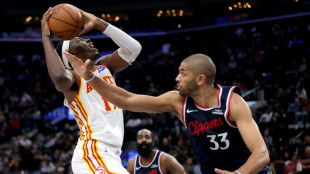
 Infantino proposes consulting federations to reform FIFA

 El Nino weather pattern enters record territory: scientist
 OpenAI calls for US to lead global effort on AI standards
 South African ostriches plucked alive for luxury fashion: report
 US networks halt Trump coverage in revolt over White House ban
Far-right protesters in Madrid tussled with police Monday as the remains of a fascist party founder were to be re-buried in a simple grave as Spain works to reckon with its authoritarian past.
The exhumation of Jose Antonio Primo de Rivera's body came six months after Spain passed its so-called democratic memory law aimed at tackling the legacy of the 1936-39 civil war and the decades of dictatorship that followed.
Primo de Rivera founded the Falange party in 1933 which went on to become one of the pillars of Franco's brutal regime, along with the military and Spain's Roman Catholic Church.
He was executed in November 1936 for conspiring against the elected Republican government and in 1959, his remains were transferred to a vast basilica in Valley of the Fallen, 50 kilometres (30 miles) northwest of Madrid.
As his remains arrived for reburial at Madrid's San Isidro cemetery, scuffles broke out between police and around 200 far-right activists chanting and making fascist salutes, an AFP correspondent said.
Police had blocked off access to the cemetery although banner-waving supporters began gathering outside before the arrival of his remains.
- From grandeur to simple grave -
The basilica where Primo de Rivera's remains lay for over six decades, is part of a vast hillside mausoleum built after the civil war by Franco's regime -- in part by the forced labour of 20,000 political prisoners.
When the dictator died in 1975, he was also buried there, in a tomb by the altar, with the site long being a draw for those nostalgic for the Franco era.
Under the new law, no figure linked to the 1936 military coup that triggered the civil war should have a grave in "a prominent public place" that could encourage acts of homage or exultation.
Primo de Rivera's family agreed to have his remains removed, selecting April 24 because it marks 120 years since his birth.
Honouring Franco-era victims has been a top priority for Prime Minister Pedro Sanchez's left-wing government.
It wants to strip the mausoleum of its status as a symbol of Francoism and far-right ideology and turn it into a place of memory for the dark years of the dictatorship.
Education Minister Pilar Alegria said the exhumation was "one more step towards restoring the dignity of Spain's democracy" which would see the complex repurposed as a space of remembrance for the victims.
"It can never again be a place where any figure or any ideology that evokes the dictatorship can be glorified," she told reporters.
In 2019, Sanchez's government relocated Franco's remains from the basilica following a lengthy legal battle with the dictator's family.
- A place of memory -
The basilica -- topped by a 150-metre (500-foot) stone cross -- and mausoleum also house remains of more than 30,000 victims from both sides of the civil war, all in unmarked graves.
It is a deeply divisive symbol of a past Spain still finds difficult to digest.
But the law and the exhumation have angered the right, which has accused the government of needlessly dredging up the past, noting the upcoming local and regional polls on May 28 and the year-end general election.
"When the prime minister has problems, he digs up the dead. He did it before the last elections and he's doing it today," said Santiago Abascal of the far-right Vox, referring to Franco's exhumation just weeks before a general election.
"We are totally fed up with this government that is only interested in digging up hatred and pitting Spaniards against each other," he said.
K.Thomson--BTB