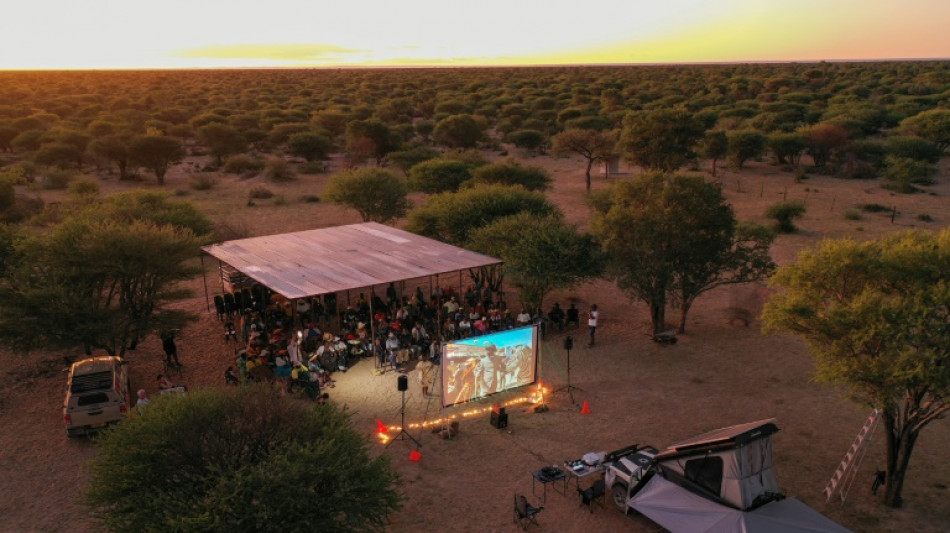
Germany's colonial crimes in Namibia tackled on screen / Photo: © STUDIOCANAL/AFP

 Stocks rise on AI buzz, oil prices cool

 India narrowly survive huge scare against minnows Japan

 Missing F-35 fighter parts 'not sensitive', says Australia minister

 Cambodia showcases scams crackdown with global conference

 Afghan cyclist who disguised herself as man wins Asian Games silver

 Typhoon Dujuan leaves four dead in Japan, 45,000 houses without power

 G7 leaders condemn Houthi strikes on Saudi Arabia

 Google data centre sparks protests in Austria

 Shin Ohashi: Junk food-loving teen and Japan's next big swimming hope

 Stocks rise on AI buzz, drop in oil prices

 China's robot dancers limber up for America's Got Talent final

 Despite military might, Saudi struggles to crush the Houthis
 Trump to tout deals, defend Iran war in UN speech

 Sri Lanka to issue verdict in landmark Easter attack trial

 No green light to lift EU sanctions on Russian oligarchs, talks to resume

 UK agrees support for Saudi in struggle with Houthis: reports

 EU foreign policy chief calls for continued sanctions on Russia

 Flights scrapped, evacuations urged as Typhoon Dujuan wallops Japan

 Fonseca to take break from tennis

 A Cuban zoo, and its animals, in epic battle for survival

 Infantino proposes consulting federations to reform FIFA

 El Nino weather pattern enters record territory: scientist
 OpenAI calls for US to lead global effort on AI standards

 South African ostriches plucked alive for luxury fashion: report

 US networks halt Trump coverage in revolt over White House ban

Long overshadowed by World War II and the Holocaust, a colonial-era genocide committed by Germany in Namibia has been brought to the big screen, shining a light on the country's neglected crimes.
Lars Kraume's "Measures of Men" tells the story of a German ethnologist who travels to what was German South West Africa in the early 1900s to study the country's indigenous peoples and harvest their skulls.
The film was released in German cinemas on March 23 and has also been the subject of special screenings, including in schools and the Bundestag lower house of parliament.
"The colonial era was long repressed by Germany, which lost all its colonies in 1919," Kraume, 50, told AFP.
"This film is a contribution to making Germans aware of their responsibilities," he said.
Germany is well known for its efforts to remember and atone for the atrocities committed during World War II.
Children are taught about the Holocaust in schools, a memorial to the murdered Jews occupies a prominent place in Berlin, and countless films and documentaries have been made about the Nazis.
But only one other film, "Morenga" by German director Egon Guenther, based on the novel of the same name by Uwe Timm, has been made in Germany about the country's role in Namibia.
- Racist experiments -
Though smaller than those of France and Britain, Germany's colonial empire encompassed parts of several African countries, including present-day Burundi, Rwanda, Tanzania, Namibia and Cameroon.
In Namibia, Germany was responsible for mass killings of indigenous Herero and Nama people that many historians refer to as the first genocide of the 20th century.
Over the past 20 years, Germany has been gradually starting to talk more about the massacre, in which at least 60,000 Herero and 10,000 Nama were killed between 1904 and 1908.
Germany has returned skulls and other human remains to Namibia that it had sent to Berlin during the period for "scientific" experiments.
And in May 2021, the country officially acknowledged that it had committed genocide in Namibia and promised a billion euros in financial support to descendants of the victims.
"Since the centenary of the genocide in 2004, historians and activists have done a lot of work on the subject," said Joel Glasman, a professor of African history at the University of Bayreuth.
In "Measures of Men", an ethnologist from Berlin, Alexander Hoffmann (Leonard Scheicher), is sent to Namibia to conduct experiments on the population and collect their bones for research.
At the beginning of the film, Hoffmann believes no race is superior to any other.
But he is ambitious and, in order to further his career, ends up going along with the prevailing scientific wisdom -- which went on to pave the way for the racist ideology of the Nazis.
The story is told mainly from the German perspective, though Hoffmann's friend Kezia Kambazembi (Girley Charlene Jazama), a Herero translator, also plays a prominent role.
- 'Very emotional' -
Israel Kaunatjike, a Herero rights activist based in Berlin, said "Measures of Men" had "moved me deeply".
"It motivated me to continue to fight for our cause," said the 76-year-old, who was an anti-apartheid resistance fighter when Namibia was still under South African control.
When "Measures of Men" was shown in some Herero villages, "it was very emotional, people thought Lars Kraume was brave to show such a film to the descendants of the victims", Kaunatjike said.
A film showing the perspective of the Herero and Nama on the same events would be welcome, Kaunatjike said. "But unfortunately they don't have the money to make a film."
When the film was shown in schools, "the students understood the ambivalence of the hero and wanted to discuss it", Kraume said.
Both Kaunatjike and Kraume believe Germany still has some way to go to reckon with its colonial past.
"We need an official request for forgiveness from the German president in Namibia and the return of all the Herero and Nama skulls and bones still in German collections for burial," said Kraume.
For Kaunatjike, "development aid is no substitute for reparations".
E.Schubert--BTB