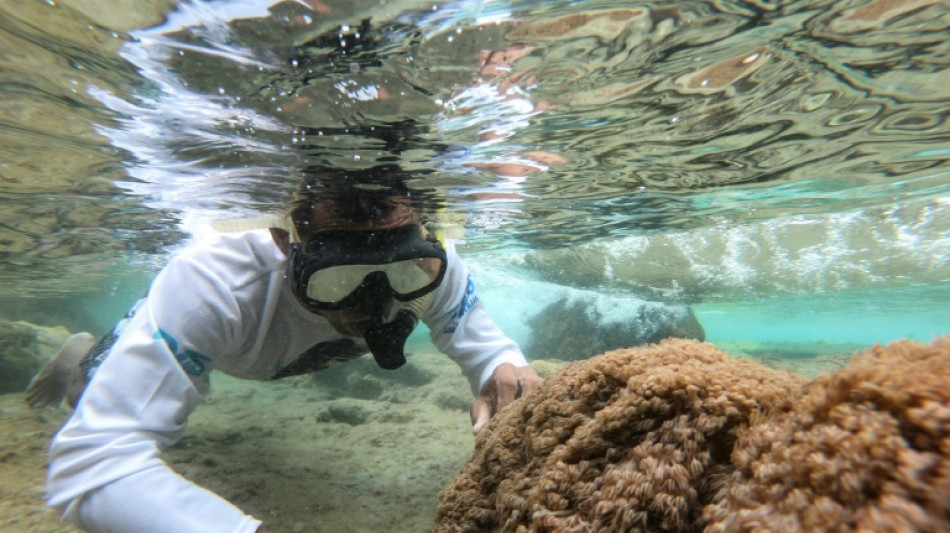
Deadly invader devastating Venezuelan coral reefs / Photo: © AFP

 Stocks rise on AI buzz, oil prices cool

 India narrowly survive huge scare against minnows Japan

 Missing F-35 fighter parts 'not sensitive', says Australia minister

 Cambodia showcases scams crackdown with global conference

 Afghan cyclist who disguised herself as man wins Asian Games silver

 Typhoon Dujuan leaves four dead in Japan, 45,000 houses without power

 G7 leaders condemn Houthi strikes on Saudi Arabia

 Google data centre sparks protests in Austria

 Shin Ohashi: Junk food-loving teen and Japan's next big swimming hope

 Stocks rise on AI buzz, drop in oil prices

 China's robot dancers limber up for America's Got Talent final

 Despite military might, Saudi struggles to crush the Houthis

 Trump to tout deals, defend Iran war in UN speech

 Sri Lanka to issue verdict in landmark Easter attack trial

 No green light to lift EU sanctions on Russian oligarchs, talks to resume

 UK agrees support for Saudi in struggle with Houthis: reports

 EU foreign policy chief calls for continued sanctions on Russia

 Flights scrapped, evacuations urged as Typhoon Dujuan wallops Japan

 Fonseca to take break from tennis

 A Cuban zoo, and its animals, in epic battle for survival

 Infantino proposes consulting federations to reform FIFA

 El Nino weather pattern enters record territory: scientist

 OpenAI calls for US to lead global effort on AI standards

 South African ostriches plucked alive for luxury fashion: report

 US networks halt Trump coverage in revolt over White House ban

An ominous shadow in the turquoise Caribbean waters off Venezuela comes from a deadly intruder -- a soft coral that experts say has caused one of the most destructive habitat invasions on record anywhere.
The Unomia stolonifera, native to Indonesia and the Indo-Pacific, is a pinkish type of pulse coral so called for its dance-like movements in the ocean currents.
It is a popular aquarium ornament -- pretty to look at and hardy -- with a single polyp fetching as much as $80 to $120.
But it is also a killer -- settling on native hard corals, rocks and even seagrass which it suffocates and replaces, ultimately destroying entire ecosystems.
Off Venezuela's north coast, Unomia dominates the ocean floor landscape after being introduced through the illegal aquarium trade around 20 years ago.
"This is an ecological catastrophe," said marine biologist Juan Pedro Ruiz-Allais, director of Project Unomia, named after the invader he has spent years investigating.
Fish stocks are drastically decreasing in the waters off Venezuela as native reefs, which serve as nurseries and feeding grounds, die off, he told AFP.
"When the reef dies, when it is covered by the Unomia stolonifera, a disruption of the food chain occurs," said the biologist.
"It is a social, food security, and economic problem because the livelihood of fishermen is compromised."
- 'Nobody knew' -
When Ruiz-Allais first came across the invader in 2007, it was an unknown species in the Caribbean and even the Atlantic, he recalled. "Nobody knew what it was."
It was first spotted in the Mochima National Park, a gorgeous archipelago covering more than 94,000 hectares, and has since been found to have colonized most of those islands.
The first scientific report was published in 2014, and the coral was initially classified as a member of the broad Xeniidae family before it was finally categorized in 2021 as Unomia stolonifera.
From Mochima, it has spread west and east in the Caribbean Sea.
Off the northern state of Anzoategui, it has taken over the equivalent of 300 football stadiums.
The coral is spread by fishing nets, anchors, and ship ballast water.
"It is a great colonizer," Gustavo Carrasquel, director of the Azul Ambientalistas, an environmental NGO, told AFP.
- 'Unprecedented' -
The threat extends beyond Venezuela's borders: officials say Unomia traces have been found near the islands of Aruba and Curacao, and in waters off Colombia and Brazil -- where it became attached to an oil rig but was controlled.
"It is a problem that will affect the rest of the Caribbean," said Ruiz-Allais.
But nowhere has it been more destructive than in Venezuela.
"It is an unprecedented case," said Project Unomia coordinator Mariano Onoro.
Fishermen and tour operators, concerned about the invasive coral's rapid propagation, have resorted to manual extraction.
But experts say this is not advised, because broken-off fragments are transported by the tides, settling to create yet more colonies.
The privately funded Project Unomia has developed an extraction machine with a group of engineers that is awaiting government approval for testing.
Venezuela's Institute for Scientific Research and the ministry of eco-socialism have launched an investigation into the coral's rapid spread but have yet to come up with a solution.
For now, the magnitude of the problem is such that the invader's elimination appears impossible.
"What we can do is recover some areas and control it," said Onoro.
J.Fankhauser--BTB