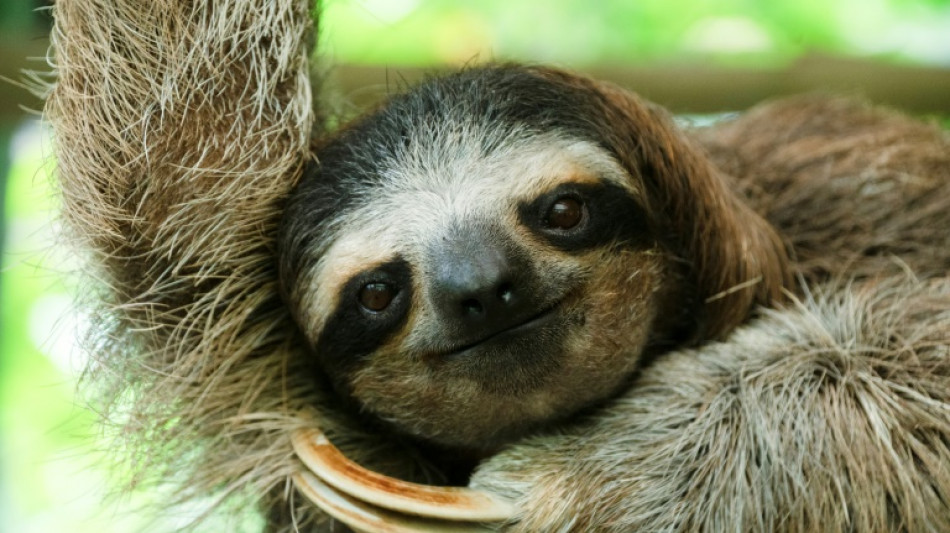
Costa Rican sloth antibiotics offer hope for human medicine / Photo: © AFP

 Stocks rise on AI buzz, oil prices cool

 India narrowly survive huge scare against minnows Japan

 Missing F-35 fighter parts 'not sensitive', says Australia minister

 Cambodia showcases scams crackdown with global conference

 Afghan cyclist who disguised herself as man wins Asian Games silver

 Typhoon Dujuan leaves four dead in Japan, 45,000 houses without power

 G7 leaders condemn Houthi strikes on Saudi Arabia

 Google data centre sparks protests in Austria

 Shin Ohashi: Junk food-loving teen and Japan's next big swimming hope

 Stocks rise on AI buzz, drop in oil prices

 China's robot dancers limber up for America's Got Talent final

 Despite military might, Saudi struggles to crush the Houthis

 Trump to tout deals, defend Iran war in UN speech

 Sri Lanka to issue verdict in landmark Easter attack trial

 No green light to lift EU sanctions on Russian oligarchs, talks to resume

 UK agrees support for Saudi in struggle with Houthis: reports

 EU foreign policy chief calls for continued sanctions on Russia

 Flights scrapped, evacuations urged as Typhoon Dujuan wallops Japan

 Fonseca to take break from tennis

 A Cuban zoo, and its animals, in epic battle for survival

 Infantino proposes consulting federations to reform FIFA

 El Nino weather pattern enters record territory: scientist

 OpenAI calls for US to lead global effort on AI standards

 South African ostriches plucked alive for luxury fashion: report

 US networks halt Trump coverage in revolt over White House ban

The fur of Costa Rican sloths appears to harbor antibiotic-producing bacteria that scientists hope may hold a solution to the growing problem of "superbugs" resistant to humanity's dwindling arsenal of drugs.
Sloth fur, research has found, hosts bustling communities of insects, algae, fungi and bacteria, among other microbes, some of which could pose disease risk.
Yet, experts say, the famously slow-moving mammals appear to be surprisingly infection-proof.
"If you look at the sloth's fur, you see movement: you see moths, you see different types of insects... a very extensive habitat," Max Chavarria, a researcher at the University of Costa Rica, told AFP.
"Obviously when there is co-existence of many types of organisms, there must also be systems that control them," he said.
Chavarria and a team took fur samples from Costa Rican two- and three-toed sloths to examine what that control system could be.
They found the possible existence of antibiotic-producing bacteria that "makes it possible to control the proliferation of potentially pathogenic bacteria... or inhibit other competitors" such as fungi, according to a study published in the journal Environmental Microbiology.
- 'No infection' -
The sloth is a national symbol in laid back Costa Rica, and a major tourist attraction for the Central American country.
Both the two-toed (Choloepus Hoffmanni) and three-toed (Bradypus variegatus) sloth species have seen their populations decline, according to the International Union for the Conservation of Nature's Red List of Threatened Species.
They live in the canopies of trees in the jungle on the Caribbean coast, where the climate is hot and humid.
American Judy Avey runs a sanctuary in the balmy jungle to care for sloths injured after coming into contact with humans or other animals.
She treats and rehabilitates the creatures with a view to releasing them back into the wild.
"We've never received a sloth that has been sick, that has a disease or has an illness," she told AFP.
"We've received sloths that had been burned by power lines and their entire arm is just destroyed... and there's no infection.
"I think maybe in the 30 years (we've been open), we've seen five animals that have come in with an infected injury. So that tells us there's something going on in their... bodily ecosystem."
Avey, who established the sanctuary with her late Costa Rican husband, Luis Arroyo, had never even heard of a sloth back home in Alaska.
Since receiving her first sloth, whom she named "Buttercup," in 1992, she has cared for around 1,000 animals.
- Penicillin inspiration -
Researcher Chavarria took fur samples taken from sloths at the sanctuary to examine in his laboratory.
He began his research in 2020, and has already pinpointed 20 "candidate" microorganisms waiting to be named.
But he said there is a long road ahead in determining whether the sloth compounds could be useful to humans.
"Before thinking about an application in human health, it's important to first understand... what type of molecules are involved," said Chavarria.
An example of this is penicillin, discovered in 1928 by British scientist Alexander Fleming, who discovered that a fungal contamination of a laboratory culture appeared to kill a disease-causing bacteria.
His discovery of the world's first bacteria-killer, or antibiotic, earned him the 1945 Nobel Prize in medicine.
However, microbial resistance to antibiotics has been a growing problem, meaning some medicines no longer work to fight the infections they were designed to treat.
Antimicrobial resistance is a natural phenomenon, but the overuse and misuse of antibiotics in humans, animals and plants has made the problem worse.
The World Health Organization estimates that by 2050, resistance to antibiotics could cause 10 million deaths a year.
"Projects like ours can contribute to finding... new molecules that can, in the medium or long term, be used in this battle against antibiotic resistance," said Chavarria.
F.Müller--BTB