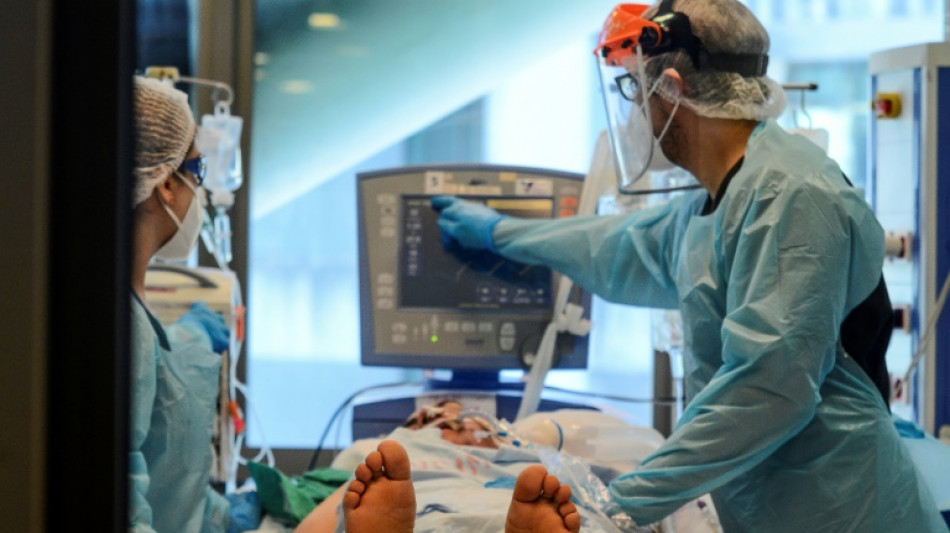
Why does your life flash before your eyes near death? / Photo: © AFP/File

 Stocks rise on AI buzz, oil prices cool
 India narrowly survive huge scare against minnows Japan

 Missing F-35 fighter parts 'not sensitive', says Australia minister

 Cambodia showcases scams crackdown with global conference
 Afghan cyclist who disguised herself as man wins Asian Games silver

 Typhoon Dujuan leaves four dead in Japan, 45,000 houses without power

 G7 leaders condemn Houthi strikes on Saudi Arabia

 Google data centre sparks protests in Austria

 Shin Ohashi: Junk food-loving teen and Japan's next big swimming hope

 Stocks rise on AI buzz, drop in oil prices

 China's robot dancers limber up for America's Got Talent final

 Despite military might, Saudi struggles to crush the Houthis

 Trump to tout deals, defend Iran war in UN speech

 Sri Lanka to issue verdict in landmark Easter attack trial

 No green light to lift EU sanctions on Russian oligarchs, talks to resume

 UK agrees support for Saudi in struggle with Houthis: reports

 EU foreign policy chief calls for continued sanctions on Russia

 Flights scrapped, evacuations urged as Typhoon Dujuan wallops Japan

 Fonseca to take break from tennis

 A Cuban zoo, and its animals, in epic battle for survival

 Infantino proposes consulting federations to reform FIFA

 El Nino weather pattern enters record territory: scientist

 OpenAI calls for US to lead global effort on AI standards

 South African ostriches plucked alive for luxury fashion: report

 US networks halt Trump coverage in revolt over White House ban

Survivors of close calls with death often recall extraordinary experiences: seeing light at the end of a tunnel, floating outside their own bodies, encountering deceased loved ones or recapping major life events in an instant.
The fact that these stories share so many elements in common and come from people from diverse cultural backgrounds points to a possible biological mechanism -- one that has yet to be de-mystified by scientists.
In a new paper published Monday in the Proceedings of the National Academy of Science (PNAS), researchers at the University of Michigan found evidence of surges in brain activity associated with consciousness in two dying patients.
While not the first study of its kind, what sets the new research apart is that it's detailed in a way "that's never been done before," senior author Jimo Borjigin, whose lab is devoted to understanding the neurological basis of consciousness, told AFP.
The team looked back at the records of four patients who died from cardiac arrest while on electroencephalogram (EEG) monitoring.
All four fell into comas and were removed from life support after it was determined they were beyond medical help.
When taken off their ventilators, two of the four patients -- a 24-year-old woman and a 77-year-old woman -- saw increases in their heart rates as well as surges of brain waves in the gamma frequency -- the fastest such brain activity, which is associated with consciousness.
Earlier studies -- including a prominent paper published in 2022 about an 87-year-old man who died from a fall -- have also found spikes in gamma waves in some people near the point of death.
The University of Michigan paper went further by examining in greater depth which parts of the brain lit up, with the activity detected in the "posterior cortical hot zone" -- comprised of the temporal, parietal and occipital lobes, which are associated with changes in consciousness.
"If this part of the brain lights up, that means the patient is seeing something, can hear something, and they might feel sensations out of the body," said Borjigin, adding that the region was "on fire."
Brain and heart activity were monitored, second by second, for the last few hours of the patients' life, contributing to the strength of the analysis, she added.
It's not clear why two of the patients experienced these potential signs of "covert consciousness" while two did not, though Borjigin speculated their history of seizures might have primed their brains in some way.
Owing to the small sample size, the authors cautioned against making wide-ranging inferences.
What's more, it's not possible to confirm that the patients really had any visions as they did not live to tell the tale.
Borjigin hopes in the future to collect data on hundreds more people -- increasing the chances that some will actually survive.
One way to do so might be to create an experiment that simulates a near-death experience while the patient is being monitored under lab conditions.
O.Krause--BTB