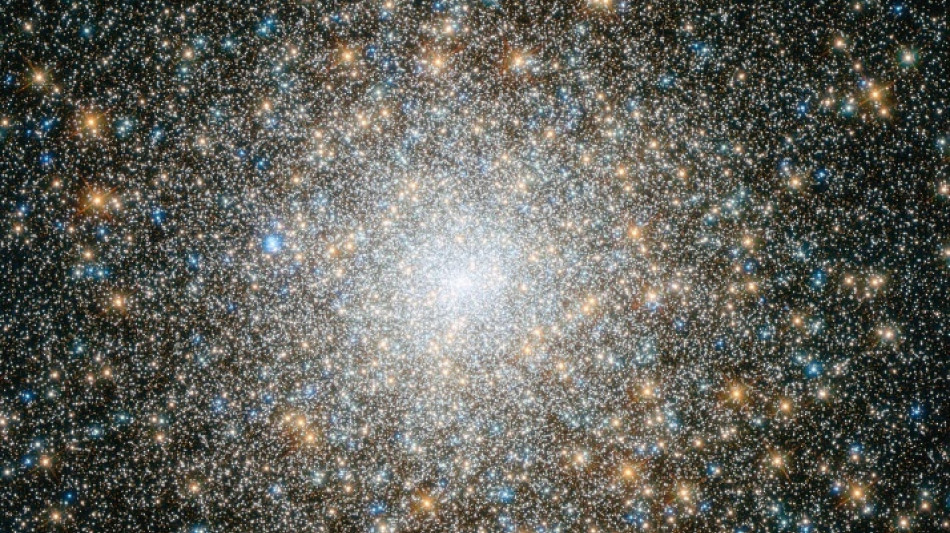
Webb telescope spots signs of universe's biggest stars / Photo: © ESA/HUBBLE/AFP/File

 Newcomers South Korea face holders Italy in Davis Cup finals

 Japan's Kojima sounds Marchand warning with Asian Games gold

 England rugby star Pollock signs new Northampton deal

 STARTRADER Expands Its Chinese Equity CFD Range with CXMT and Unitree Robotics

 MEXC Expands Opportunity Compass with Stock Trading Handbook to Help Crypto Users Build Investment Knowledge

 England paceman Wood retires from international cricket

 Magnificent Mandhana's 79 helps India to Asian Games cricket gold

 Marchand 'stressed' about racing Japanese rivals at LA Olympics

 Mobile boat clinics bring healthcare to India's remote islands

 Former India paceman Zaheer Khan named Chennai coach in IPL

 Six-year-old Chinese girl sets world record with Rubik's Cube

 Swimming prodigy Yu, 13, says 'interviews way harder than racing'

 Star coaches make their bows as Nations League returns

 Rams bounce back as Giants reel from Dart injury

 In Bangladesh, Pakistan's Jinnah photo stirs anger

 Two New Zealand naval ships transit Taiwan Strait

 Zidane gets down to work as France start new era

 Inside the Venezuelan prison meant to 'drive you insane'

 UK king braces as memoir by Diana's brother goes on sale

 Akkodis and Hamburg Public Transport Association Showcase hvv mia at InnoTrans 2026, Demonstrating the Future of AI-Powered Mobility

 Macron says talks with Trump on Red Sea, Ukraine 'constructive'

 Green policies just good politics, says UK minister

 Bardot auction in Paris fetches nearly one million euros

 No timeline on Daniels injury return, says Commanders coach

 British Columbia sues OpenAI in US court over Canada school shooting

The James Webb Space Telescope has helped astronomers detect the first chemical signs of supermassive stars, "celestial monsters" blazing with the brightness of millions of Suns in the early universe.
So far, the largest stars observed anywhere have a mass of around 300 times that of our Sun.
But the supermassive star described in a new study has an estimated mass of 5,000 to 10,000 Suns.
The team of European researchers behind the study previously theorised the existence of supermassive stars in 2018 in an attempt to explain one of the great mysteries of astronomy.
For decades, astronomers have been baffled by the huge diversity in the composition of different stars packed into what are called globular clusters.
The clusters, which are mostly very old, can contain millions of stars in a relatively small space.
Advances in astronomy have revealed an increasing number of globular clusters, which are thought to be a missing link between the universe's first stars and first galaxies.
Our Milky Way galaxy, which has more than 100 billion stars, has around 180 globular clusters.
But the question remains: Why do the stars in these clusters have such a variety of chemical elements, despite presumably all being born around the same time, from the same cloud of gas?
- Rampaging 'seed star' -
Many of the stars have elements that would require colossal amounts of heat to produce, such as aluminium which would need a temperature of up to 70 million degrees Celsius.
That is far above the temperature that the stars are thought to get up to at their core, around the 15-20 million Celsius mark which is similar to the Sun.
So the researchers came up with a possible solution: a rampaging supermassive star shooting out chemical "pollution".
They theorise that these huge stars are born from successive collisions in the tightly packed globular clusters.
Corinne Charbonnel, an astrophysicist at the University of Geneva and lead author of the study, told AFP that "a kind of seed star would engulf more and more stars".
It would eventually become "like a huge nuclear reactor, continuously feeding on matter, which will eject out a lot of it," she added.
This discarded "pollution" will in turn feed young forming stars, giving them a greater variety of chemicals the closer they are to the supermassive star, she added.
But the team still needed observations to back up their theory.
- 'Like finding a bone' -
They found them in the galaxy GN-z11, which is more than 13 billion light years away -- the light we see from it comes from just 440 million years after the Big Bang.
It was discovered by the Hubble Space Telescope in 2015, and until recently held the record of oldest observed galaxy.
This made it an obvious early target for Hubble's successor as most powerful space telescope, the James Webb, which started releasing its first observations last year.
Webb offered up two new clues: the incredible density of stars in globular clusters and -- most crucially -- the presence of lots of nitrogen.
It takes truly extreme temperatures to make nitrogen, which the researchers believe could only be produced by a supermassive star.
"Thanks to the data collected by the James Webb Space Telescope, we believe we have found a first clue of the presence of these extraordinary stars," Charbonnel said in a statement, which also called the stars "celestial monsters".
If the team's theory was previously "a sort of footprint of our supermassive star, this is a bit like finding a bone," Charbonnel said.
"We are speculating about the head of the beast behind all this," she added.
But there is little hope of ever directly observing this beast.
The scientists estimate that the life expectancy of supermassive stars is only around two million years -- a blink of an eye in the cosmic time scale.
However they suspect that globular clusters were around until roughly two billion years ago, and they could yet reveal more traces of the supermassive stars they may have once hosted.
The study was published in the journal Astronomy and Astrophysics this month.
M.Ouellet--BTB