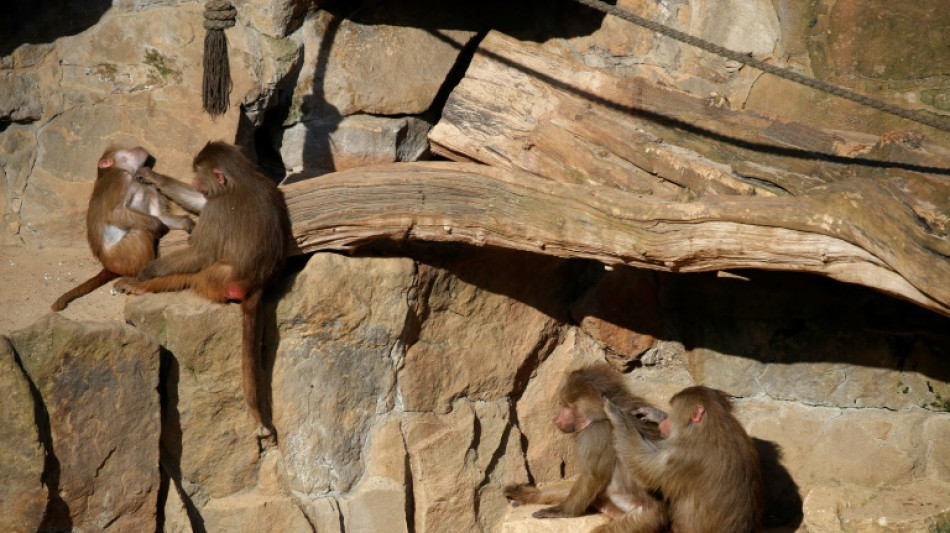
Adult friends help baboons conquer childhood trauma / Photo: © AFP

 Newcomers South Korea face holders Italy in Davis Cup finals

 Japan's Kojima sounds Marchand warning with Asian Games gold

 England rugby star Pollock signs new Northampton deal

 STARTRADER Expands Its Chinese Equity CFD Range with CXMT and Unitree Robotics

 MEXC Expands Opportunity Compass with Stock Trading Handbook to Help Crypto Users Build Investment Knowledge

 England paceman Wood retires from international cricket

 Magnificent Mandhana's 79 helps India to Asian Games cricket gold

 Marchand 'stressed' about racing Japanese rivals at LA Olympics

 Mobile boat clinics bring healthcare to India's remote islands

 Former India paceman Zaheer Khan named Chennai coach in IPL

 Six-year-old Chinese girl sets world record with Rubik's Cube

 Swimming prodigy Yu, 13, says 'interviews way harder than racing'

 Star coaches make their bows as Nations League returns

 Rams bounce back as Giants reel from Dart injury

 In Bangladesh, Pakistan's Jinnah photo stirs anger

 Two New Zealand naval ships transit Taiwan Strait

 Zidane gets down to work as France start new era

 Inside the Venezuelan prison meant to 'drive you insane'

 UK king braces as memoir by Diana's brother goes on sale

 Akkodis and Hamburg Public Transport Association Showcase hvv mia at InnoTrans 2026, Demonstrating the Future of AI-Powered Mobility

 Macron says talks with Trump on Red Sea, Ukraine 'constructive'

 Green policies just good politics, says UK minister

 Bardot auction in Paris fetches nearly one million euros

 No timeline on Daniels injury return, says Commanders coach

 British Columbia sues OpenAI in US court over Canada school shooting

Like humans, baboons get by with a little help from their friends.
Forming close social bonds as adults helps the primates triumph over childhood adversity and live longer, according to a new study.
The paper, published in Science Advances on Wednesday, drew on 36 years of data from nearly 200 of the Old World monkeys in the Amboseli National Park, in southern Kenya.
"It's like the saying from the King James Apocrypha, 'a faithful friend is the medicine of life,'" senior author Susan Alberts, a professor of biology and evolutionary anthropology at Duke University, said in a statement.
Baboons who had challenging youths were able to reclaim two years of life expectancy by forming close friendships, the study showed.
Research in humans has found that people who experience early trauma, such as having an alcoholic parent or growing up in an abusive home, are more likely to face an early grave.
But because these experiences are subjective and people's memories of the past are imperfect, wild primates, which share more than 90 percent of our DNA, are thought to be useful study subjects for better understanding humans.
For their research, Alberts and her co-authors focused on female baboons and tracked exposures to sources of childhood hardships, such as being born to a low-ranking mother, losing their mother young, being a drought year baby, or having to compete with many siblings for parental attention.
They found that the effect of such hardships was cumulative, with each additional exposure translating to 1.4 years of life lost.
And the impact wasn't just because such events led to greater social isolation as adults, as had been previously hypothesized. Rather, the survival dip was independently attributable to effects of early adversity.
But that didn't mean that baboons born under an unlucky star were destined to live short, miserable lives.
"Females who have bad early lives are not doomed," said first author Elizabeth Lange, an assistant professor at SUNY Oswego.
The team found that baboons who formed strong friendships, as measured by how often they groomed their closest associates, restored 2.2 years to their lives, regardless of early hardships.
"If you did have early life adversity, whatever you do, try to make friends," said Alberts.
W.Lapointe--BTB