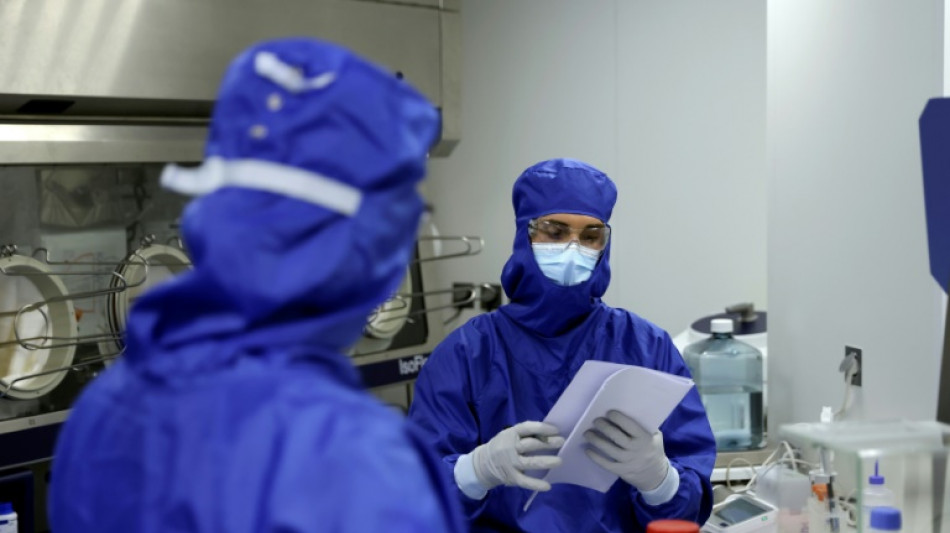
Treatment found to reduce progression of rare blood cancer by 74% / Photo: © AFP/File

 Newcomers South Korea face holders Italy in Davis Cup finals

 Japan's Kojima sounds Marchand warning with Asian Games gold

 England rugby star Pollock signs new Northampton deal

 STARTRADER Expands Its Chinese Equity CFD Range with CXMT and Unitree Robotics

 MEXC Expands Opportunity Compass with Stock Trading Handbook to Help Crypto Users Build Investment Knowledge

 England paceman Wood retires from international cricket

 Magnificent Mandhana's 79 helps India to Asian Games cricket gold

 Marchand 'stressed' about racing Japanese rivals at LA Olympics

 Mobile boat clinics bring healthcare to India's remote islands

 Former India paceman Zaheer Khan named Chennai coach in IPL

 Six-year-old Chinese girl sets world record with Rubik's Cube

 Swimming prodigy Yu, 13, says 'interviews way harder than racing'

 Star coaches make their bows as Nations League returns

 Rams bounce back as Giants reel from Dart injury

 In Bangladesh, Pakistan's Jinnah photo stirs anger

 Two New Zealand naval ships transit Taiwan Strait

 Zidane gets down to work as France start new era

 Inside the Venezuelan prison meant to 'drive you insane'

 UK king braces as memoir by Diana's brother goes on sale

 Akkodis and Hamburg Public Transport Association Showcase hvv mia at InnoTrans 2026, Demonstrating the Future of AI-Powered Mobility

 Macron says talks with Trump on Red Sea, Ukraine 'constructive'

 Green policies just good politics, says UK minister

 Bardot auction in Paris fetches nearly one million euros

 No timeline on Daniels injury return, says Commanders coach

 British Columbia sues OpenAI in US court over Canada school shooting

A treatment that involves genetically modifying the body's own immune cells has been found to cut the risk of disease progression by 74 percent in people with a rare type of blood cancer, results showed Monday.
Ciltacabtagene autoleucel -- also known by its trade name Carvykti -- was tested in a clinical trial involving 419 patients with multiple myeloma, whose disease was not responsive to the current frontline drug lenalidomide, a chemotherapy medicine.
"Lenalidomide has become a foundation of care for people with myeloma, but as its use has expanded, so has the number of patients whose disease will no longer respond to the treatment," said oncologist Oreofe Odejide at the American Society of Clinical Oncology's annual meeting where results were presented.
Ciltacabtagene autoleucel "delivers remarkably effective outcomes compared to patients' current options" and "can be used safely earlier in the treatment phase," added Odejide, an expert who was not part of the research.
Multiple myeloma affects a type of white blood cells called plasma cells, and can cause cascading harms to the bones, kidneys, and immune health.
It affects seven people out of 100,000 every year, according to the Cleveland Clinic, with 100,000 people impacted in the United States. There is currently no cure, though progression can be stopped for a long time.
Risk increases with age, with men more likely to be affected than women, and Black people at higher risk than other races. Not everyone requires immediate treatment and the disease may be monitored if it is slow growing.
In the new clinical trial, half the patients were randomly assigned ciltacabtagene autoleucel, while the other half received a cocktail of drugs that represents the current standard of care, including chemotherapy and steroids.
"After a median follow-up of 16 months, the researchers found that ciltacabtagene autoleucel reduced the risk of disease progression by 74 percent, compared with the standard-of-care treatments," a press statement said.
Ciltacabtagene autoleucel is a type of chimeric antigen receptor (CAR) T-cell therapy, a newer form of treatment.
CAR T-cell therapy involves removing the patient's disease fighting T cells, and genetically engineering them in a lab so they have specific proteins known as receptors that, once returned to the body, will seek out and destroy cancer cells.
Nearly all the patients in both groups experienced severe to life-threatening adverse events, including infections and low blood cell counts.
Three-quarters of patients on ciltacabtagene autoleucel developed Cytokine release syndrome, in which the immune system is sent into overdrive. It can affect multiple organs and cause death.
Around five percent of patients on ciltacabtagene autoleucel developed immune effector cell-associated neurotoxicity syndrome (ICANS), which affects a person's nervous system.
Next, the researchers will continue to follow the study participants to determine long-term effects and impacts on quality of life.
The clinical trial was funded by Janssen Research & Development and Legend Biotech USA.
M.Furrer--BTB