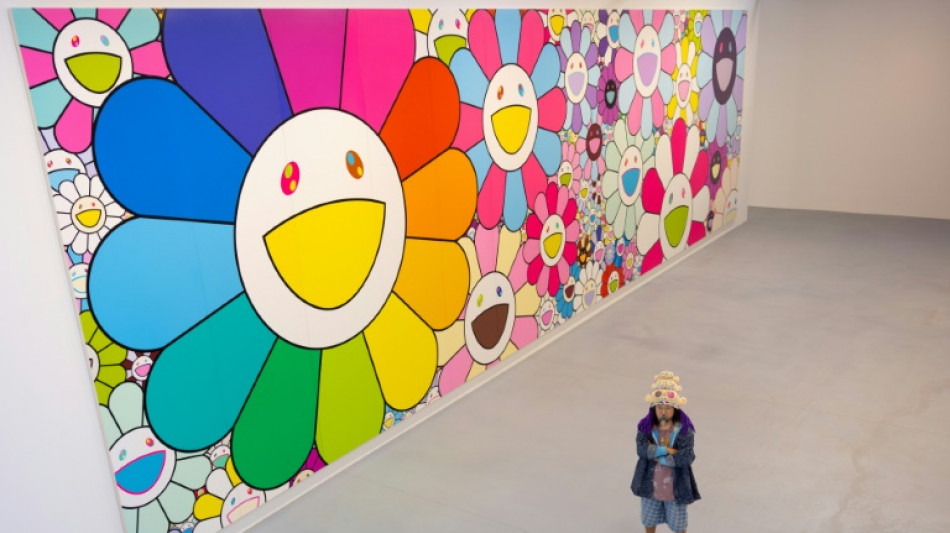
Takashi Murakami loves and fears AI / Photo: © AFP

 Newcomers South Korea face holders Italy in Davis Cup finals

 Japan's Kojima sounds Marchand warning with Asian Games gold

 England rugby star Pollock signs new Northampton deal

 STARTRADER Expands Its Chinese Equity CFD Range with CXMT and Unitree Robotics

 MEXC Expands Opportunity Compass with Stock Trading Handbook to Help Crypto Users Build Investment Knowledge

 England paceman Wood retires from international cricket

 Magnificent Mandhana's 79 helps India to Asian Games cricket gold

 Marchand 'stressed' about racing Japanese rivals at LA Olympics

 Mobile boat clinics bring healthcare to India's remote islands
 Former India paceman Zaheer Khan named Chennai coach in IPL

 Six-year-old Chinese girl sets world record with Rubik's Cube

 Swimming prodigy Yu, 13, says 'interviews way harder than racing'

 Star coaches make their bows as Nations League returns
 Rams bounce back as Giants reel from Dart injury

 In Bangladesh, Pakistan's Jinnah photo stirs anger

 Two New Zealand naval ships transit Taiwan Strait

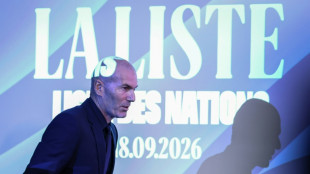 Zidane gets down to work as France start new era

 Inside the Venezuelan prison meant to 'drive you insane'

 UK king braces as memoir by Diana's brother goes on sale

 Akkodis and Hamburg Public Transport Association Showcase hvv mia at InnoTrans 2026, Demonstrating the Future of AI-Powered Mobility

 Macron says talks with Trump on Red Sea, Ukraine 'constructive'

 Green policies just good politics, says UK minister

 Bardot auction in Paris fetches nearly one million euros

 No timeline on Daniels injury return, says Commanders coach

 British Columbia sues OpenAI in US court over Canada school shooting

Neo-pop art superstar Takashi Murakami has always embraced new technology and was an early adopter of crypto and NFTs, but even he admits fearing that AI might make him obsolete.
Murakami, 61, has become a brand unto himself thanks to his loveable technicolour paintings that mix traditional Japanese art motifs with modern anime and manga.
His paintings have sold for millions of dollars, led to fashion collaborations with Louis Vuitton and Kanye West, and been shown at some of the world's great institutions, prized as insightful commentary on the fine line between art and commerce.
It has not always made him popular with Japan's art establishment, but Murakami likes being a disruptor.
He sees another wave of change coming thanks to AI-powered software.
"The generational change will be dramatic," he told AFP at the opening of a new exhibition at the Gagosian gallery on the outskirts of Paris.
It reminds him of the arrival of the Apple II computer in the 1980s that swept away an older generation of design professionals, but empowered those who embraced it.
"AI will certainly do damage to technical trades but I don't think it will be able to block our ideas," he said.
"The wackiest ideas, those that even AI cannot generate, will become even more valuable."
That does mean power perhaps shifting from artists to tech engineers, who will be able to explore things that are hard to imagine at the moment.
"Artists who create familiar things will be left behind," he said.
"I myself work with a certain kind of fear of one day being replaced."
- 'Not very appreciated' -
Ironically, Murakami says he was touched to finally receive some praise from a more traditional part of Japanese society with his recent work in homage to Kabuki theatre.
He spoke to AFP in front of an enormous 23-metres-long by 5-metres-high fresco that tells a Kabuki narrative in his dazzling, cartoonish style.
"I'm not very appreciated in Japan," he said, wearing Bermuda shorts and a jacket adorned with his famous smiling flowers.
"My reputation is fairly bad because I'm seen as presenting a false image of Japanese culture to the rest of the world.
"This is the first time I was welcomed in this way in Japan. I was very pleased."
- 'A new continent' -
Nonetheless, his commitment to technological change is clear.
Visitors to Saturday's gallery opening -- requiring some dedication since it was hidden away among the private jet hangars near Charles de Gaulle airport -- were set to receive an NFT of a flower-adorned virtual coin.
The show includes a wall of NFT-style pixelated portraits that draw a line from Karl Marx and Adam Smith to current tech honchos Vitalik Buterin and Elon Musk.
Like all his work, they are deceptively simple, seemingly printed, yet in fact painstakingly painted by hand and then lacquered to remove any sign of human involvement and create his renowned "Superflat" aesthetic.
He sees this work as building a bridge between traditional and digital art, but admits they can be a hard sell.
"Collectors who have been fans of mine for a long time clearly have some trouble with these pixelated drawings," he said.
"But I created my works following Japanese or Eastern styles, not Western, and I consider pixel art to be a sort of representation of Japanese culture from the video games of the 1970s."
The world of crypto is "like a new continent" still being discovered.
"It will take several more years for people to get used to it," he said.
C.Kovalenko--BTB