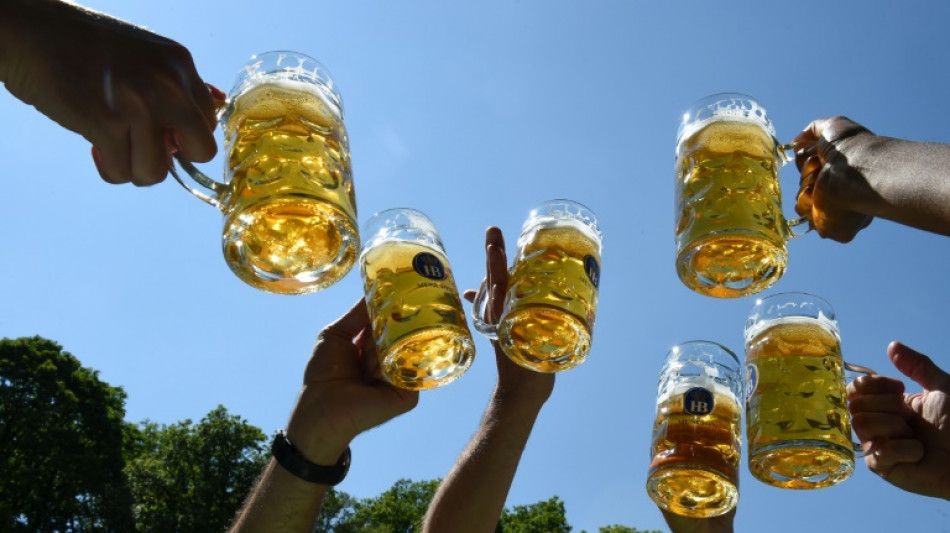
Scientists explain why peanuts 'dance' when dropped in beer / Photo: © AFP/File

 Newcomers South Korea face holders Italy in Davis Cup finals

 Japan's Kojima sounds Marchand warning with Asian Games gold

 England rugby star Pollock signs new Northampton deal

 STARTRADER Expands Its Chinese Equity CFD Range with CXMT and Unitree Robotics

 MEXC Expands Opportunity Compass with Stock Trading Handbook to Help Crypto Users Build Investment Knowledge

 England paceman Wood retires from international cricket

 Magnificent Mandhana's 79 helps India to Asian Games cricket gold

 Marchand 'stressed' about racing Japanese rivals at LA Olympics
 Mobile boat clinics bring healthcare to India's remote islands
 Former India paceman Zaheer Khan named Chennai coach in IPL

 Six-year-old Chinese girl sets world record with Rubik's Cube
 Swimming prodigy Yu, 13, says 'interviews way harder than racing'

 Star coaches make their bows as Nations League returns

 Rams bounce back as Giants reel from Dart injury

 In Bangladesh, Pakistan's Jinnah photo stirs anger

 Two New Zealand naval ships transit Taiwan Strait

 Zidane gets down to work as France start new era

 Inside the Venezuelan prison meant to 'drive you insane'

 UK king braces as memoir by Diana's brother goes on sale

 Akkodis and Hamburg Public Transport Association Showcase hvv mia at InnoTrans 2026, Demonstrating the Future of AI-Powered Mobility

 Macron says talks with Trump on Red Sea, Ukraine 'constructive'

 Green policies just good politics, says UK minister

 Bardot auction in Paris fetches nearly one million euros

 No timeline on Daniels injury return, says Commanders coach

 British Columbia sues OpenAI in US court over Canada school shooting

When peanuts are dropped into a pint of beer, they initially sink to the bottom before floating up and "dancing" in the glass.
Scientists have dug deep seeking to investigate this phenomenon in a new study published on Wednesday, saying it has implications for understanding mineral extraction or bubbling magma in the Earth's crust.
Brazilian researcher Luiz Pereira, the study's lead author, told AFP that he first had the idea when passing through Argentina's capital Buenos Aires to learn Spanish.
It was a "bartender thing" in the city to take a few peanuts and pop them into beers, Pereira said.
Because the peanuts are denser than the beer, they first sink down to the bottom of the glass.
Then each peanut becomes what is called a "nucleation site". Hundreds of tiny bubbles of carbon dioxide form on their surface, acting as buoys to drag them upwards.
"The bubbles prefer to form on the peanuts rather than on the glass walls," explained Pereira, a researcher at Germany's Ludwig Maximilian University of Munich.
When the bubbles reach the surface, they burst.
The peanuts then dive down before being propelled up again by freshly formed bubbles, in a dance that continues until the carbon dioxide runs out -- or someone interrupts by drinking the beer.
In a series of experiments, the team of researchers in Germany, Britain and France examined how roasted, shelled peanuts fared in a lager-style beer.
- Next up: more beers -
The study, published in the journal Royal Society Open Science, describes two key factors in what the researchers dubbed the "beer–gas–peanut system".
They found that the larger the "contact angle" between the curve of an individual bubble and the surface of the peanut was, the more likely it was to form and grow.
But it cannot grow too much -- a radius of under 1.3 millimetres is ideal, the study said.
Pereira said he hoped that "by deeply researching this simple system, which everyone can grasp, we can understand a system" that would be useful for industry or explaining natural phenomena.
For example, he said the floatation process was similar to the one used to separate iron from ore.
Air is injected, in a controlled way, into a mixture in which a mineral -- such as iron -- "will rise because bubbles attach themselves more easily to it, while other (minerals) sink to the bottom," he said.
The same process could also explain why volcanologists find that the mineral magnetite rises to higher layers in the crystallised magma of the Earth's crust than would be expected.
Like peanuts, magnetite is denser, so should sit at the bottom. But due to a high contact angle, the researchers theorise, the mineral rises through the magma with help from gas bubbles.
Of course, science is never settled -- particularly when beer is involved.
Hoping to create a better model of the dancing peanut phenomenon, Pereira said the scientists will continue to "play with the characteristics of different peanuts and different beers".
I.Meyer--BTB