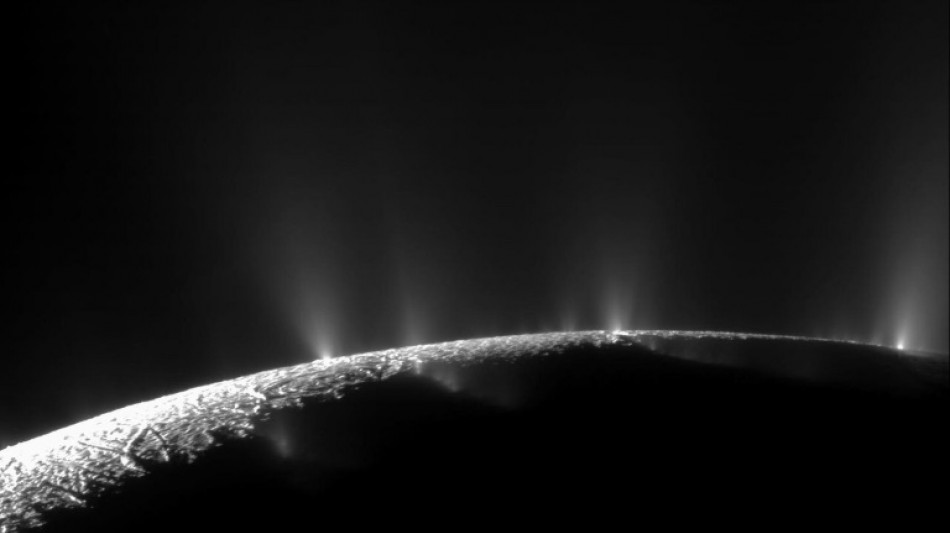
NASA finds key building block for life in a moon of Saturn / Photo: © NASA/AFP

 Newcomers South Korea face holders Italy in Davis Cup finals

 Japan's Kojima sounds Marchand warning with Asian Games gold

 England rugby star Pollock signs new Northampton deal

 STARTRADER Expands Its Chinese Equity CFD Range with CXMT and Unitree Robotics

 MEXC Expands Opportunity Compass with Stock Trading Handbook to Help Crypto Users Build Investment Knowledge

 England paceman Wood retires from international cricket

 Magnificent Mandhana's 79 helps India to Asian Games cricket gold

 Marchand 'stressed' about racing Japanese rivals at LA Olympics

 Mobile boat clinics bring healthcare to India's remote islands

 Former India paceman Zaheer Khan named Chennai coach in IPL

 Six-year-old Chinese girl sets world record with Rubik's Cube

 Swimming prodigy Yu, 13, says 'interviews way harder than racing'

 Star coaches make their bows as Nations League returns

 Rams bounce back as Giants reel from Dart injury

 In Bangladesh, Pakistan's Jinnah photo stirs anger

 Two New Zealand naval ships transit Taiwan Strait

 Zidane gets down to work as France start new era

 Inside the Venezuelan prison meant to 'drive you insane'

 UK king braces as memoir by Diana's brother goes on sale

 Akkodis and Hamburg Public Transport Association Showcase hvv mia at InnoTrans 2026, Demonstrating the Future of AI-Powered Mobility

 Macron says talks with Trump on Red Sea, Ukraine 'constructive'

 Green policies just good politics, says UK minister

 Bardot auction in Paris fetches nearly one million euros

 No timeline on Daniels injury return, says Commanders coach

 British Columbia sues OpenAI in US court over Canada school shooting

The long hunt for extraterrestrials just got a big boost.
Scientists have discovered that phosphorus, a key building block of life, lies in the ocean beneath the icy surface of Saturn's moon Enceladus.
The finding was based on a review of data collected by NASA's Cassini probe, and was published Wednesday in the prestigious journal Nature.
Cassini started exploring Saturn and its rings and moons in 2004, before burning up in the gas giant's atmosphere when its mission ended in 2017.
"This is a stunning discovery for astrobiology," said Christopher Glein of the Southwest Research Institute, one of the paper's co-authors, adding: "We have found abundant phosphorus in plume ice samples spraying out of the subsurface ocean."
Geysers on Enceladus' south pole spew icy particles through cracks on the surface out into space, feeding Saturn's E ring -- the faint ring outside the brighter main rings.
Scientists previously found other minerals and organic compounds in the ejected ice grains, but not phosphorus, which is an essential building block for DNA and RNA, and is also found in the bones and teeth of people, animals, and even ocean plankton.
Simply put, life as we know it would not be possible without phosphorus.
While geochemical modeling had previously found it was likely phosphorus would also be present, and this prediction was published in an earlier paper, it is one thing to forecast something and another to confirm, said Glein.
"It's the first time this essential element has been discovered in an ocean beyond Earth," added first author Frank Postberg, a planetary scientist at Freie Universitat Berlin, in a NASA statement.
To make the new discovery, authors combed through data collected by Cassini's Cosmic Dust Analyzer instrument, and confirmed the findings by carrying out laboratory experiments to show that Enceladus' ocean has phosphorus bound inside different water-soluble forms.
Over the past 25 years, planetary scientists have discovered that worlds with oceans beneath a surface layer of ice are common in our solar system.
These include Jupiter's moon Europa, Saturn's largest moon Titan, but even the more distant body, Pluto.
While planets like Earth that have surface oceans need to reside within a narrow window of distance from their host star to maintain the right temperatures for life, the discovery of worlds with subsurface oceans expands the number of habitable bodies that might exist.
"With this finding, the ocean of Enceladus is now known to satisfy what is generally considered to be the strictest requirement for life," said Glein.
"The next step is clear –- we need to go back to Enceladus to see if the habitable ocean is actually inhabited."
S.Keller--BTB