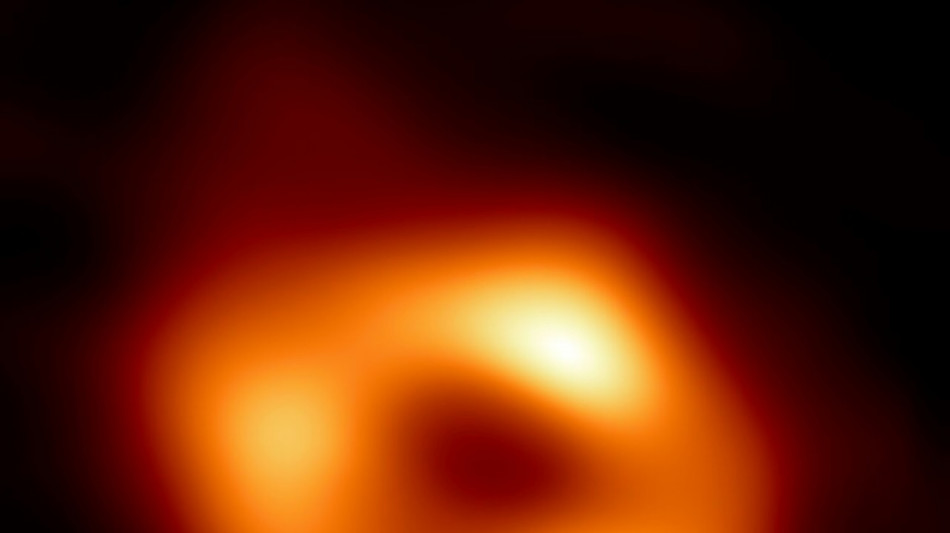
Our galaxy's black hole not as sleepy as thought: astronomers / Photo: © European Southern Observatory/AFP/File

 Newcomers South Korea face holders Italy in Davis Cup finals

 Japan's Kojima sounds Marchand warning with Asian Games gold

 England rugby star Pollock signs new Northampton deal

 STARTRADER Expands Its Chinese Equity CFD Range with CXMT and Unitree Robotics

 MEXC Expands Opportunity Compass with Stock Trading Handbook to Help Crypto Users Build Investment Knowledge

 England paceman Wood retires from international cricket

 Magnificent Mandhana's 79 helps India to Asian Games cricket gold

 Marchand 'stressed' about racing Japanese rivals at LA Olympics

 Mobile boat clinics bring healthcare to India's remote islands

 Former India paceman Zaheer Khan named Chennai coach in IPL

 Six-year-old Chinese girl sets world record with Rubik's Cube

 Swimming prodigy Yu, 13, says 'interviews way harder than racing'

 Star coaches make their bows as Nations League returns

 Rams bounce back as Giants reel from Dart injury

 In Bangladesh, Pakistan's Jinnah photo stirs anger

 Two New Zealand naval ships transit Taiwan Strait

 Zidane gets down to work as France start new era

 Inside the Venezuelan prison meant to 'drive you insane'

 UK king braces as memoir by Diana's brother goes on sale

 Akkodis and Hamburg Public Transport Association Showcase hvv mia at InnoTrans 2026, Demonstrating the Future of AI-Powered Mobility

 Macron says talks with Trump on Red Sea, Ukraine 'constructive'

 Green policies just good politics, says UK minister

 Bardot auction in Paris fetches nearly one million euros

 No timeline on Daniels injury return, says Commanders coach

 British Columbia sues OpenAI in US court over Canada school shooting

The supermassive black hole lurking at the centre of our Milky Way galaxy is not as dormant as had been thought, a new study shows.
The slumbering giant woke up around 200 years ago to gobble up some nearby cosmic objects before going back to sleep, according to the study published in the journal Nature on Wednesday.
NASA's IXPE space observatory spotted an x-ray echo of this powerful resurgence of activity, the researchers said.
The supermassive black hole Sagittarius A* -- abbreviated to Sgr A* -- is four million times more massive than the Sun. It sits 27,000 light years from Earth at the centre of the Milky Way's spiral.
Last year astronomers revealed the first-ever image of the black hole -- or rather, the glowing ring of gas that surrounds its blackness.
Sgr A* has "always been seen as a dormant black hole," said Frederic Marin, a researcher at France's Strasbourg Astronomical Observatory and the study's first author.
Most supermassive black holes squatting at the middle of their galaxies go dormant after swallowing up all the nearby matter.
"Imagine a bear going into hibernation after devouring everything around it," Marin told AFP.
But the international team of researchers discovered that at around the end of the 19th century, Sgr A* came out of its slumber and consumed any gas and dust unlucky enough to be within its reach.
The feeding frenzy lasted from several months to a year, before the beast went back into hibernation.
- Million times brighter -
When it was active, the black hole was "at least a million times brighter than it is today," Marin said.
Its awakening was noticable because nearby galactic molecular clouds started giving off vastly more x-ray light.
The surge in x-ray light was as "if a single glow-worm hidden in a forest suddenly became as bright as the Sun," French research agency CNRS said in a statement.
Astronomers using NASA's IXPE (Imaging X-ray Polarimetry Explorer) space observatory managed to track the x-ray light and found that it pointed straight back at Sgr A*.
The black hole "emitted an echo of its past activity, which we managed to observe for the first time," Marin said.
The pull of gravity from black holes is so intense that nothing can escape, including light.
But when matter is sucked beyond the black hole's final boundary, known as the event horizon, it emits a massive amount of heat and light before disappearing into the darkness.
Exactly what caused Sgr A* to briefly emerge from its dormant state remains unclear. Could a star or cloud of gas and dust have ventured too close?
The astronomers hope that further observations from the IXPE observatory will help them better understand what happened -- and perhaps reveal more about the origin of supermassive black holes, which remains shrouded in mystery.
M.Furrer--BTB