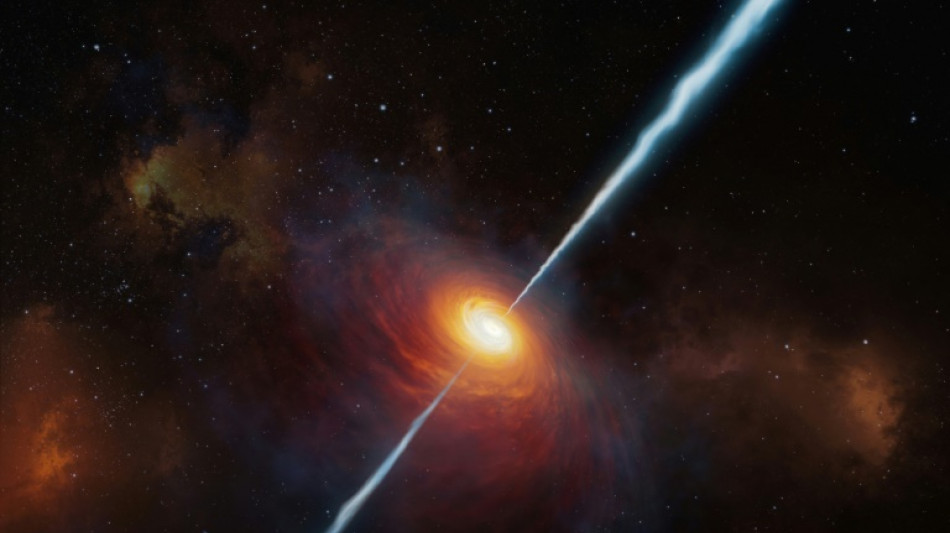
Time appears five times slower in early universe: study / Photo: © European Southern Observatory/AFP/File

 Newcomers South Korea face holders Italy in Davis Cup finals

 Japan's Kojima sounds Marchand warning with Asian Games gold

 England rugby star Pollock signs new Northampton deal

 STARTRADER Expands Its Chinese Equity CFD Range with CXMT and Unitree Robotics

 MEXC Expands Opportunity Compass with Stock Trading Handbook to Help Crypto Users Build Investment Knowledge

 England paceman Wood retires from international cricket

 Magnificent Mandhana's 79 helps India to Asian Games cricket gold

 Marchand 'stressed' about racing Japanese rivals at LA Olympics

 Mobile boat clinics bring healthcare to India's remote islands

 Former India paceman Zaheer Khan named Chennai coach in IPL

 Six-year-old Chinese girl sets world record with Rubik's Cube

 Swimming prodigy Yu, 13, says 'interviews way harder than racing'

 Star coaches make their bows as Nations League returns

 Rams bounce back as Giants reel from Dart injury

 In Bangladesh, Pakistan's Jinnah photo stirs anger

 Two New Zealand naval ships transit Taiwan Strait

 Zidane gets down to work as France start new era

 Inside the Venezuelan prison meant to 'drive you insane'

 UK king braces as memoir by Diana's brother goes on sale

 Akkodis and Hamburg Public Transport Association Showcase hvv mia at InnoTrans 2026, Demonstrating the Future of AI-Powered Mobility

 Macron says talks with Trump on Red Sea, Ukraine 'constructive'

 Green policies just good politics, says UK minister

 Bardot auction in Paris fetches nearly one million euros

 No timeline on Daniels injury return, says Commanders coach

 British Columbia sues OpenAI in US court over Canada school shooting
Time appears to run five times slower in the early universe, scientists said on Monday, for the first time using extraordinarily bright cosmic objects called quasars as "clocks" to confirm this strange phenomenon.
Einstein's theory of relativity predicts that because space is expanding, "we should see the distant universe run in slow motion," said Geraint Lewis, an astrophysicist at the University of Sydney and the lead author of a new study.
Researchers had previously used observations of very bright exploding stars called supernovas as cosmic clocks to show that time ran twice as slowly back when the universe was half its current age.
The new study used even brighter quasars to peer further back into the history of the 13.8-billion-year-old universe.
Just over a billion years after the Big Bang, time appeared to flow five times slower, according to the study in the journal Nature Astronomy.
While "everything looks like it's slowed down" from here, Lewis emphasised that the experience of time in these distant places was not different.
"If I could magically transport you back 10 billion years and drop you next to one of these quasars, and you've got a stopwatch, time would just be normal," he told AFP.
"One second would be one second."
- Cosmic clocks -
Aiming to measure this phenomenon, which is called cosmological time dilation, Lewis and University of Auckland statistician Brendon Brewer analysed data from 190 quasars collected over two decades.
Quasars -- supermassive black holes at the centres of distant galaxies -- are thought to be the brightest and most powerful objects in the universe.
This makes them "useful beacons for charting the universe," Lewis said.
But they have proved more difficult to turn into cosmic clocks than supernovas, which provide a reliable single flash as a "tick".
Previous attempts to use quasars to measure time dilation had failed, leading to some "strange suggestions," Lewis said.
These included theories that perhaps quasars were not as distant as had been thought -- or even that "something fundamental was broken" in cosmology, he said.
But the new research "puts everything back in the right place," Lewis said.
It also confirmed that "Einstein is right again," he added.
The researchers were able to succeed where other attempts had fallen short because they had far more data on quasars, according to Lewis. Recent advances in the statistical understanding of randomness also helped.
To turn quasars into clocks with measurable ticks, the researchers had to make sense of the turbulent explosions that occurred as the black holes swallowed material.
Lewis compared it to watching a fireworks display, in which the great flashes seem random but different elements are "brightening and fading on their own kind of timescales".
"What we have done is unravel this firework display, showing that quasars, too, can be used as standard markers of time for the early universe."
A.Gasser--BTB