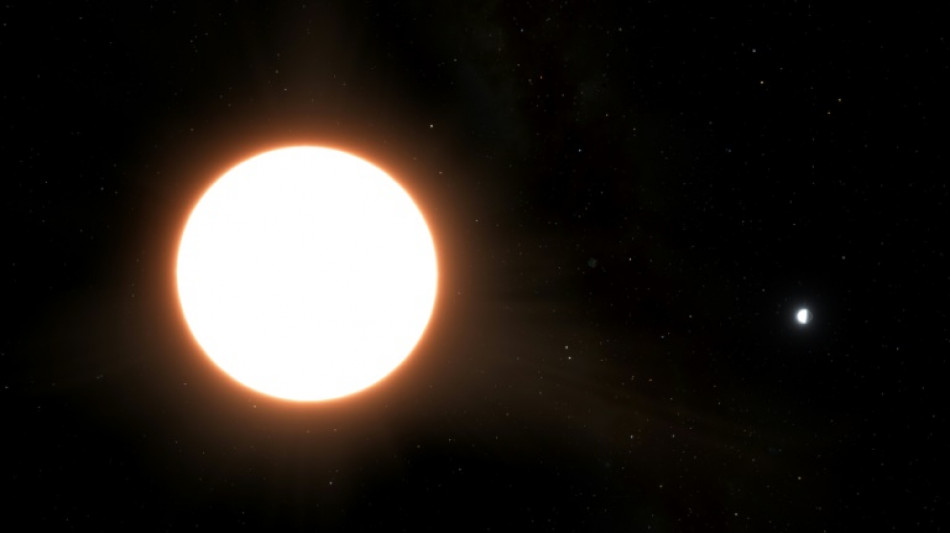
'Like a mirror': Astronomers identify most reflective exoplanet / Photo: © EUROPEAN SPACE AGENCY/AFP

 Republican senator seeks probe of Trump Jr Russian-funded wedding

 Memoir by Diana's brother goes on sale after rocking UK monarchy

 Newcomers South Korea face holders Italy in Davis Cup finals

 Japan's Kojima sounds Marchand warning with Asian Games gold

 England rugby star Pollock signs new Northampton deal

 STARTRADER Expands Its Chinese Equity CFD Range with CXMT and Unitree Robotics

 MEXC Expands Opportunity Compass with Stock Trading Handbook to Help Crypto Users Build Investment Knowledge

 England paceman Wood retires from international cricket

 Magnificent Mandhana's 79 helps India to Asian Games cricket gold

 Marchand 'stressed' about racing Japanese rivals at LA Olympics

 Mobile boat clinics bring healthcare to India's remote islands

 Former India paceman Zaheer Khan named Chennai coach in IPL

 Six-year-old Chinese girl sets world record with Rubik's Cube

 Swimming prodigy Yu, 13, says 'interviews way harder than racing'

 Star coaches make their bows as Nations League returns

 Rams bounce back as Giants reel from Dart injury

 In Bangladesh, Pakistan's Jinnah photo stirs anger

 Two New Zealand naval ships transit Taiwan Strait

 Zidane gets down to work as France start new era

 Inside the Venezuelan prison meant to 'drive you insane'

 UK king braces as memoir by Diana's brother goes on sale

 Akkodis and Hamburg Public Transport Association Showcase hvv mia at InnoTrans 2026, Demonstrating the Future of AI-Powered Mobility

 No green light to lift EU sanctions on Russian oligarchs, talks to resume

 UK agrees support for Saudi in struggle with Houthis: reports

 EU foreign policy chief calls for continued sanctions on Russia

A scorching hot world where metal clouds rain drops of titanium is the most reflective planet ever observed outside of our Solar System, astronomers said on Monday.
This strange world, which is more than 260 light years from Earth, reflects 80 percent of the light from its host star, according to new observations from Europe's exoplanet-probing Cheops space telescope.
That makes it the first exoplanet comparably shiny as Venus, which is the brightest object in our night sky other than the Moon.
First discovered in 2020, the Neptune-sized planet called LTT9779b orbits its star in just 19 hours.
Because it is so close, the side of the planet facing its star is a sizzling 2,000 degrees Celsius, which is considered far too hot for clouds to form.
Yet LTT9779b seems to have them.
"It was really a puzzle," said Vivien Parmentier, a researcher at France's Cote d'Azur Observatory and co-author of a new study in the journal Astronomy and Astrophysics.
The researchers then "realised we should think about this cloud formation in the same way as condensation forming in a bathroom after a hot shower," he said in a statement.
Like running hot water steams up a bathroom, a scorching stream of metal and silicate -- the stuff of which glass is made -- oversaturated LTT9779b's atmosphere until metallic clouds formed, he said.
- Surviving 'Neptune desert' -
The planet, which is around five times the size of Earth, is an outlier in other ways.
The only exoplanets previously found that orbit their stars in less than 24 hours are either gas giants 10 times bigger than Earth -- or rocky planets half its size.
But LTT9779b lives in a region called the "Neptune desert", where planets its size are not supposed to be found.
"It's a planet that shouldn't exist," Parmentier said.
"We expect planets like this to have their atmosphere blown away by their star, leaving behind bare rock."
The planet's metallic clouds "act like a mirror," reflecting away light and preventing the atmosphere from being blown away, according to the European Space Agency's Cheops project scientist Maximilian Guenther.
"It's a bit like a shield, like in those old Star Trek films where they have shields around their ships," he told AFP.
The research marks "a big milestone" because it shows how a Neptune-sized planet could survive in the Neptune desert, he added.
The European Space Agency's Cheops space telescope was launched into Earth's orbit in 2019 on a mission to investigate planets discovered outside our Solar System.
It measured the reflectiveness of LTT9779b by comparing the light before and after the exoplanet disappeared behind its star.
M.Furrer--BTB