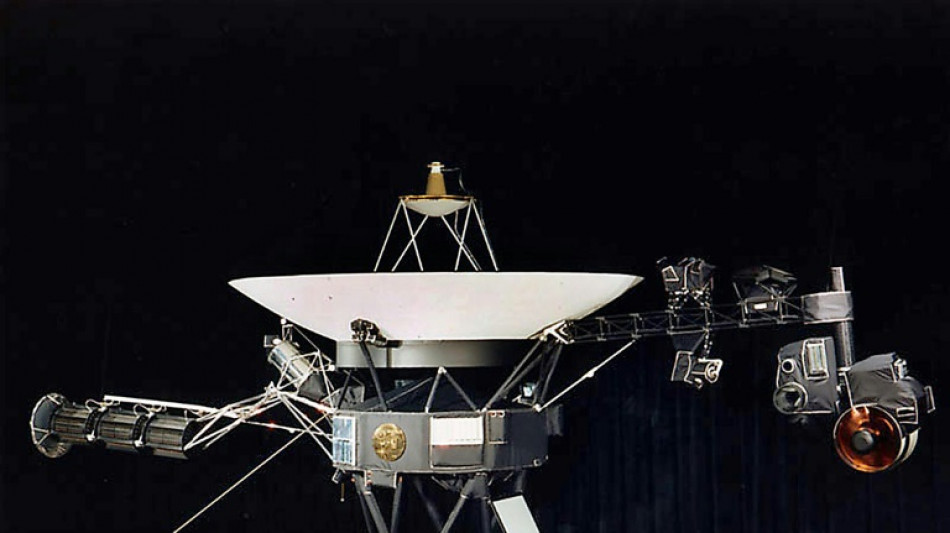
NASA hears 'heartbeat' from Voyager 2 after inadvertant blackout / Photo: © NASA/AFP/File

 Republican senator seeks probe of Trump Jr Russian-funded wedding

 Memoir by Diana's brother goes on sale after rocking UK monarchy

 Newcomers South Korea face holders Italy in Davis Cup finals

 Japan's Kojima sounds Marchand warning with Asian Games gold

 England rugby star Pollock signs new Northampton deal

 STARTRADER Expands Its Chinese Equity CFD Range with CXMT and Unitree Robotics

 MEXC Expands Opportunity Compass with Stock Trading Handbook to Help Crypto Users Build Investment Knowledge

 England paceman Wood retires from international cricket

 Magnificent Mandhana's 79 helps India to Asian Games cricket gold

 Marchand 'stressed' about racing Japanese rivals at LA Olympics

 Mobile boat clinics bring healthcare to India's remote islands

 Former India paceman Zaheer Khan named Chennai coach in IPL

 Six-year-old Chinese girl sets world record with Rubik's Cube

 Swimming prodigy Yu, 13, says 'interviews way harder than racing'

 Star coaches make their bows as Nations League returns

 Rams bounce back as Giants reel from Dart injury

 In Bangladesh, Pakistan's Jinnah photo stirs anger

 Two New Zealand naval ships transit Taiwan Strait

 Zidane gets down to work as France start new era

 Inside the Venezuelan prison meant to 'drive you insane'

 UK king braces as memoir by Diana's brother goes on sale

 Akkodis and Hamburg Public Transport Association Showcase hvv mia at InnoTrans 2026, Demonstrating the Future of AI-Powered Mobility

 No green light to lift EU sanctions on Russian oligarchs, talks to resume

 UK agrees support for Saudi in struggle with Houthis: reports

 EU foreign policy chief calls for continued sanctions on Russia

NASA's distant Voyager 2 probe has sent a "heartbeat" signal to Earth after mission control mistakenly cut contact, the US space agency said Tuesday.
Launched in 1977 to explore the outer planets and serve as a beacon of humanity to the wider universe, it is currently more than 12.3 billion miles (19.9 billion kilometers) from our planet -- well beyond the solar system.
A series of planned commands sent to Voyager 2 on July 21 "inadvertently caused the antenna to point two degrees away from Earth," NASA's Jet Propulsion Laboratory (JPL) said in a recent update.
This left it unable to transmit data or receive commands to its mission control -- a situation that was not expected to be resolved until it conducted an automated re-orientation maneuver on October 15.
But on Tuesday, Voyager project manager Suzanne Dodd told AFP the team enlisted the help of the Deep Space Network -- an international array of giant radio antennas, plus a few that orbit Earth -- in a last-ditch effort to re-establish contact sooner.
To their surprise, "this was successful in that we see the 'heartbeat' signal from the spacecraft," she said. "So we know the spacecraft is alive and operating. This buoyed our spirits."
The team is "now generating a new command to attempt to point the spacecraft antenna toward Earth," Dodd added, although she said there is only a "low probability" it will work.
Still, given October 15 is a long way away, NASA will keep trying to send up these commands.
- Golden Record -
While JPL built and operates Voyager spacecraft, the missions are now part of the NASA Heliophysics System Observatory.
Voyager 2 left the protective magnetic bubble provided by the Sun, called the heliosphere, in December 2018, and is currently traveling through the space between the stars.
Before leaving our solar system, it explored Jupiter and Saturn, and became the first and so far only spacecraft to visit Uranus and Neptune.
Voyager 1 was mankind's first spacecraft to enter the interstellar medium, in 2012, and is currently almost 15 billion miles from Earth.
Both Voyager spacecraft carry "Golden Records" -- 12-inch, gold-plated copper disks intended to convey the story of our world to extraterrestrials.
These include a map of our solar system, a piece of uranium that serves as a radioactive clock allowing recipients to date the spaceship's launch, and symbolic instructions that convey how to play the record.
The contents of the record, selected for NASA by a committee chaired by legendary astronomer Carl Sagan, include encoded images of life on Earth, as well as music and sounds that can be played using an included stylus.
For now, the Voyagers continue to transmit back scientific data, though their power banks are expected to be eventually depleted, sometime after 2025.
They will then continue to wander the Milky Way, potentially for eternity, in silence.
O.Krause--BTB