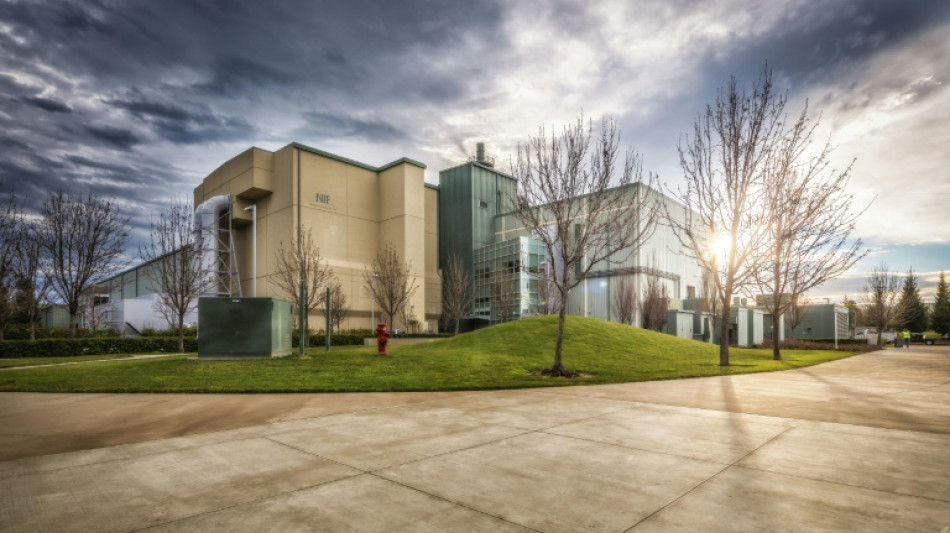
US lab repeats nuclear fusion feat, with higher yield / Photo: © Lawrence Livermore National Laboratory/AFP/File

 Republican senator seeks probe of Trump Jr Russian-funded wedding

 Memoir by Diana's brother goes on sale after rocking UK monarchy

 Newcomers South Korea face holders Italy in Davis Cup finals

 Japan's Kojima sounds Marchand warning with Asian Games gold

 England rugby star Pollock signs new Northampton deal

 STARTRADER Expands Its Chinese Equity CFD Range with CXMT and Unitree Robotics

 MEXC Expands Opportunity Compass with Stock Trading Handbook to Help Crypto Users Build Investment Knowledge

 England paceman Wood retires from international cricket

 Magnificent Mandhana's 79 helps India to Asian Games cricket gold

 Marchand 'stressed' about racing Japanese rivals at LA Olympics
 Mobile boat clinics bring healthcare to India's remote islands

 Former India paceman Zaheer Khan named Chennai coach in IPL

 Six-year-old Chinese girl sets world record with Rubik's Cube

 Swimming prodigy Yu, 13, says 'interviews way harder than racing'

 Star coaches make their bows as Nations League returns

 Rams bounce back as Giants reel from Dart injury

 In Bangladesh, Pakistan's Jinnah photo stirs anger

 Two New Zealand naval ships transit Taiwan Strait

 Zidane gets down to work as France start new era

 Inside the Venezuelan prison meant to 'drive you insane'

 UK king braces as memoir by Diana's brother goes on sale

 Akkodis and Hamburg Public Transport Association Showcase hvv mia at InnoTrans 2026, Demonstrating the Future of AI-Powered Mobility
 No green light to lift EU sanctions on Russian oligarchs, talks to resume

 UK agrees support for Saudi in struggle with Houthis: reports

 EU foreign policy chief calls for continued sanctions on Russia

US scientists responsible for a historic nuclear fusion breakthrough say they have repeated the feat -- this time achieving a greater yield of energy.
The Lawrence Livermore National Laboratory stunned the world in December when it announced it had carried out an experimental nuclear reaction that put out more energy than was put into it, a holy grail of science in the quest for unlimited, clean power to end the era of fossil fuels.
"We can confirm the experiment produced a higher yield than the December 2022 experiment," public information officer Paul Rhien said Monday in an emailed statement, without disclosing specific figures.
He added the California lab planned to report the results at upcoming scientific conferences and in peer-reviewed publications.
The new development was first reported by the Financial Times.
Nuclear fusion has been touted by its supporters as a clean, abundant and safe source of energy that could eventually allow humanity to break its dependence on coal, crude oil, natural gas and other hydrocarbons driving a global climate crisis.
However, there is still a long way to go before fusion is viable on an industrial scale, providing power to homes and businesses.
Nuclear power plants around the world currently use fission -- the splitting of a heavy atom's nucleus -- to produce energy.
Fusion on the other hand combines two light hydrogen atoms to form one heavier helium atom, releasing a large amount of energy in the process.
That is what occurs inside stars, including our Sun.
On Earth, fusion reactions can be provoked by heating hydrogen to extreme temperatures inside specialized devices.
Like fission, fusion is carbon-free during operation, and has additional critical advantages: it poses no risk of nuclear disaster and produces much less radioactive waste.
During December's experiment, the lab used 192 ultra-powerful lasers to deliver 2.05 megajoules of energy to a tiny capsule smaller than a pea containing isotopes of hydrogen. It produced 3.15 megajoules of fusion energy output.
While the result was a net energy gain, 300 megajoules of energy was needed from the electrical grid to power the lasers.
J.Fankhauser--BTB