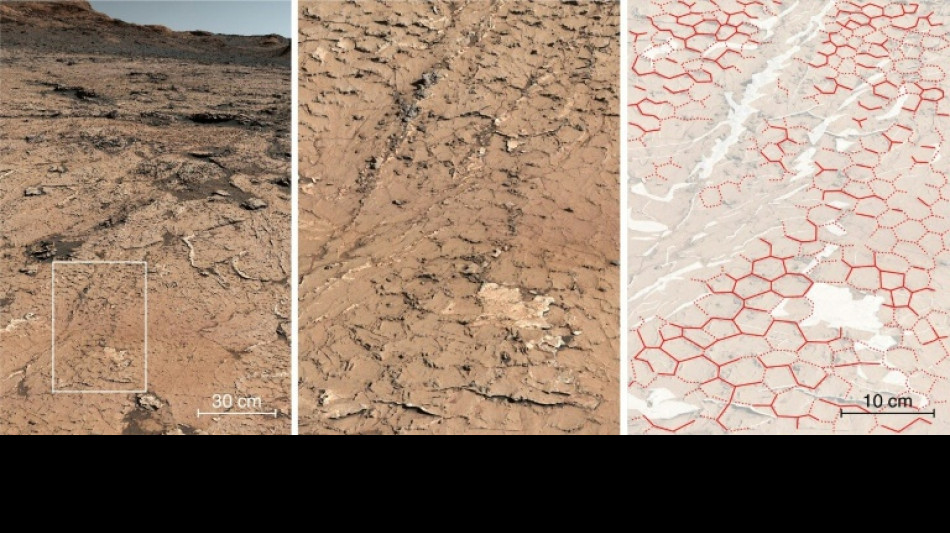
Mars once had wet-dry climate conducive to supporting life: study / Photo: © NASA/JPL-Caltech/MSSS/IRAP/Rapin et al./Nature/AFP

 Hurricane Polo strengthens to top category 5 off Mexico

 11 hurt as teen opens fire outside school in western Turkey

 UN chief says 'Big Oil' treats atmosphere as open sewer

 Tunisia says 2026 summer hottest on record

 England's Rashid out of Sri Lanka ODIs with hand injury

 Houthis accuse Saudi Arabia of deadly strikes as thousands flee

 Stocks climb as oil slides, AI buzz returns

 India cricketers win in style as Afghan savours 'special' Games silver

 La Liga president hits out at Real Madrid refereeing 'conspiracy' claims

 MEXC Launches “Real Stocks, Real Friends” with Rewards for Bringing Friends to Wall Street

 Mbappe continues media push for Ballon d'Or recognition

 Stocks rise on AI buzz, oil prices cool

 India narrowly survive huge scare against minnows Japan

 Missing F-35 fighter parts 'not sensitive', says Australia minister

 Cambodia showcases scams crackdown with global conference

 Afghan cyclist who disguised herself as man wins Asian Games silver

 Typhoon Dujuan leaves four dead in Japan, 45,000 houses without power

 G7 leaders condemn Houthi strikes on Saudi Arabia

 Google data centre sparks protests in Austria

 Shin Ohashi: Junk food-loving teen and Japan's next big swimming hope

 Stocks rise on AI buzz, drop in oil prices

 China's robot dancers limber up for America's Got Talent final

 Despite military might, Saudi struggles to crush the Houthis

 Trump to tout deals, defend Iran war in UN speech

 Sri Lanka to issue verdict in landmark Easter attack trial

NASA's Curiosity rover has discovered the first evidence that Mars once had a climate which alternated between wet and dry seasons similar to Earth, a study said on Wednesday, suggesting the red planet may have once had the right conditions to support life.
Though the surface of Mars is now an arid desert, billions of years ago rivers and vast lakes are thought to have stretched across its surface.
Since 2012, the Curiosity rover has been exploring the huge Gale crater, which is believed to be home of a former lake and has a massive mountain of sediment nearly six kilometres (four miles) high in its centre.
"We quickly realised that we were working in lakes and rivers deposits, but did not know what type of climate they were linked to," William Rapin, a researcher at France's CNRS scientific research centre and the study's lead author, told AFP.
While climbing the slope of the sediment mountain in 2021, Curiosity found salt deposits forming a hexagonal pattern in soil dated to nearly four billion years ago.
The rover's instruments identified the patterns as cracks in dried mud, according to the study published in the journal Nature.
"When a lake dries up the mud cracks, and when it fills back up, the cracks heal," Rapin explained.
Repeat this process enough times, and the cracks arrange themselves in hexagons.
Therefore, this is "the first tangible proof that Mars had a cyclical climate," Rapin said.
Regularly occurring wet and dry seasons, as on Earth, could have provided the conditions needed for life to form, the researchers said.
- 'Pretty lucky' -
Curiosity has already detected the presence of organic compounds considered the building blocks of life on Mars, which could be another piece of the puzzle.
But these building blocks need the right conditions to become the precursors of life.
"In a world that's too dry, these molecules never have the opportunity to form -- nor do they in a world that's too wet," Rapin said.
But banish thoughts of big-headed green men -- if Mars did support life, it was likely primitive single-celled microorganisms.
"Over 11 years, we've found ample evidence that ancient Mars could have supported microbial life" due to the Curiosity rover, said Ashwin Vasavada of NASA's Jet Propulsion Laboratory.
"Now, the mission has found evidence of conditions that may have promoted the origin of life, too," he said in a statement.
The discovery of such ancient terrain could never have been possible on Earth, where tectonic plates constantly reshuffle the surface, sifting away such lingering traces of the past.
That means that studying Mars -- which lacks tectonic plates -- could help scientists solve the mystery of how life began on our home planet.
"It's pretty lucky of us to have a planet like Mars nearby that still holds a memory of the natural processes which may have led to life," Rapin said.
J.Horn--BTB