Robot fried chicken: entrepreneur seeks to improve S. Korea's favourite food / Photo: © AFP

 Hurricane Polo strengthens to top category 5 off Mexico
 11 hurt as teen opens fire outside school in western Turkey

 UN chief says 'Big Oil' treats atmosphere as open sewer

 Tunisia says 2026 summer hottest on record

 England's Rashid out of Sri Lanka ODIs with hand injury

 Houthis accuse Saudi Arabia of deadly strikes as thousands flee

 Stocks climb as oil slides, AI buzz returns
 India cricketers win in style as Afghan savours 'special' Games silver

 La Liga president hits out at Real Madrid refereeing 'conspiracy' claims

 MEXC Launches “Real Stocks, Real Friends” with Rewards for Bringing Friends to Wall Street

 Mbappe continues media push for Ballon d'Or recognition

 Stocks rise on AI buzz, oil prices cool

 India narrowly survive huge scare against minnows Japan

 Missing F-35 fighter parts 'not sensitive', says Australia minister

 Cambodia showcases scams crackdown with global conference

 Afghan cyclist who disguised herself as man wins Asian Games silver

 Typhoon Dujuan leaves four dead in Japan, 45,000 houses without power
 G7 leaders condemn Houthi strikes on Saudi Arabia

 Google data centre sparks protests in Austria

 Shin Ohashi: Junk food-loving teen and Japan's next big swimming hope

 Stocks rise on AI buzz, drop in oil prices

 China's robot dancers limber up for America's Got Talent final

 Despite military might, Saudi struggles to crush the Houthis

 Trump to tout deals, defend Iran war in UN speech

 Sri Lanka to issue verdict in landmark Easter attack trial

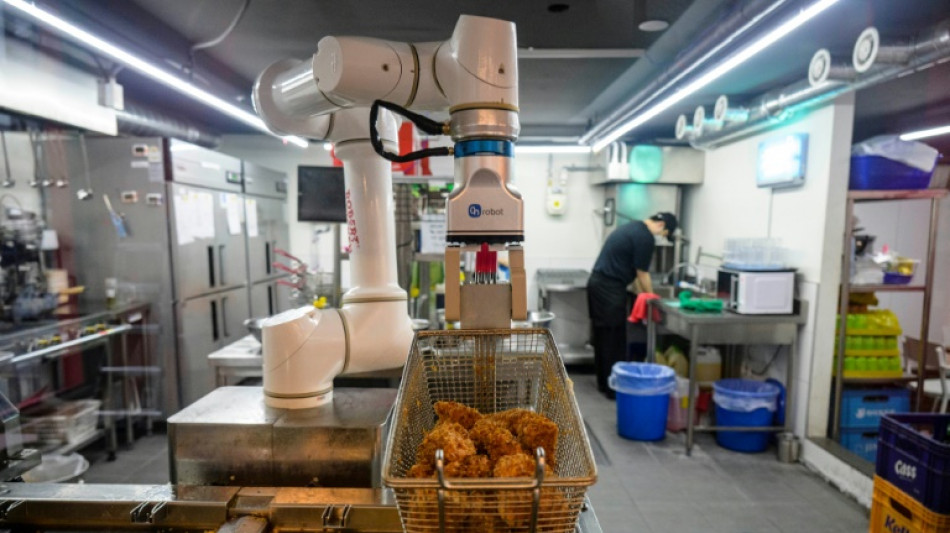
In fried-chicken-obsessed South Korea, restaurants serving the nation's favourite fast-food dish dot every street corner. But Kang Ji-young's establishment brings something a little different to the table: a robot is cooking the chicken.
Eaten at everything from tiny family gatherings to a 10-million-viewer live-streamed "mukbang" -- eating broadcast -- by K-pop star Jungkook of BTS fame, fried chicken is deeply embedded in South Korean culture.
Paired with cold lager and known as "chimaek" -- a portmanteau of the Korean words for chicken and beer -- it is a staple of Seoul's famed baseball-watching experience.
The domestic market -- the world's third largest, after the United States and China -- is worth about seven trillion won ($5.3 billion), but labour shortages are starting to bite as South Korea faces a looming demographic disaster due to having the world's lowest birth rate.
Around 54 percent of business owners in the food service sector report problems finding employees, a government survey last year found, with long hours and stressful conditions the likely culprit, according to industry research.
Korean fried chicken is brined and double-fried, which gives it its signature crispy exterior, but the process -- more elaborate than what is typically used by US fast food chains -- creates additional labour and requires extended worker proximity to hot oil.
Enter Kang, a 38-year-old entrepreneur who saw an opportunity to improve the South Korean fried chicken business model -- and the dish itself.
"The market is huge," Kang told AFP at her Robert Chicken franchise.
Chicken and pork cutlets are the most popular delivery orders in South Korea, and the industry could clearly benefit from more automation to "effectively address labour costs and workforce shortages", she said.
Kang's robot, composed of a simple, flexible mechanical arm, is capable of frying 100 chickens in two hours -- a task that would require around five people and several deep fryers.
But not only does the robot make chicken more efficiently -- it makes it more delicious, says Kang.
"We can now say with confidence that our robot fries better than human beings do," she said.
- Investing in 'foodtech' -
Already a global cultural powerhouse and major semiconductor exporter, South Korea last year announced plans to plough millions of dollars into a "foodtech" fund to help startups working on high-tech food industry solutions.
Seoul says such innovations could become a "new growth engine", arguing there is huge potential if the country's prowess in advanced robotics and AI technology could be combined with the competitiveness of Korean food classics like kimchi.
South Korea's existing foodtech industry -- including everything from next-day grocery delivery app Market Kurly to AI smart kitchens to a "vegan egg" startup -- is already worth millions, said food science professor Lee Ki-won at Seoul National University.
Even South Korea's Samsung Electronics -- one of the world's biggest tech companies -- is trying to get in on the action, recently launching Samsung Food, an AI-personalised recipe and meal-planning platform, available in eight languages.
Lee predicted South Korea's other major conglomerates are likely to follow Samsung into foodtech.
"Delivering food using electric vehicles or having robots directly provide deliveries within apartment complexes, known as 'metamobility', could become a part of our daily lives," he said.
"I am confident that within the next 10 years, the food tech industry will transform into the leading sector in South Korea."
- 'Initially struggled' -
Entrepreneur Kang now has 15 robot-made chicken restaurants in South Korea, and one branch in Singapore.
During AFP's visit to a Seoul branch, a robot meticulously handled the frying process -- from immersing chicken in oil, flipping it for even cooking, to retrieving it at the perfect level of crispiness, as the irresistible scent of crunchy chicken wafted through the shop.
Many customers remained oblivious to the hard-working robotic cook behind their meal.
Kim Moon-jung, a 54-year-old insurance worker, said she was not sure how a robot would make the chicken differently from a human "but one thing is certain -- it tastes delicious".
The robot can monitor oil temperature and oxidation levels in real time while it fries chicken, ensuring consistent taste and superior hygiene.
When Kang first started her business she "initially struggled" to see why anyone would use robots rather than human chefs.
But "after developing these technologies, I've come to realise that from a customer's perspective, they're able to enjoy food that is not only cleaner but also tastier", she told AFP.
Her next venture is a tip-free bar in Koreatown in New York City, where the cocktails will feature Korea's soju rice wine -- and will be made by robots.
M.Furrer--BTB