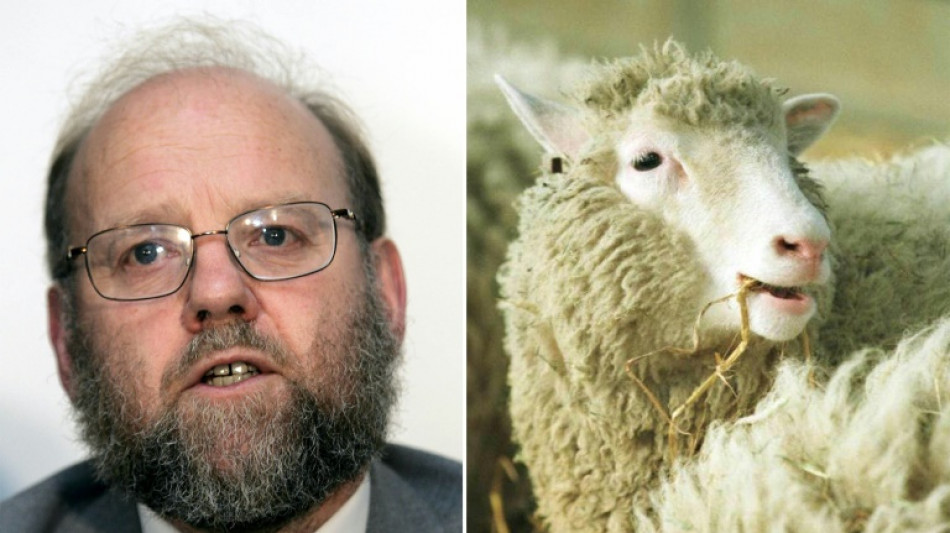
Scientist who led team that created Dolly the cloned sheep dies at 79 / Photo: © AFP/File

 Hurricane Polo strengthens to top category 5 off Mexico

 11 hurt as teen opens fire outside school in western Turkey

 UN chief says 'Big Oil' treats atmosphere as open sewer

 Tunisia says 2026 summer hottest on record

 England's Rashid out of Sri Lanka ODIs with hand injury

 Houthis accuse Saudi Arabia of deadly strikes as thousands flee

 Stocks climb as oil slides, AI buzz returns

 India cricketers win in style as Afghan savours 'special' Games silver

 La Liga president hits out at Real Madrid refereeing 'conspiracy' claims

 MEXC Launches “Real Stocks, Real Friends” with Rewards for Bringing Friends to Wall Street

 Mbappe continues media push for Ballon d'Or recognition

 Stocks rise on AI buzz, oil prices cool

 India narrowly survive huge scare against minnows Japan

 Missing F-35 fighter parts 'not sensitive', says Australia minister

 Cambodia showcases scams crackdown with global conference

 Afghan cyclist who disguised herself as man wins Asian Games silver

 Typhoon Dujuan leaves four dead in Japan, 45,000 houses without power

 G7 leaders condemn Houthi strikes on Saudi Arabia
 Google data centre sparks protests in Austria

 Shin Ohashi: Junk food-loving teen and Japan's next big swimming hope

 Stocks rise on AI buzz, drop in oil prices

 China's robot dancers limber up for America's Got Talent final

 Despite military might, Saudi struggles to crush the Houthis

 Trump to tout deals, defend Iran war in UN speech

 Sri Lanka to issue verdict in landmark Easter attack trial

The British scientist who led the team that created Dolly the sheep, a breakthrough in cloning, has died at the age of 79, his former university said on Monday.
Ian Wilmut, who revealed in 2018 he had been diagnosed with Parkinson's disease, helmed the team at the Roslin Institute at the University of Edinburgh in Scotland, which cloned Dolly in 1996.
Dolly was the first mammal to be cloned from an adult cell, and the breakthrough garnered global headlines and led to new advances in animal and medical research.
Peter Mathieson, the vice-chancellor of Edinburgh University, hailed Wilmut as "a titan of the scientific world" whose work cloning Dolly "transformed scientific thinking at the time".
"This breakthrough continues to fuel many of the advances that have been made in the field of regenerative medicine that we see today," he said in a statement.
Bruce Whitelaw, the current head of the Roslin Institute, said it was "sad news".
"Science has lost a household name," he added.
Wilmut retired from Edinburgh University of 2012.
But in 2018, he announced support for new research into Parkinson's, revealing he had diagnosed with the uncurable, progressive brain disorder, which can cause uncontrollable movements such as shaking.
"There was a sense of clarity, well at least now we know and we can start doing things about it," Wilmut told the BBC at the time.
"As well as obviously the disappointment that it will possibly shorten my life slightly, and more particularly it will alter the quality of life."
Parkinson's is the second most common neurodegenerative disease after Alzheimer's and affects more than 8.5 million people worldwide, according to the World Health Organization (WHO).
Y.Bouchard--BTB