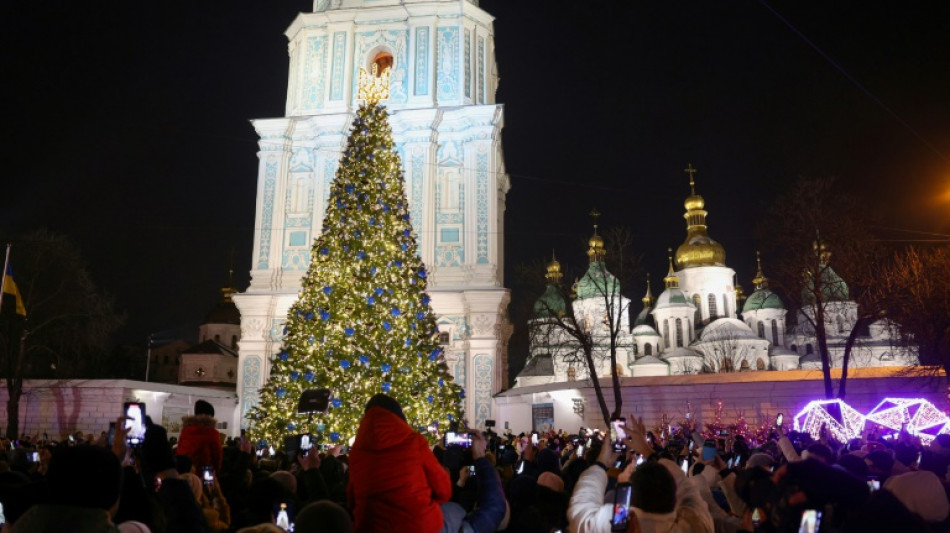
How Ukraine independence song became a Christmas classic / Photo: © AFP/File

 Macron urges world to choose UN over 'law of the jungle'

 All-rounder Jacks stars as England beat Sri Lanka in 1st ODI

 Man City peg back Bayern to start Women's Champions League
 Trump beats 'America first' drum at UN as allies tread carefully

 Snedeker backs Spaun for Ryder Cup after Presidents snub

 French prosecutors probe secret filming of women with smart glasses

 Trump renames AI "super intelligence," rejects international oversight
 Trump rejects international regulation of AI

 How is the EU approaching record fuel prices?

 Sri Lanka's Colombage strikes on debut as England dismissed for 265 in first ODI

 Hurricane Polo strengthens to top category 5 off Mexico

 11 hurt as teen opens fire outside school in western Turkey

 UN chief says 'Big Oil' treats atmosphere as open sewer

 Tunisia says 2026 summer hottest on record

 England's Rashid out of Sri Lanka ODIs with hand injury
 Houthis accuse Saudi Arabia of deadly strikes as thousands flee

 Stocks climb as oil slides, AI buzz returns

 India cricketers win in style as Afghan savours 'special' Games silver

 La Liga president hits out at Real Madrid refereeing 'conspiracy' claims

 MEXC Launches “Real Stocks, Real Friends” with Rewards for Bringing Friends to Wall Street

 Mbappe continues media push for Ballon d'Or recognition

 Stocks rise on AI buzz, oil prices cool

 India narrowly survive huge scare against minnows Japan

 Missing F-35 fighter parts 'not sensitive', says Australia minister

 Cambodia showcases scams crackdown with global conference

The catchy tune of "Carol of the Bells" may sound instantly familiar and evoke Christmas movies such as "Home Alone" but those humming along may have little inkling to the music's origins.
Used in countless holiday films and even performed by The Muppets, Carol of the Bells, a staple in western pop culture, stemmed from an early bid for Ukrainian independence.
The melody is a Ukrainian song called "Shchedryk", or New Year's carol, written by composer Mykola Leontovych and first performed in Kyiv at Christmas 1916.
This Christmas Eve, Ukrainian Radio Choir will perform the piece at Kyiv's Philharmonic at a sold-out concert that re-treads some of that musical history.
This comes as Ukraine celebrates Christmas on December 25 for the first time ever -- in sync with the West -- instead of on January 7 as in Russia.
- 'Musical diplomacy' -
The Kyiv concert on Sunday will recreate the first US concert performance of the Shchedryk, at a time when Ukraine was in a fragile state of independence after World War I.
The Ukrainian People's Republic had declared independence from Russia in 1918, led by nationalist politician Symon Petlyura.
To bolster the republic's standing, Petlyura decided to send the Ukrainian National Choir on a world tour.
"Petlyura wanted to persuade the Western entente to recognise Ukraine's independence, and so he initiated this project of musical diplomacy," said Tina Peresunko, who helped organise Sunday's concert.
The cultural researcher has written a book about Shchedryk and its links to Ukraine's struggle for independence.
The Ukrainian National Choir travelled to western Europe in 1919, then went to the United States, where Shchedryk had its national premiere at the Carnegie Hall in New York in October 1922.
Petlyura aimed "through song, through culture, through Ukraine's thousand-year-old folklore... to show that we are a nation, we are not Russians," Peresunko told AFP.
"The idea was through song to convey the right of Ukrainian people to independence.
"And it's very symbolic that it was Shchedryk, known to the world now as Carol of the Bells, became the hit of that tour."
Ultimately, though, Petlyura's musical diplomacy did not work and Ukraine became part of the USSR.
The original choir's singers remained in the US as emigres, fearing arrest by the Soviets.
The composer of Shchedryk never enjoyed the worldwide reaction to his piece: he was shot dead at his father's house in 1921 by a Soviet agent, according to the Ukrainian culture ministry.
But his music lived on.
In 1936, an American with Ukrainian roots, Peter Wilhousky took Shchedryk's music and wrote English lyrics titled Carol of the Bells, that have made it synonymous with Christmas.
- 'Difficult time for Ukraine' -
Ahead of Sunday's concert, the conductor of the Ukrainian Radio Choir, Yuliya Tkach, was leading a rehearsal in Kyiv, with singers wrapped up in scarves and jackets.
"Is it heated in here?" she asked at one point.
They were about to perform Shchedryk when an air raid siren sounded and they had to go down to a cellar.
Dressed in a traditional embroidered blouse, Tkach drew parallels between the turbulent time of the early performances of Shchedryk and now.
"Then there was a war, then there was a real struggle resulting in the Ukrainian People's Republic," she told AFP.
"Now this historical spiral is repeating itself."
The Kyiv concert on Sunday will recreate part of the programme from the first US concert which featured Shchedryk.
Tkach said the song is special to her: "First of all it's symbolic of Christmas holidays, secondly it is also about presenting Ukraine to the world, and thirdly, Mykola Leontovych is a composer dear to me."
The concert will also feature other songs from the original choir's world tour, some now rarely heard.
Peresunko scoured archives for the sheet music, some of which were only available in one copy.
"It's an extremely interesting programme," said Tkach.
"Some of the works were just a revelation to me."
The conductor said she would also like to take her choir on a tour abroad to "present the same repertoire to the world at this difficult time for Ukraine".
F.Müller--BTB