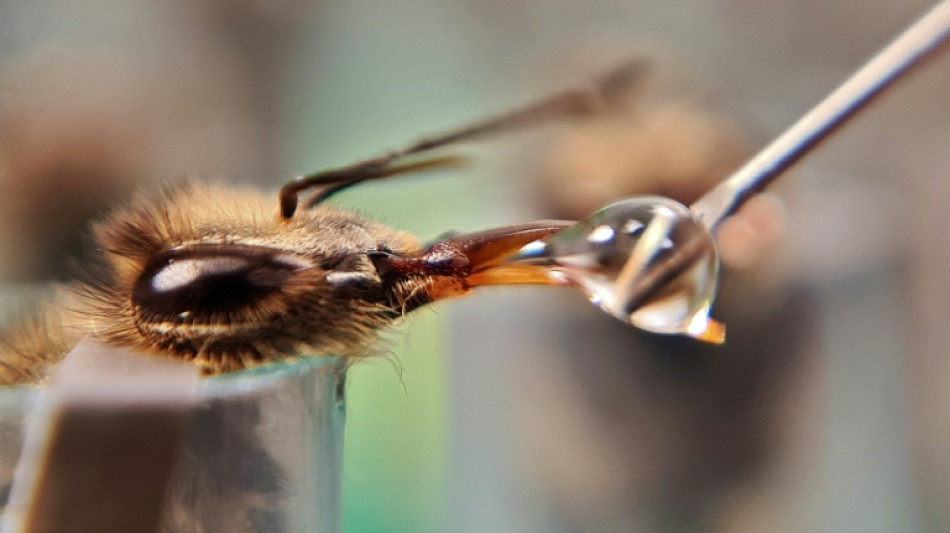
Colombian researchers seek safety for bees in urban jungle / Photo: ©

 Ed Sheeran returns to stage after Palestinian controversy

 Asian Games to open in Japan after troubled build-up

 Drone owners rush to offload devices ahead of Beijing ban

 Trump's beef policies irk Texas ranchers, testing their loyalty

 Nvidia, OpenAI CEOs to attend Xi dinner at White House

 Anthropic picks Accenture for in-house AI safety evaluation

 Balogun returns as Monaco beat Lens to continue strong Ligue 1 start

 'Pause' on overt repression in Venezuela, but reforms still needed: HRW

 Global stocks mixed as yen falls despite Bank of Japan rate hike

 Cuba hit with seventh major blackout of the year

 Murray out with concussion so Wentz will start for Vikings

 UN chief 'deeply regrets' US visa refusal to Abbas for annual meeting

 England quick Carse to face no charges over alleged nightclub assault

 Mancini brings nine newcomers into the first squad of his Italy comeback

 Czechs level Davis Cup tie against USA as South Korea eye Finals

 New France boss Zidane confirms Mbappe as captain after naming first squad

 California governor signs order to explore AI 'kill switch'

 Head leads run spree as Australia win Zimbabwe ODI series

 In-form Raphinha wants to finish career at Barcelona

 Warren Buffett steps down as Berkshire Hathaway chairman

 Carrick confident Man Utd can 'work through' tough time

 Mbappe ends Nike partnership to join Swiss brand On

 Liverpool boss Iraola puts Bournemouth love affair on hold

 'A disaster' if Man City do not win says Maresca after flawless start

 Kerry James Marshall: American 'blackness' painter celebrated in Europe

Far from the flowery fields that are their natural home, honey bees imperiled by pesticides in rural Colombia are finding sanctuary on university campuses in the bustling capital Bogota.
Even though hives are banned from the city due to the risk the insects' stings can pose to humans, universities enjoy an exemption for research purposes.
At the University of Rosario, biologist Andre Riveros very carefully feeds a bee some sugar water, watching attentively as it stretches its straw-like tongue, or proboscis, towards the sweet liquid.
The university boasts a rooftop apiary in a bamboo structure some six meters (nearly 20 feet) high, surrounded by trees and flowers.
Here, Riveros and his team study a colony of bees in the hopes of developing a food supplement that will offer the critical crop pollinators protection from insecticides
"Pesticides end up affecting some (neurological) regions that, for example, affect learning and memory and (the bees) end up with damage very similar to Alzheimer's," Riveros told AFP.
"We are trying to find a solution for the problem of bee disappearances," he added. "We seek to shield the bees, in essence."
The team's work focuses on the Apis mellifera, or Western Honey Bee, one of about 20,000 known species worldwide.
Hundreds of hives have been killed off in Colombia in recent years, and investigations into the cause have pointed to fipronil, an insecticide banned in Europe and restricted in the United States and China.
Fipronil has been widely used in a profitable avocado and citrus boom in Colombia, though the Latin American country suspended its use in some crops for six months last year.
- 'Fleeing the fields' -
Elsewhere in Bogota, the EAN University boasts its own hives, perched on a six-story building overlooking the city of eight million people.
Beekeeper Gino Cala extracts honey from the hives as part of his work to instruct and assist universities in the management of urban apiaries.
But Cala told AFP Colombia's bees "are fleeing the fields" partly due to the "indiscriminate use of agrochemicals."
"These insects are extremely relevant and important... because they help guarantee part of the food security of Colombia and the world," he added.
From the EAN University grounds, Cala's bees help to pollinate plants in surrounding areas.
About 1.4 billion jobs and three-quarters of all crops around the world, according to a 2016 study, depend on pollinators -- mainly bees -- which provide free fertilization services worth billions of dollars.
In recent years, bees in North America, Europe, Russia, South America and elsewhere have started dying off from "colony collapse disorder," a mysterious scourge blamed partly on pesticides but also on mites, viruses and fungi.
The UN warns that nearly half of insect pollinators, particularly bees and butterflies, risk global extinction.
Despite the city ban, there are private beekeepers in Bogota who sell products such as honey, pollen or beeswax.
The fire department of Bogota says it attends to eight bee sting-related emergencies on average every day.
K.Brown--BTB