Brazil seeks to curb AI deepfakes as key elections loom / Photo: © AFP

 Voting opens in Alaska's annual Fat Bear Week
 MLS coach axed for telling female ref 'It's a man's game'
 US refuses to give Sudan's de facto leader visa for UN
 Man City hold Bayern to start Women's Champions League, Arsenal win late
 Trump threatens Iran with 'hell' but reveals fresh talks

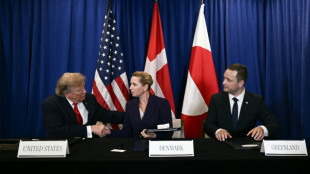 Trump signs security deal with Greenland, Denmark at UN
 Trump threatens Iran with 'hell' but unveils fresh talks

 Chile's Atacama Desert blossoms with life after El Nino rains

 Sri Lanka hands 220-year jail terms to 15 convicted of Easter bombings
 Typhoon Dujuan leaves 7 dead in Japan from landslides, flooding: media

 Ganna and Borghini lead Italy to mixed relay gold at cycling worlds

 Drug cocktail killed former child star Hayden Panettiere: coroner
 Moldova declares energy, water emergency
 French Holocaust denier jailed for eight months

 Oil prices slide, AI stock buzz fades

 Trump threatens to 'annihilate' Iran in bombastic UN speech

 Prada's skirts take centre stage as Milan Fashion Week begins

 Quoin Pharmaceuticals Announces FDA Fast Track Designation for QRX003 for the Treatment of Peeling Skin Syndrome

 Brazil's Flavio Bolsonaro turns scandal into poll gains

 Republican senator seeks probe of Trump Jr Russian-funded wedding

 Memoir by Diana's brother goes on sale after rocking UK monarchy
 Newcomers South Korea face holders Italy in Davis Cup finals

 Japan's Kojima sounds Marchand warning with Asian Games gold

 England rugby star Pollock signs new Northampton deal

 STARTRADER Expands Its Chinese Equity CFD Range with CXMT and Unitree Robotics

AI-generated videos and photos used for political disinformation are the scourge of a busy global election year, and Brazil is scrambling to regulate the technology ahead of municipal polls.
In a country of 203 million, which counts more phones than people, Brazilian authorities last week banned the use of deepfake technology and set out guidelines for uses of AI for electoral purposes.
"Video montages can be used to manipulate public opinion, to defame individuals, or to interfere in the democratic process," Ana Carolina da Hora, a computer specialist at the PUC Catholic University in Rio de Janeiro, told AFP.
The rapid development of AI, turbocharged by the 2022 launch of ChatGPT, has shaken up the online landscape while sparking awe and fear over the future of the technology.
In a video circulating on social media in Brazil, the country's biggest pop star Anitta and football icon Neymar promote an online gambling scheme, or rather, ultra-realistic deepfakes of the celebrities do.
But in a country hard hit by political disinformation, authorities are particularly alarmed by cases like that of a mayor whose voice was cloned to create an audio file shared on social media in which he insults teachers in his municipality.
Similar cases are being investigated in two other states.
- 'Most modern standards' -
The Superior Electoral Tribunal (TSE) has decided to act. Last week, the use of deepfake technology was formally banned in the October municipal electoral campaign.
Any other type of use of artificial intelligence for electoral purposes must be accompanied by a notice clearly identifiable to the public.
Candidates caught using deepfake technology in the campaign could be blocked from running or have their mandates rescinded if elected.
TSE president Alexandre de Moraes said these were some of "the most modern standards in the world in relation to combating disinformation, fake news and the illicit use of artificial intelligence."
He warned that deepfake technology could "change the result of the elections."
In Brazil, former president Jair Bolsonaro was banned from holding office until 2030 for abuse of power and misuse of the media after he claimed, without evidence, that the Brazilian electoral system was not secure.
"The fact is that humanity is becoming a victim of algorithms... and being manipulated by artificial intelligence, in a way that has never been seen in history," President Luiz Inacio Lula da Silva said last week in an interview with the RedeTV channel.
Lula beat Bolsonaro by a razor-thin margin in 2022 elections that bitterly divided the nation, and the October municipal elections will be a crucial litmus test of his popularity.
- 'No single solution' -
Deepfake technology is also alarming experts in the United States, where opponents of President Joe Biden recently released an AI-generated call using what sounded like his voice, urging people not to cast ballots in a primary.
The nonprofit Center for Countering Digital Hate (CCDH) on Wednesday warned that several generative AI tools continue to allow the creation of deceptive images related to political candidates and voting.
Twenty digital giants, including Meta, Microsoft, Google, OpenAI, TikTok and X, last month joined together in a pledge to fight AI content designed to mislead voters.
They promised to use technologies to counter potentially harmful AI content, such as watermarks invisible to the human eye but detectable by machine.
In Brazil, Congress has waded into the debate, and Senate President Rodrigo Pacheco introduced a bill on the regulation of the use of artificial intelligence in all aspects of life which he hopes will be approved in April.
There is "no single solution to regulate artificial intelligence," said Bruno Bioni, director of Data Privacy Brazil, a data protection and digital rights organization, who stressed that AI affects sectors ranging from telecommunications to health.
He also highlighted the risk of discrimination linked to AI facial recognition in a country where more than half of the population is black or mixed race.
M.Furrer--BTB