
EU parliament adopts 'historic' rules on AI / Photo: © AFP/File

 Voting opens in Alaska's annual Fat Bear Week

 MLS coach axed for telling female ref 'It's a man's game'

 US refuses to give Sudan's de facto leader visa for UN

 Man City hold Bayern to start Women's Champions League, Arsenal win late

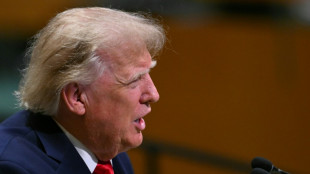 Trump threatens Iran with 'hell' but reveals fresh talks

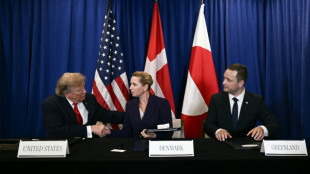 Trump signs security deal with Greenland, Denmark at UN

 Trump threatens Iran with 'hell' but unveils fresh talks

 Chile's Atacama Desert blossoms with life after El Nino rains

 Sri Lanka hands 220-year jail terms to 15 convicted of Easter bombings

 Typhoon Dujuan leaves 7 dead in Japan from landslides, flooding: media

 Ganna and Borghini lead Italy to mixed relay gold at cycling worlds

 Drug cocktail killed former child star Hayden Panettiere: coroner

 Moldova declares energy, water emergency

 French Holocaust denier jailed for eight months

 Oil prices slide, AI stock buzz fades

 Trump threatens to 'annihilate' Iran in bombastic UN speech

 Prada's skirts take centre stage as Milan Fashion Week begins

 Quoin Pharmaceuticals Announces FDA Fast Track Designation for QRX003 for the Treatment of Peeling Skin Syndrome

 Brazil's Flavio Bolsonaro turns scandal into poll gains

 Republican senator seeks probe of Trump Jr Russian-funded wedding

 Memoir by Diana's brother goes on sale after rocking UK monarchy

 Newcomers South Korea face holders Italy in Davis Cup finals

 Japan's Kojima sounds Marchand warning with Asian Games gold

 England rugby star Pollock signs new Northampton deal

 STARTRADER Expands Its Chinese Equity CFD Range with CXMT and Unitree Robotics

The European Parliament gave final approval on Wednesday to wide-ranging EU rules to govern artificial intelligence, including powerful systems like OpenAI's ChatGPT.
Senior European Union officials say the rules, first proposed in 2021, will protect citizens from the possible risks of a technology developing at breakneck speed, while also fostering innovation on the continent.
Brussels has sprinted to pass the new law since OpenAI's Microsoft-backed ChatGPT arrived on the scene in late 2022, unleashing a global AI race.
There was a burst of excitement for generative AI as ChatGPT wowed the world with its human-like capabilities -- from digesting complex text to producing poems within seconds, or passing medical exams.
Further examples of generative AI models include DALL-E and Midjourney, which produce images, while other models produce sounds from a simple input in everyday language.
The far-reaching regulation passed with the support of 523 lawmakers in the European Parliament in Strasbourg, France, with 46 voting against.
The EU's 27 states are expected to endorse the text in April before the law is published in the EU's Official Journal in May or June.
"Today is again an historic day on our long path towards regulation of AI," said Brando Benifei, an Italian lawmaker who pushed the text through parliament with Romanian MEP Dragos Tudorache.
"(This is) the first regulation in the world that is putting a clear path towards a safe and human-centric development of AI," Benifei added, speaking just before the vote.
"We managed to find that very delicate balance between the interest to innovate and the interest to protect," Tudorache told journalists before the vote.
The EU's internal market commissioner, Thierry Breton, hailed the vote.
"I welcome the overwhelming support from the European Parliament for the EU AI Act," he said. "Europe is now a global standard-setter in trustworthy AI."
Rules covering AI models like ChatGPT will enter into force 12 months after the law becomes official, while companies must comply with most other provisions in two years.
- AI policing restrictions -
The EU's rules known as the "AI Act" take a risk-based approach: the riskier the system, the tougher the requirements -- with outright bans on the AI tools deemed to carry the most threat.
For example, high-risk AI providers must conduct risk assessments and ensure their products comply with the law before they are made available to the public.
"We are regulating as little as possible and as much as needed, with proportionate measures for AI models," Breton told AFP.
Violations can see companies hit with fines ranging from 7.5 million to 35 million euros ($8.2 million to $38.2 million), depending on the type of infringement and the firm's size.
There are strict bans on using AI for predictive policing and systems that use biometric information to infer an individual's race, religion or sexual orientation.
The rules also ban real-time facial recognition in public spaces but with some exceptions for law enforcement, although police must seek approval from a judicial authority before any AI deployment.
- Lobbies vs watchdogs -
Since AI will likely transform every aspect of Europeans' lives and big tech firms are vying for dominance in what will be a lucrative market, the EU has been subject to intense lobbying over the legislation.
Watchdogs on Tuesday pointed to campaigning by French AI startup Mistral AI and Germany's Aleph Alpha as well as US-based tech giants like Google and Microsoft.
They warned the implementation of the new rules "could be further weakened by corporate lobbying", adding that research showed "just how strong corporate influence" was during negotiations.
"Many details of the AI Act are still open and need to be clarified in numerous implementing acts, for example, with regard to standards, thresholds or transparency obligations," three watchdogs based in Belgium, France and Germany said.
Commissioner Breton stressed that the EU "withstood the special interests and lobbyists calling to exclude large AI models from the regulation", adding: "The result is a balanced, risk-based and future-proof regulation."
Lawmaker Tudorache said the law was "one of the... heaviest lobbied pieces of legislation, certainly in this mandate", but insisted: "We resisted the pressure."
J.Horn--BTB