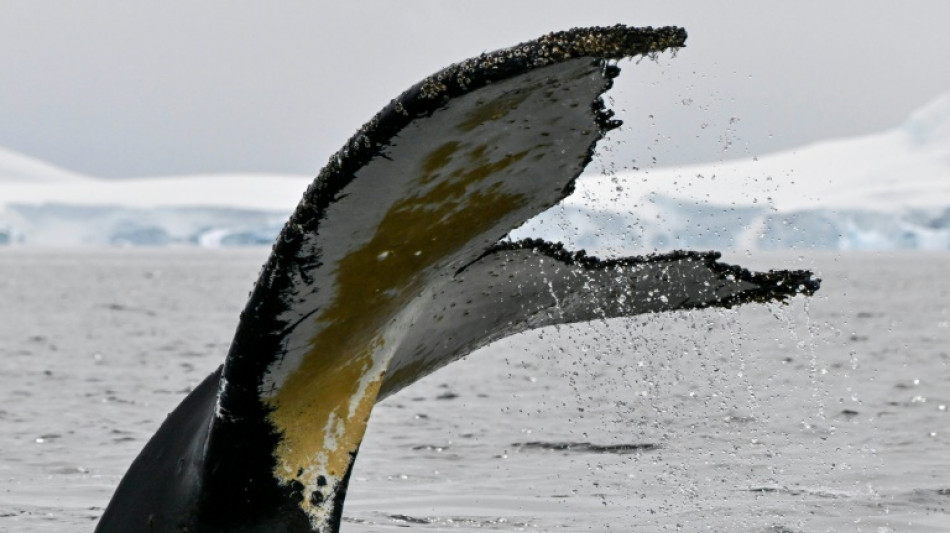
Whale of a tail: Scientists track unique humpback 'fingerprint' / Photo: © AFP

 Voting opens in Alaska's annual Fat Bear Week

 MLS coach axed for telling female ref 'It's a man's game'

 US refuses to give Sudan's de facto leader visa for UN

 Man City hold Bayern to start Women's Champions League, Arsenal win late

 Trump threatens Iran with 'hell' but reveals fresh talks

 Trump signs security deal with Greenland, Denmark at UN

 Trump threatens Iran with 'hell' but unveils fresh talks

 Chile's Atacama Desert blossoms with life after El Nino rains

 Sri Lanka hands 220-year jail terms to 15 convicted of Easter bombings

 Typhoon Dujuan leaves 7 dead in Japan from landslides, flooding: media

 Ganna and Borghini lead Italy to mixed relay gold at cycling worlds

 Drug cocktail killed former child star Hayden Panettiere: coroner

 Moldova declares energy, water emergency

 French Holocaust denier jailed for eight months

 Oil prices slide, AI stock buzz fades

 Trump threatens to 'annihilate' Iran in bombastic UN speech

 Prada's skirts take centre stage as Milan Fashion Week begins

 Quoin Pharmaceuticals Announces FDA Fast Track Designation for QRX003 for the Treatment of Peeling Skin Syndrome

 Brazil's Flavio Bolsonaro turns scandal into poll gains

 Republican senator seeks probe of Trump Jr Russian-funded wedding

 Memoir by Diana's brother goes on sale after rocking UK monarchy

 Newcomers South Korea face holders Italy in Davis Cup finals

 Japan's Kojima sounds Marchand warning with Asian Games gold

 England rugby star Pollock signs new Northampton deal

 STARTRADER Expands Its Chinese Equity CFD Range with CXMT and Unitree Robotics

In Antarctica, a scientist waits patiently for two frolicking humpback whales to poke their tails out of the icy waters so she can take a photographic "fingerprint" of the unique colors and patterns that allow researchers to identify individuals of the species.
Andrea Bonilla, a Colombian scientist at Cornell University in the United States, has been working with a team of researchers since 2014 to catalog humpback whales from a visual analysis of their tails -- or flukes.
"What we are doing is tracking the history of each individual," Bonilla told AFP onboard the ARC Simon Bolivar during a scientific expedition by the Colombian navy.
Over the years, the team has identified 70 whales, and hopes to see some of them again to record any physical changes that could provide clues to their migratory patterns, population sizes, health and sexual maturity.
On the tail, "the coloration and patterns that each whale has is unique, it is like a fingerprint, so what we do is look at the different marks they have, the different scars" to identify an individual, said Bonilla.
Global populations of humpbacks have bounced back after once being decimated by commercial whaling, but the ocean giants remain under threat from vessel strikes, illegal fishing, pollution and underwater noise.
Today there are about 84,000 adult specimens in the world, according to the International Union for Conservation of Nature.
The importance of tail identification was highlighted in a study published last month in the Royal Society Open Science journal which showed the number of humpback whales in the North Pacific had plummeted 20 percent in less than a decade.
Tracking some 33,000 whales through photos of their flukes, scientists noted the steep decline which they speculate was due to starvation because of marine heat waves.
- 'Accumulating energy' -
Photo identification is common in the study of marine mammals, although the use of fluke identification is most used with humpbacks both because of their unique markings, and their habit of raising their tails out off the water while diving.
Different populations of humpback whales live across the world's oceans, carrying out mammoth migrations from warmer breeding spots to feeding grounds in polar waters.
"They take advantage of this great biomass of food that is here (in Antarctica) and for several months they are simply accumulating energy," said Bonilla.
Using photographs, the scientist draws reproductions of the details of the tails of the enormous marine mammals, which can reach up to 18 meters (59 feet) long and weigh about 40 tons.
On a computer, she zooms in on the details of the flukes, which can reveal attacks from other animals, "if there is some type of skin disease" or information about their diet.
The inventory allows scientists to track the movement of specific whales, which is crucial for conservation initiatives.
"If a whale always comes to the same area to reproduce, it is important to protect those areas. If they cease to exist or are disturbed, that whale will have nowhere to go," warned Bonilla.
C.Kovalenko--BTB