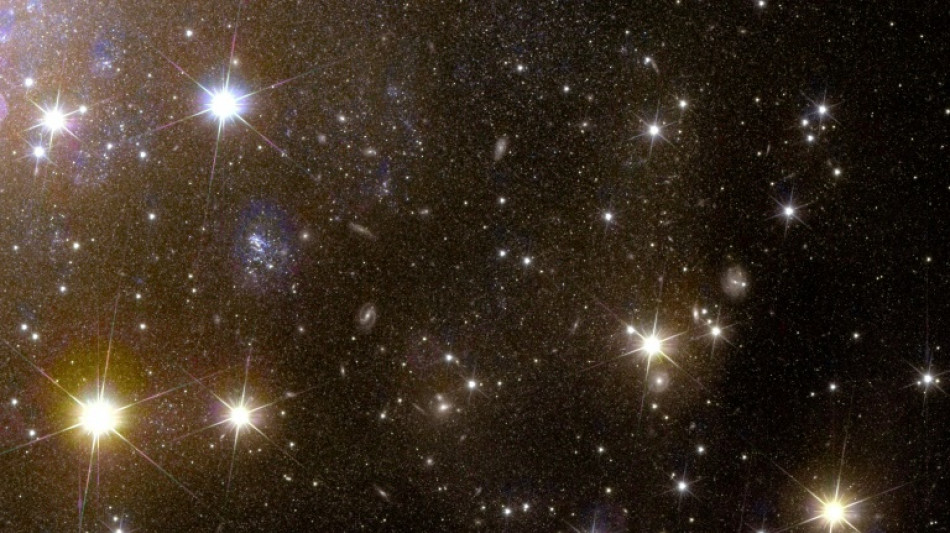
Creeping ice clouding vision of Europe space telescope Euclid / Photo: © ESA/Euclid/Euclid Consortium/NASA/AFP/File

 Voting opens in Alaska's annual Fat Bear Week

 MLS coach axed for telling female ref 'It's a man's game'

 US refuses to give Sudan's de facto leader visa for UN

 Man City hold Bayern to start Women's Champions League, Arsenal win late

 Trump threatens Iran with 'hell' but reveals fresh talks

 Trump signs security deal with Greenland, Denmark at UN

 Trump threatens Iran with 'hell' but unveils fresh talks

 Chile's Atacama Desert blossoms with life after El Nino rains

 Sri Lanka hands 220-year jail terms to 15 convicted of Easter bombings

 Typhoon Dujuan leaves 7 dead in Japan from landslides, flooding: media
 Ganna and Borghini lead Italy to mixed relay gold at cycling worlds
 Drug cocktail killed former child star Hayden Panettiere: coroner

 Moldova declares energy, water emergency

 French Holocaust denier jailed for eight months

 Oil prices slide, AI stock buzz fades

 Trump threatens to 'annihilate' Iran in bombastic UN speech

 Prada's skirts take centre stage as Milan Fashion Week begins

 Quoin Pharmaceuticals Announces FDA Fast Track Designation for QRX003 for the Treatment of Peeling Skin Syndrome

 Brazil's Flavio Bolsonaro turns scandal into poll gains
 Republican senator seeks probe of Trump Jr Russian-funded wedding

 Memoir by Diana's brother goes on sale after rocking UK monarchy

 Newcomers South Korea face holders Italy in Davis Cup finals

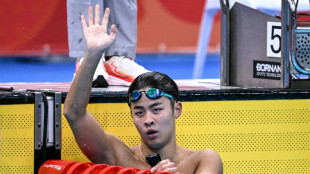 Japan's Kojima sounds Marchand warning with Asian Games gold

 England rugby star Pollock signs new Northampton deal

 STARTRADER Expands Its Chinese Equity CFD Range with CXMT and Unitree Robotics

Scientists are trying to melt a thin layer of ice that is increasingly clouding the vision of the "dark universe detective" space telescope Euclid, the European Space Agency said on Tuesday.
It is the latest of several technical setbacks for the wide-eyed telescope, which blasted off into space in July on a mission to chart a third of the sky.
By doing so, the ESA hopes Euclid will reveal out more about the nature of dark matter and dark energy, which are thought to make up 95 percent of the universe but remain shrouded in mystery.
During checks in November, the team on the ground first noticed that they were losing a little light coming into the telescope's visible light imager, Euclid instrument operations scientist Ralf Kohley told AFP.
After digging into the data, they believe the problem is a layer of ice -- thought to be just the width of a strand of DNA -- that is building up on the telescope's optical surfaces.
"It's a big problem," Kohley acknowledged.
But researchers have been working on it, Kohley said, adding that he had no doubt Euclid would be able to finish its mission.
Keeping out water is a common problem for all spacecrafts.
Despite best efforts on the ground, a tiny amount of water absorbed during a spacecraft's assembly on Earth can smuggle its way to space.
Faced with the cold vastness of space, the water molecules freeze to the first surface they can -- in this case, some may have landed on the Euclid's mirrors.
- Thin ice -
Shortly after the telescope launched, scientists used its on-board heaters to heat up everything on the spacecraft, hoping to blast out any potential water.
This could be done again.
"But heating out everything is very disruptive for the mission," Kohley said.
Because heat expands most materials, warming up the whole spacecraft involves careful recalibration.
It would take at least a month to get the telescope back to its job surveying the sky, Kohley said.
So last week, the ESA started warming just two of the telescope's mirrors, turning the temperature up just enough to hopefully melt away the ice.
This "minimally invasive" partial warming will last until Thursday, Kohley said.
The scientists may not know if it works until mid-April.
Part of the problem is that the scientists do not know exactly where the ice is accumulating -- or how much there is.
And even if the scientists do manage to melt the ice, it could come back over time, Kohley warned.
If the partial warming plan fails, the ESA will have to heat up the whole spacecraft.
If the team have to do this every year during the telescope's planned-six year mission it could result in a six-month delay, Kohley said.
"But that's all speculation," he said.
"For the moment, we have to wait and see -- and hope we can rid of this problem in a more elegant fashion."
It is not the first problem for Euclid.
Cosmic rays previously confused the spacecraft's fine guidance sensor, which required a complicated software update.
Some unwanted sunlight also interfered with its observations, a problem solved by slightly rotating the telescope, Kohley said.
However nothing can be done about particularly strong solar flares occasionally projecting X-ray images on the visible imager.
Euclid, which the ESA calls its "dark universe detective," officially started its survey last month.
Its first images, released in November, revealed swirling galaxies bursting with colour in the distant cosmos.
C.Meier--BTB