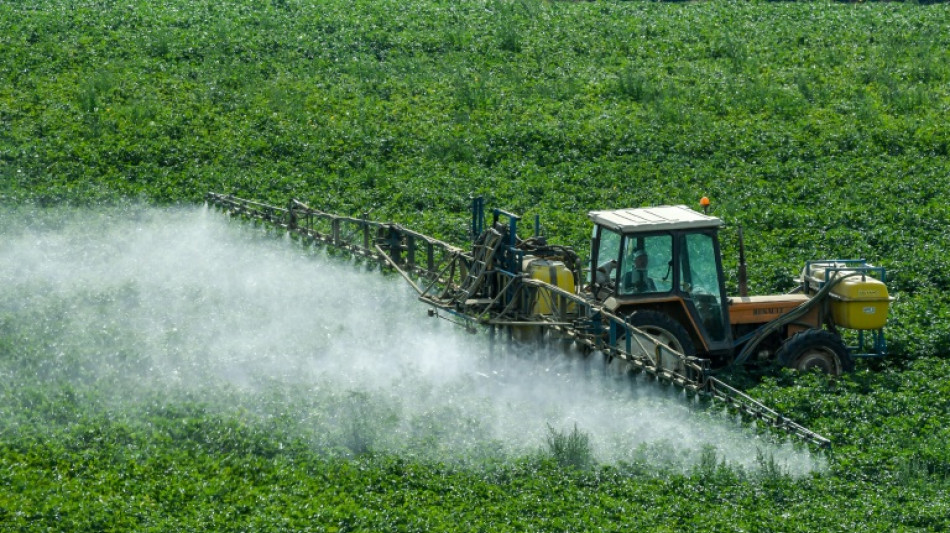
New research shows unintended harms of organic farming / Photo: © AFP/File

 Voting opens in Alaska's annual Fat Bear Week

 MLS coach axed for telling female ref 'It's a man's game'

 US refuses to give Sudan's de facto leader visa for UN

 Man City hold Bayern to start Women's Champions League, Arsenal win late

 Trump threatens Iran with 'hell' but reveals fresh talks

 Trump signs security deal with Greenland, Denmark at UN

 Trump threatens Iran with 'hell' but unveils fresh talks

 Chile's Atacama Desert blossoms with life after El Nino rains

 Sri Lanka hands 220-year jail terms to 15 convicted of Easter bombings

 Typhoon Dujuan leaves 7 dead in Japan from landslides, flooding: media

 Ganna and Borghini lead Italy to mixed relay gold at cycling worlds

 Drug cocktail killed former child star Hayden Panettiere: coroner

 Moldova declares energy, water emergency

 French Holocaust denier jailed for eight months

 Oil prices slide, AI stock buzz fades

 Trump threatens to 'annihilate' Iran in bombastic UN speech

 Prada's skirts take centre stage as Milan Fashion Week begins

 Quoin Pharmaceuticals Announces FDA Fast Track Designation for QRX003 for the Treatment of Peeling Skin Syndrome

 Brazil's Flavio Bolsonaro turns scandal into poll gains

 Republican senator seeks probe of Trump Jr Russian-funded wedding

 Memoir by Diana's brother goes on sale after rocking UK monarchy

 Newcomers South Korea face holders Italy in Davis Cup finals

 Japan's Kojima sounds Marchand warning with Asian Games gold

 England rugby star Pollock signs new Northampton deal

 STARTRADER Expands Its Chinese Equity CFD Range with CXMT and Unitree Robotics

Organic farming is often touted as a more sustainable solution for food production, leveraging natural forms of pest control to promote eco-friendly cultivation.
But a new study published in Science on Thursday finds that expanding organic cropland can lead to increased pesticide use in surrounding non-organic fields, offsetting some environmental benefits.
These harmful "spillover effects" can be mitigated if organic farms are clustered together and geographically separated from conventional farms, the researchers found.
"Despite policy pushes to increase the amount of organic agriculture, there remain key knowledge gaps regarding how organic agriculture impacts the environment," said lead author Ashley Larsen, of the University of California, Santa Barbara.
Although organic agricultural practices generally improve environmental conditions such as soil and water quality, the trade-offs aren't very well understood.
For example, organic fields could harbor more beneficial species that prey on insects, such birds, spiders and predatory beetles and fewer pests. Or, the lack of chemical pesticides and genetically modified seeds could mean they harbor more pests.
To find out, Larsen and colleagues analyzed data on some 14,000 fields in Kern County, California, across seven years.
Kern County produces high-value crops including grapes, watermelons, citrus, tomatoes, potatoes and much more, making it one of the most valuable crop producing regions in the United States.
The team paired digitized maps of fields and the crops grown on them with records of pesticide applications and whether a field had an organic certification.
"Surrounding organic agriculture leads to an increase in pesticide use on conventional fields, but also leads to a larger decrease on nearby organic fields," said Larsen, with the effect manifesting primarily in insecticides, which specifically target insects.
The level of pesticides in conventional fields decreased the further away they were from organic fields.
But the situation could be completely remedied if organic fields were grouped together, the researchers found, based on a less-detailed national level analysis they also carried out.
"Spatially clustering organic fields and spatially separating organic and conventional fields could reduce the environmental footprint of both organic and conventional cropland," the team concluded.
Writing in a related commentary, Erik Lichtenberg of the University of Maryland said that the authors had shown farmers' decisions about pesticide are influenced by the presence of nearby organic fields -- but it's not fully clear why.
The value of the crops, their susceptibility to pests, and farmers' personal risk tolerances likely all play roles.
"Which mobile pests are involved, where they originate in the landscape, or how and why they move across the landscape are poorly understood," said Lichtenberg, calling for more research in this area.
E.Schubert--BTB